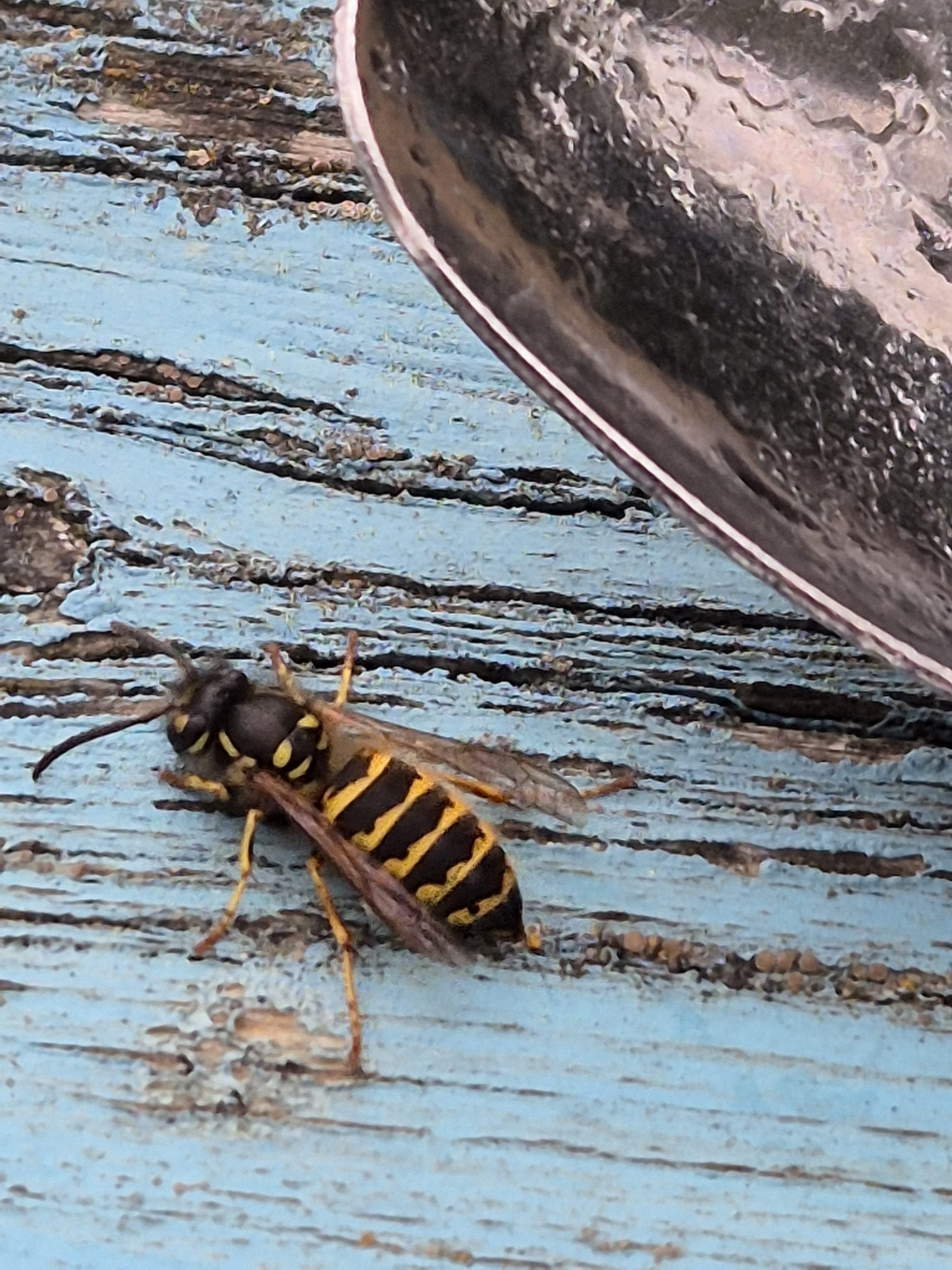
It’s hardly the first time I have fished a wasp out of a pint of lager. They do, apparently, become intoxicated by alcohol (not the case for all animals). I fetched a spoon, fished him out and tipped him onto the table as gently as possible. He seemed to stagger around for a bit, giving me a chance to take a photo – it flew off and so, I hope, was ok.
On the same day I found a panicky Robin unable to find its way out of my summerhouse, even though the door was open. It was repeatedly bashing itself against the window so I acted fast and fetched the net from my car (always in the boot in case I need to catch a bird for wildlife rescue*). Although I say so myself, I was pretty deft about it and once a bird is on the black net they tend to drop to the bottom and stay still. I placed the net on the ground and it quickly flew off. Two rescues, of a sort, in one day.
*I have left HART Wildlife Rescue, for now at least and am going instead to Oxfordshire Wildlife Rescue, which is similar in many ways but also very different. Volunteers are treated more as equals and entrusted with all of the animals (including, foxes, birds of prey, badgers, gulls) except deer. It’s much closer to home which saves a lot of time and petrol and I can do collections and releases which because of the distance didn’t make much sense at HART – it would mostly have been quicker and cheaper for me to pay for a taxi driver to do it. It is a strange and unsettling thing that I have now left two animal rescues, one after eight years, the other after three and a half, and received no message of regret (perhaps I am not taking the hint) and either no thanks at all or begrudging thanks only after several weeks once I had pointed out their omission. My first book, Animal Trust, raised thousands of pounds for Trindledown with the management’s help, but at HART they refused to stock the second book, Animal Wild, in their shop (which was half the point and agreed with a previous manager before I had even written it) and so only the sum of a few hundred pounds has been raised for the charity. There are other reasons – the second book is more accomplished (and more expensive) I think but it seems you can get plenty of friends and customers to buy one book as a sort of favour but not so many a second time around.
Animal rescues are very strict about what goes out to the public, and rightly so, but I will say that I was rather traumatised when I collected an animal to take in to one not so long ago. It was obvious that she was in such a terrible state (I won’t go into detail but it was horrific) that I knew the kindest thing would be to euthanise her right away. But I don’t have that expertise (other than by the crudest methods) and so she had to be taken in for that. In any case, it really wasn’t my call. I need to resolve this somehow – I can’t unsee it and it’s been greatly troubling me for a couple of weeks now that she suffered needlessly for an additional half an hour.
This is pretty random, but I have been enjoying, mostly, Star Trek: Strange New Worlds, the latest incarnation, which is now well into its third season. If you are a fan, see here for more on my love of the franchise: Star Trek Beyond – Animal Wild.
Reviews say that the third season has achieved a more even tone, but it really hasn’t. Some episodes have been good or even excellent, others absolutely dreadful. In one, the whole thing turns into a musical for no apparent reason, and if I want that or to watch an old-fashioned detective mystery set in the past, then I’ll seek that elsewhere. Others are just utterly ridiculous. They all are really of course – it reminds me of expressing to a friend my annoyance that the character of Tauriel, a woodland elf in the over long film version of The Hobbit, was “just made up” as though the whole thing wasn’t. The captain’s chair is occupied by Christopher Pike, Kirk’s predecessor, who has the most ridiculous hair imaginable – a strange sort of quiff with not a strand ever out of place whether he has just removed a space helmet or engaged in intense physical combat. The versions of Spock and Scotty are fine and I like the African doctor, Nurse Chapel and various others.
In the latest episode of Strange New Worlds, ‘What Is Starfleet?’, I am not sure what happened to the Prime Directive for a start. It’s a sad tale of a creature described as livestock which has been weaponised and, being a sentient and sensitive being, wishes to and does commit suicide (by flying into a sun) as a result. So there’s the relevance to this blog. What galled me though was Pike’s recalling with relish his lassoing of broncos and regretting that he had had to kill one because of the injuries he had caused it. I watch a lot of tv and I do like there to be consistency in the worlds in which the series are set and in their plots. Surely in a future where mankind no longer goes to war on earth and racism, sexism and all the rest no longer exist, where food is synthesised, torturing animals for entertainment (which is what a rodeo is) would be no more than a horrific memory of the past. At least at last I now have some idea of how big the Enterprise is supposed to be – the length is given in metres which doesn’t help me, but it works out at a little over a quarter of a mile.

Derek Gow’s book above is an absolute treat. See here for a review of his terrific book about wolves: Wolf – Animal Wild.
He seems to be completely honest, he writes with panache, is often laugh out loud funny and his cameo portraits are pure gold. Almost any one picked at random will make the point. “Laconically tall and Welsh, with a sinister ghoulish laugh” for example, or “both physically and metaphorically a huge character with a vast waxed beard and moustache flowing out in fine Raleighian form. At the helm of an Elizabethan man-o’-war wielding a cutlass he would not have been out of place.” Another: “an old colonial sort with erect startled eyebrows.” And one more: “like an old bald mate of Thorin Oakenshield who had swallowed Rapunzel’s grandmother whole and then forgotten to pick out his teeth. Any impression that this might afford of infirmity is wrong. Alf was hard as hell.”
His style reminds me of Gerald Durrell (as he does somewhat physically) who was a very early influence on me, in spite of the dubious nature of his first forays into collecting wildlife. I happily devoured this book in spite of Gow’s beginnings in the grisly world of livestock farming and auctioneering. He is however totally frank about it. As he is eloquently furious about what we have done to the natural world: “Britain once hosted a broad range of great beasts. We slaughtered the bears, elk and lynx many centuries ago. The wolves lasted longest. Now, only the names of their crags, hills, meres or the ubiquitous deep pits where we caught and bound them for torture recall their once being. Like the aquamarine blue moor frogs, black storks and night herons, we were the end of them all. One in seven of our surviving species is now also threatened with extinction. In large part, much of the landscape so seemingly green, which we traverse with daily indifference, is dead. Chemicals and pesticides in the soil have killed the very small things. The passing of these has so starved, poisoned or otherwise compromised the other slightly larger, but still small things, that shockwaves of depletion now ripple upwards through every level of natural dependency. Gone is the food for some creatures or the cover for others. The living space that remains is highly restricted and commonly of poor quality. The absence of one pivotal creature can mean the loss of natural function upon which others depend. Even when our understanding of this is crystal clear, we act in reluctant slow-motion response.”
His descriptions are wonderful too: “elfin” is a brilliant word to describe Red Squirrels. The delivery of David Attenborough voiceovers, of whom I am very far from a fan, is “like a great aunt cooing over cakes in a tea shop”.
I think he must be about my age since he recalls being inspired by the tv show Animal Magic, Look and Learn magazine, and the books of Willard Price, which I don’t suppose are read much now, although the latter relates the adventures of the two sons of an animal dealer.
The book is principally about rewilding and reintroductions of many species. His determination is inspiring whilst he is completely candid about mistakes made. There’s very much a confessional element too as Gow admits to himself what he had so long denied – the harm the farming industry has done to our ecosystem.
“Although farmers fall out with each other for the most trivial of reasons, they commonly stand together against all else. Outside their tribe lie enemies: vegans, conservationists, the government, other people with other points of view [my italics]. As a farmer you wish the latter to support you in your ‘buy British’ campaigns and try to connect with them on ‘Open Farm Sundays’. You want them to stay and spend money in your shepherd’s huts or to camp in your fields with a view. You definitely want their tax payers’ cash for your Single Farm Payment together with any other grants or subsidies you can subsume. If they ask why the soil is dead, why the birds don’t sing or if it’s really necessary to kill beavers and badgers, you call them ‘ignorant townies’ and tell them to ‘[eff] off’.”
He sees the corruption and dishonesty at the heart of the unholy alliance between farming, the press and government: “after many seasons of sales, the lambs or calves I produced barely covered their costs. I understood that the chemicals I used on them would kill all other life but I supressed this certainty with excuses that any action to kill their parasites was justified. My out all too often was because everyone else acted in a certain way, that no further significant wrong could come from my individually so doing and, in any case, that even if I changed, what difference would it make. I knew when I paused to consider that hardly a lark or a lizard lived on my land. I am sure the flocks of meadow pipits, which were small to begin with, diminished even further in the very worst of times I imposed.”
On the catastrophic decline of water voles: “It was enough. I was and am sick of their loss. I am appalled as I write this that these memories, which I know were only fleeting impressions drawn from moments of observation, remain so clear in my mind to this day. Though their passing was swift and I was so busy that I gave them no time, my memory is long and I think of their going now with anguish. I knew I had to change.”
On beavers: “I believe now quite firmly that they have come back to heal [my italics again]. A natural blessing whose offspring have rippled out to the mouth of the River Tamar as far as its tidal pulse and found there wetlands where they can live in peace. Complex watercourses and wetlands now extend well down our valley and into our neighbour’s lands as well who are mainly content. Ducks of many sorts fly in and out. Otters hunt fish where they could never before in ponds that are boiling with fry. Amphibians abound. Dragonflies, damsels, demoiselles and darters whirr freely and butterflies are everywhere. Lizards have returned.”
The dung of ponies: “…poorly digested, gives different life opportunity. Tiny tangerine fungi with linking web systems, fragile, intricate and bedecked with dew are beautiful beyond elfin.”
He is good on zoos past as well and their spurious claims that they served nothing but a serious conservation purpose: “Although this has now changed, with many of the best doing credible work both in Britain and abroad, in my time leaders would lean on lecterns and espouse to audiences of the completely converted home-spun credentials for the preservation of glamorous species whose futures they could not possibly hope to influence.” He does not take prisoners.
With this I could hardly agree more: “It takes real determination to annihilate … species from a landscape as large as our island. With hatred in depth. In Britain in past times, we did so repetitively. The big carnivores, such as the bear, lynx and wolf were first to go, with the smaller wildcat, polecat and pine marten diminished thereafter. We reduced the golden eagle to a much-restricted range, where it remains to this day, and, until the 1970s when its reintroduction from Norway began, the great white-tailed eagle was extinct. All of the other birds of prey, from the osprey to the slate blue merlin, were knocked back to near nothing. Otters and badgers, though now recovering well, declined significantly in the past. This slaughter destroyed complex systems of balance where wolves and lynx predated badgers and red foxes to eliminate their competition for resources, while foxes performed the same function for pine martens.”
I am quoting rather a lot from this book – I hope the author doesn’t mind or have an aggressive copyright lawyer, but his prose is too good to paraphrase or abridge (you are allowed to paraphrase, quote short extracts and there is fair use but I think I may be pushing it here).
On wolves: “One day inevitably, if we survive long enough and are in any sense sincere, we will have to come to terms with the wolf. We will have to forget our compassion for sheep alone, reinforced, as it has been, by tall tales, Christianity and seams of woollen commerce once so significant that are now long spent, and move on.”
Gow gets completely, understandably, impatiently furious with the risk-averse bureaucrats, the pencil-pushers who slow him down. We need to get on with this and allow people like him free rein. He knows what he’s doing, whether with wildcats or storks. I sometimes feel much the same about the collectors of statistics. Of course the science is important, rewilding needs to be informed, but we know what the problems with our ecosystem are. Time to stop counting, time to start doing. As Gow says: “Why does everything have to be so slow? Why can’t systems be developed to move things fast? It’s how every other industry works. Farmers do it well.”
We need to restore from ruin. His final chapter outlines what’s possible. “Let’s give it a pulse of life and of hope. Let’s do what we can.”
________________________________
Having read something about wildlife conversation in Mauritius I had a chat with the lovely Mauritian couple who run our local post office. There are no endemic terrestrial mammals at all – all were introduced. But there are many endemic species found nowhere else. Amongst the birds are the Mauritius Grey White-eye, the Mauritius Kestrel and the Pink Pigeon. All of them are exceptionally beautiful. The national bird is the Dodo of course.
Even more randomly, I noted a moment from Peep Show which I hugely enjoy almost on rotation. It seemed too left-field to include it here but then there was a long article about Mitchell and Webb in the paper today and it makes me laugh so here it is. Jeremy threatens Mark with the ombudsman over a mis-sold loan. He warns of a man in a stovepipe hat with a long hooky stick appearing at the door. “The ombudsman isn’t a person Jeremy, it’s a toothless regulatory body made up of junior and often very obliging civil servants.” Genius. I have to admit there was a time when I did think that the ombudsman was a person. I was rather disappointed and even more so by their services.
Leave a Reply