Oxfordshire Wildlife Rescue was due no volunteers at all on Monday afternoon so I went in. Usually it’s Wednesdays for me. But from now on it will be not at all. As I wrote recently I have been volunteering for well over a decade. I left Trindledown and HART for a variety of reasons (more or less unthanked after years of service at both as I mentioned previously). Yesterday though I sent this message with a very heavy heart:
“I have been volunteering at animal rescues for something like twelve years (with a bit of overlap where I was going to two at once each week) and so of course I’m familiar with what’s involved, the work and the highs and lows. What I have until now failed to admit to myself is that I am getting just a bit old for it – I am after all not far off retirement age. As a bookseller I have been moving heavy boxes of books around for decades and my back has suffered and these days aches just from bending or getting up and down if I do too much of it.
I really very much like OWR … and I greatly admire what you do. Very reluctantly though, I am going to have to call it a day. I hope you will understand.
My motivation has always been my passion for animals generally and wildlife in particular and my anger when they are mistreated – I have written and published two reasonably successful books about it. That hasn’t changed but gone are the days of chucking bales of hay about and all the rest and it just feels now that in terms of the physical graft I have done my bit…”
The truth about animal rescue volunteering is that most of it is cleaning and just about all of it involves a lot of bending up and down. On Monday my three main tasks were dealing with a couple of hedgehogs (including treating one for ringworm), the washing and the pigeon enclosures. Not just cleaning of course, there are certain skills to be acquired. I have never minded what I have been asked to do, however menial or however much animal faeces is involved. But two hours straight scrubbing away at deeply-ingrained pigeon shit and getting covered in it would be all very well if my back hadn’t ached like hell for hours afterwards. Sometimes that has been making the following day a write-off. Much as I have loved almost all of it over the years, it was time for a rethink. It is no easy thing to admit, even to oneself, that you can no longer do things you used to do with ease. I have learnt so much and so enjoyed being close-up with the animals, my two books have come from it and I will miss it hugely. OWR’s response, incidentally, was gracious and kind. It has also helped a great deal that one of my daughters said that she was proud of my decision.
Also at this point, even though it’s only been notionally for half a day a week (a full day for years at Trindledown), there’s getting there and back and one way and another it tends to work out at rather more than that. I don’t do things half-heartedly and never have. But that does not stop me feeling lousy about letting OWR down after such a short time.
I haven’t slammed any doors behind me but I cannot honestly see myself going back to it. That won’t affect this blog very much at all. Rescues are extremely sensitive and cautious about their public image and social media appearances and it is an absolute no-no for volunteers to describe what goes on except with the broadest of brush strokes, as is posting images. Both of my books were carefully checked and vetted by the rescues concerned. I do get it – things are all too easily open to misinterpretation. Sometimes though I think opportunities are wasted. I know that I have made a meaningful if small contribution and that I can happily look back on that through the sadness – it has been a major part of my life and a privilege for such a long time. And of course I will always help an animal in distress.
I suppose this leaves me free to make a few more or less light-hearted observations without being too specific. At all three rescues there is a strange tendency, which would be comical if it wasn’t so frustrating. The rule seems to be never use tools if something can be done more laboriously by hand. Another is not replacing broken equipment. Animal rescues are always short of money but when a quick fix would cost a few pounds or less, why not do it? Whether it’s a leaking hosepipe, a plastic straw bucket so broken there is hardly any of it left or poo pickers so rusty and bent as to be virtually useless. There is also the bizarre phenomenon of underusing volunteers. We have other skills which could be brought to bear, are likely to be able to make suggestions from a different viewpoint as to how things might be done more efficiently, but these are usually ignored or even resented. Some staff I have come across have resented volunteers full stop, seeing us as a threat to their jobs. That’s rare though – most have been kind and generous with their knowledge. Bio-security protocols and measures to prevent transmission of disease between animals (and animals and people for that matter) vary wildly. HART is a shining example in this regard of how it should be done. I have had no issues at all with the ethics at the wildlife rescues: euthanise when it is kindest, do not take in animals which can never be released (that’s for the sanctuaries). At Trindledown though, where some of the field animals were effectively permanent residents, there were one or two cases when euthanasia was carried out for reasons with which I was not at all comfortable. A happy atmosphere matters too with staff and volunteers feeling respected and valued. Trindledown was absolutely woeful in that regard with such a ridiculously high staff turnover that they inevitably ended up with the least qualified people – the only ones who would put up with it, to the detriment of the animals’ welfare. In the end I had been at Trindledown for very much longer than any of the staff. Both HART and OWR are very short of volunteers at the moment which makes me feel worse about abandoning ship. But there is only so much they can do about that. Sometimes at Trindledown, going in once a week, it was possible to notice changes in an animal’s well-being, less visible if seen on a more gradual, daily basis. But I was told in no uncertain terms that comments along those lines were not welcome – new management even tried to forbid it altogether. My memories overall remain fond, but as I look back I see that the road was sometimes a very great deal rockier than it needed to be.
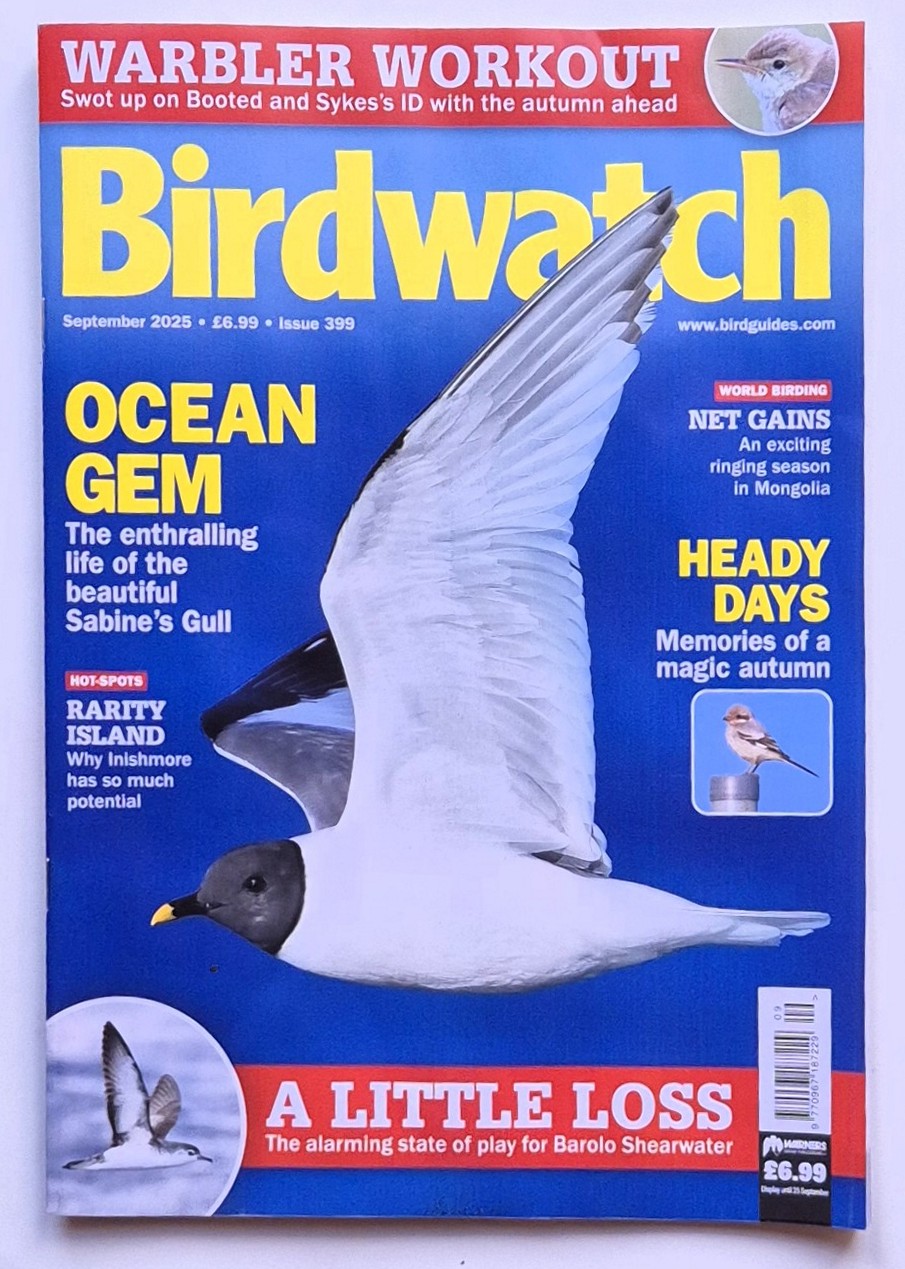
Onwards and upwards, to Birdwatch. David Campbell (‘Calling it out’) writes about what to do if you hear or overhear a misidentification. Do you leave the observer in a state of belief that he or she has seen (and may even report) something they haven’t? It can be awkward he says, and he confesses to ignoring it on occasion. But he’s right I think that that shouldn’t happen – there are gentle, tactful ways of correcting someone, as I would certainly want to be. I double-check (at least) any identifications I make on this blog but again, absolutely I would want any errors pointed out.
Mark Avery welcomes the decision finally to ban lead shot (over time) against all the fierce, weird resistance from the shooting lobby. But he deplores the recent parliamentary debate, a damp squib if ever there was one. When I first read about it from groups such as Protect the Wild, I wrongly assumed that the tableau of Tory MPS simply reading out briefings from the Countryside Alliance and BASC was a good example of sarcastic wit. It would have been an undemocratic disgrace if that were the case would it not? Mark Avery makes it clear that this in fact is exactly what happened. Unbelievable and depressing.
Niall Keogh expands at length on the stunning, highly migratory Sabine’s Gull (on the front cover), a rare sight in this country, named after Joseph Sabine who was the first to describe them formally in 1819 from specimens collected by his brother Captain Edward Sabine who took part in Captain John Ross’s Northwest Passage expedition. A nice new couple of words: larophile and larophobe, meaning someone who has a love or hate relationship with gulls respectively. Identification can be challenging, not least to me, but the Sabine is relatively distinctive, although Collins warns of possible confusion. The adults have a dark grey or black hood and their markings are strikingly contrasting.
‘Pelagic’ is a word I must have come across many times (including in the name of the publishing house whose productions I have had issues with) but it’s one of those I have only just stopped to ask myself what it means. It derives from the Greek, pelagos, meaning sea and so means relating to the open sea.
I continue to be irritated by the accounts of twitching, ‘monster finds’ and ‘mega rarities’ which do rather fill the pages of this magazine, but as I have said before, the photographs and their names continue to inform and entertain.
There’s a new tripod on the market, the USP of which seems to be its compactness. It certainly looks to be an extremely clever design but the legs are not independently adjustable so it is not much use on slopes or uneven ground, which seems to be a major shortfall. So, frankly, is the price – between £280 and £350 depending on the model and that’s without a tripod head. I am extremely happy with what I have, made by K&F, just under £125 in 2017. It is very versatile and beautifully engineered. I trust the brand and so also have a gimbal head from them and more recently purchased a compact version of the tripod for when space is at a premium at just over £40.
Birds at Rest; the Behaviour and Ecology of Avian Sleep by Roger F. Pasquier, Princeton University Press, 2025, sounds fascinating and the publisher could hardly be more reliable. I have far too many unread books still to consider it just now. I like the reviewer, David Callahan’s comment that the only problem with it is that reading it before you intend to go to sleep at night is likely to keep you awake into the small hours.
There’s good advice on cropping photos to best advantage, information about filoplumes, feathers with connections to nerve receptors, unlike others, thought perhaps to enable birds to sense when there has been damage.
Finally Lucy McRobert describes her mixed feelings about birds in captivity and falconry displays. Like her, “I would never condone any animal being taken from the wild for anything other than saving its life or protecting the species.” I suppose, rather reluctantly, that if say, a raptor, is one who would never survive in the wild, then giving it a decent life and using him or her for educational purposes (with safeguards of course) is justifiable. But the business of falconry I find repugnant.
Meanwhile a juvenile Jackdaw here is cause for concern, although there is nothing I can do. He still looks bedraggled and his eyes are black. It’s possible that one is missing altogether. He seems to be managing and so far his parents are always on hand to keep an eye and help him to feed.
We seem to be living in thoroughly desperate times, not least manifested by the terrifying profusion of Union Jacks and St George’s Cross flags around the UK – I cannot see that as being anything other than intimidatory. I blame Keir Starmer and his predecessors just as much as the appalling chancer Farage with his fake populism. I take morsels of hope and joy from the Wrens continuing to make their presence extremely loudly known in the garden, the Dunnocks darting and scuttling about in front of me now and the occasional flowering as we head into autumn. Below are a Cosmos variety and Verbena bonariensis, important as a late season food source for pollinators.


There’s some good news in the local paper this morning, alongside the safety concerns reported from the painting of St George’s Crosses on roundabouts. Proposals for a high-rise development in Newbury have finally been rejected as have those for an industrial egg farm intended to house 32,000 chickens which would have had a terrible effect on the River Kennet. It would have been on the edge of the Kennet floodplain and just a few hundred yards from a highly protected SSSI.
Leave a Reply