Trowbridge to Bath Spa
So, I have done it. Every inch, except for the part owned by the Oracle shopping centre in Reading where I was not allowed to go (it seems to be run as a sort of autonomous police state), and most of it twice, once in each direction. As I reached my journey’s end, the good people of Bath lined the streets, waving and cheering as the ticker-tape rained down. What actually happened outside Bath Spa station was that I failed to notice three shallow steps. I was stationary but the bike was right on the edge and over and down it and I went. Not my first fall from the bike after I had come to a stop. But no harm done. And thanks to the solicitous stallholder who asked if I was ok. It wasn’t my only mishap of the day. It is not always obvious, at least not to me, when the towpath switches from one bank to the other, how to access it again. In Bath at one point, the only way was a very steep flight of stone steps, not easy to negotiate with a 25kg bike with a will of its own. About halfway down momentum took over and I found myself trapped between the bike and the wall. Thanks also to the couple who asked if I needed help, but I managed to extricate myself.
In spite of these little accidents, I had an absolutely wonderful day, the perfect end as summer draws to a close to my multi-part journey.
Maps of the canal show a route from Reading to Bristol but the canal itself really does end in Bath. Undramatically, without fanfare (or even signage) it simply joins the River Avon. But I certainly felt a sense of achievement.
The canal very closely follows the Avon for all of this stretch – and the railway line in turn follows the canal – affording some spectacular views. The photos in this post are very far from my best. Partly they show the limitations of my phone’s camera (it’s great for macro, pretty hopeless for distant scenery) and partly a lack of concentration on my part and forgetting some of the basics. A little laziness too. I knew there was going to be a lot to see and do along the way and getting my camera out of the saddlebag is a little bit of a faff… I wish I had made more of an effort.
Trowbridge is just over an hour from home. I decided to take the M4, feeling that I had gone the other way once too often on my way to the various start points of my trips. Marlborough is a lovely town but it’s a traffic bottleneck I had spent too long in over the past weeks. I did come back through Devizes (another bottleneck with major roadworks), Avebury and Marlborough. Both ways gave me a satisfying sense of the distance I had cycled.
As I had hoped, the towpath was more even than it had been, never worryingly narrow and without tree roots to avoid, but it was still a long way from smooth. My total mileage was only 16.3 but it took its toll on my back, legs and hands (just from gripping the handlebars for several hours) from all the rattling and shaking. It took a lot out of the battery too (about three fifths). The last few miles back to the car in Trowbridge were mostly on tarmacked paths – the difference was huge and the distance flew by.
The bike has been stellar, albeit its heaviness has been problematic at times. It has handled everything and I am amazed that I have only suffered two punctures given the terrain. The tyres are fat and tough and either the replacement inner tubes are way more robust than the originals supplied or the slime I’ve injected had really done its job.
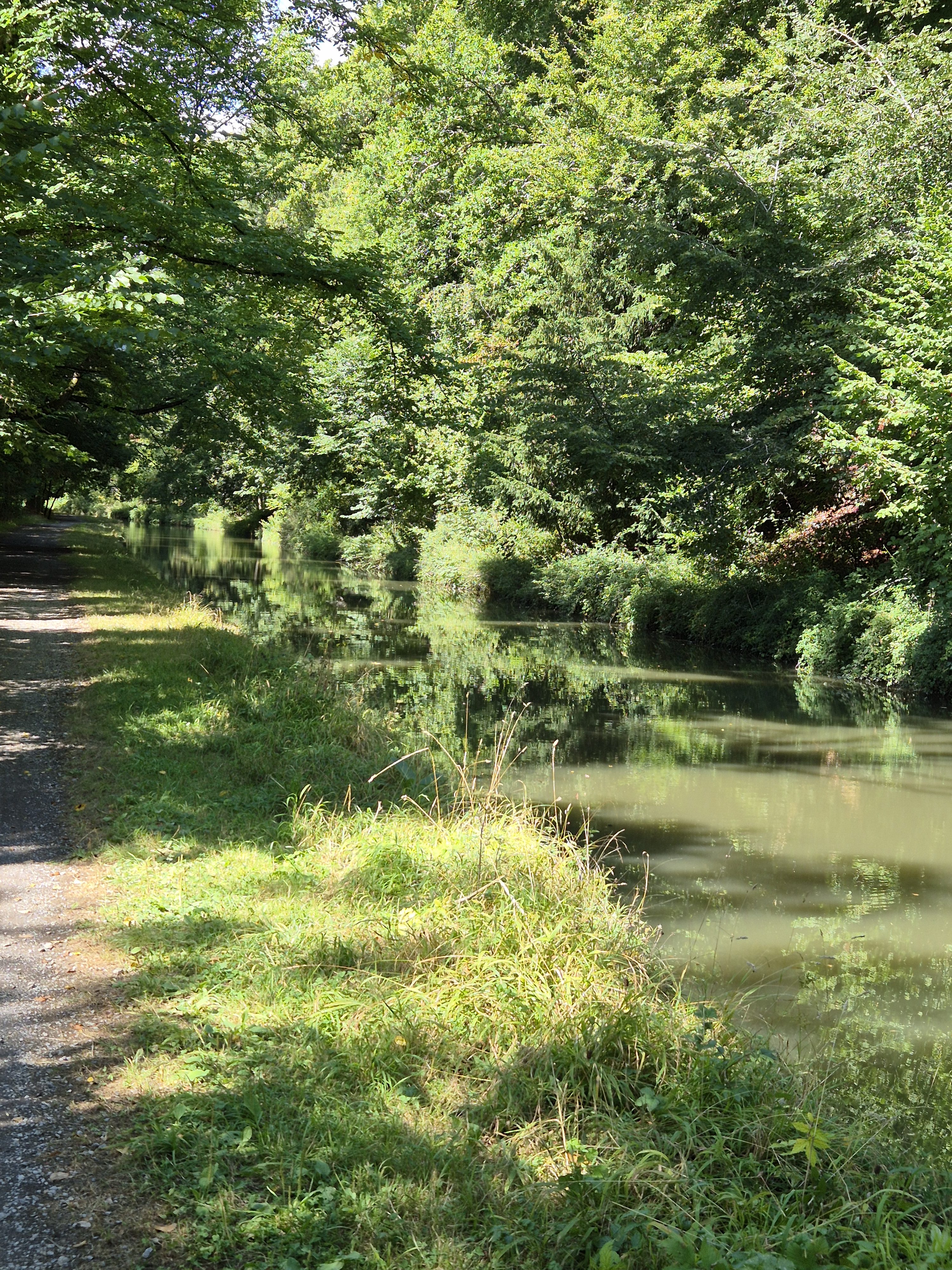
Summer has given the trees time to grow their overhanging branches, but I have at least become more adept at the requisite ducking and diving – not a single whiplash or bramble attack yesterday. This part of the canal is densely tree-lined all along giving it a very different feel.
I parked up at Trowbridge, hauled the bike out of the boot and loaded up the saddlebags (camera, book, notepad to add to the tools and other bits and pieces), installed the battery and the GPS speedometer/milometer and I was off.
The canal was crucial to the town’s development, enabling the delivery of coal from the Somerset coalfield and thus steam-powered manufacture in the woollen cloth mills, making it the foremost centre for wool production in the south-west in the late 18th and early 19th centuries, to the extent that it became known as the Manchester of the West.

The marina at Trowbridge
Apparently it rained heavily at home but further west there were only a couple of mild spatterings and for the most part the sun shone.
It’s only a couple of miles or so to Bradford on Avon but the canal and the bridges charmed as ever.


Ball’s Bridge
This is one of the surprisingly long drops down from the canal, here where it crosses a narrow stream.


Tree-lined

Bradford on Avon marina

Sunlight and reflections on the water
I liked this dramatic piece of graffiti. It doesn’t look recent but could apply to any conflict.

Bradford Wharf, below, was once one of the busiest places on the canal but between 1860 and 1890 trade passing through dropped from 100,000 to 14,000 tonnes. Ultimately the advent of the railway ended it altogether.

Bradford on Avon was an absolute revelation – I had no idea. It is utterly charming, highly picturesque and unspoilt, and very friendly. Apparently it is an international tourist destination.
There’s a chandlery and gift shop at the wharf. I had been thinking I would like to acquire some canalware and another souvenir or two to mark the completion of my challenge and had looked online during the week, but this happily satisfied that wish.


The charming map (detail only shown) is by a local bargee, Dru Marland, and the book is one I could have more usefully bought before embarking on this whole venture. It’s nicely done and well-illustrated but I think I have found most of the information elsewhere, which does not mean I am not pleased to have it. And a fridge magnet jug in canalware style.


The ominous clouds rained down elsewhere.
I could easily have spent the rest of the day there and will definitely go back – there are a Saxon church, a museum and independent shops to explore. For today though the Tithe Barn was an unexpected joy and a highlight of my whole journey. The stone seemed a particularly glorious, rich colour, like golden honey (the photos do not do the way the sunlight is absorbed justice) and the roof structure extraordinary.


A plaque informs us that Barton Grange Farm “belonged to the Abbess of Shaftesbury who was given the land in 1001 by King Ethelred. Since the 1530’s [sic, rather shockingly] it has been in private ownership and was a working farm until 1971. In 2000 the Preservation Trust bought and then restored the yard and the four smaller buildings.”


The cross looks almost neon but it was just the sunlight beaming through.


One of the smaller buildings is now a truly lovely shop prompting another hit to my purse.


Then an exhibition featuring various local artists so up my street it was ridiculous. Just my kind of wildlife art: the delicacy of the feather, the simple beauty of the stained glass Blackbird, the power of the linocut print of a Red Kite. The last is by Carrie Osborne who specialises in wildlife. Some of her prints incorporate a second colour, but I prefer the monochrome versions. We chatted – her corvid images are especially striking, almost sinister, based on a pair of ravens which live near her home. She is very shy and self-effacing. She doesn’t have a website, saying that she doesn’t have the skills. I encouraged her to find a friend who would do it cheaply for her (it really shouldn’t be expensive these days – in earlier internet times they were a lot of rip-off artists out there). Her works deserves a wider audience.
The seedhead is made entirely from wire by Kate Westcott. She emerged from behind the scenes to help separate it from its neighbours. Her work is exquisite and more can be seen here: Hand Printed Linen, Wire Art, Screen-printing.


I could have got completely carried away but my saddlebags although quite voluminous would only take so much. She makes amazing little trees one of which I hope to order from her online.
Moving on from BoA, an eccentric looking little footbridge and a boat which has seen better days:


An especially prettily designed barge name:

Avoncliff Aqueduct, the first of two:


It has a larger span and is higher above the River Avon than the better known Dundas Aqueduct further west. Almost derelict at one point, it has been relined and entirely renovated. Boaters are asked to sound their horns and proceed with caution. Deep draughted boats are advised to stick to he middle of the channel.
At this stage I was hungry, thirsty and in need of an energy boost. I had stopped in at a pub by the canal in BoA but it was a victim of what I call prime location syndrome, in other words, complacency. I went in at five minutes before noon when lunch was supposed to start. With the best will in the world I was told that they were still in breakfast mode and that the chef hadn’t even begun to think about lunch. Not great business. She could still have taken my order and I would happily have waited in that lovely spot, but she seemed utterly flustered and so I moved on. This was my second attempt:

Again a lovely place to be but the menu consisted of burgers, which I miss but no longer eat, loaded chips and that was about it apart from falafel. I was feeling the need for something more.
This Traveller’s Joy or Old Man’s Beard, Clematis vitalba caught my eye:


Winsley Bridge
My pretty heavy and not inexpensive chain bike lock somehow snaked its way out of one of the saddlebags and had fallen noiselessly to the ground. Fortunately this happened just where I stopped for a cigarette and I happened to notice it.

Location envy, two very attractive houses with sympathetic extensions:


Limpley Stoke Bridge
The Dundas Aqueduct, with vertiginous views:


The canal takes one of its slightly startling right-angled turns at Brassknocker Basin, named after a nearby hill, with a cast iron crane:


Here the Kennet & Avon is met by the Somersetshire Coal Canal, extraordinarily narrow, now disused but partly restored.
On past Claverton Pumping Station. I didn’t stop for a look since it didn’t seem there would be much to see except on open days, but I was probably wrong. The Dundas Aqueduct, constructed between 1798 and 1805 is considered the pinnacle of John Rennie’s architectural achievements. This was designed by him too, 1794-1810, and is Grade-1 listed. The pump and waterwheel (24 feet wide and 17 in diameter), essential for keeping the canal full, operated continuously for some 140 years, raising huge quantities of water from the river 48 feet below. It was all fully restored in 1978. Thanks to a lottery grant the canal bed no longer leaks, but it is wonderful to learn from the Canal & River Trust signage that the machinery used “waterpower to pump the water uphill. When the sluices are opened the flow of the river turns a massive waterwheel. Through a system of wheels, gears, cranks and rods, it operates huge beam engines. These drive the pumps and force the water up to the canal. The machinery is remarkably quiet when in action.” Learning about canal history has been a big highlight of all this for me. The scale of vision of the designers, architects and engineers is awe-inspiring.
Compare and contrast with the debacle of HS2, the most foreseeable, destructive engineering disaster imaginable. I have just read a review of Sally Gimson’s Off the Rails; the Inside Story of HS2, Oneworld, 2025. Sure, environmental concerns were not something that troubled Victorian engineers, but this was political hubris at scale alone. It never made economic sense.
Three of the photos I took yesterday are somewhat abstract and they are my favourites – the reflections above, this bridge from underneath and simply the water itself. It seemed fitting on this last day to take them.


I arrived in Bathampton and had lunch at last at The George. Bathampton was another hive of industry in the early nineteenth century where Bath stone was loaded onto barges for transport and the pub was originally a thirteenth-century monastery. Bathampton was also the home of a plasticine factory, the material having been created by William Harbutt in 1879. He was director of Bath City Council’s art school. Plasticine is made primarily from lanolin and chalk. Harbutt rolled it into sheets at first with his garden roller and sold it in small quantities to Bath art shops.
Scampi and excellent triple-cooked chips at The George were just what I needed. The quality of pub chips is a litmus test for me. If they can’t get that right … and yet so many fail miserably.
I popped into the church, St Nicholas, before heading on. It’s 13th century, with a 15th-century tower and 18th and 19th century restorations. The font cover is striking. I could see no indication of the identity of the lady.


The final approach into Bath:

Some gorgeous bridges and buildings and a few of the last locks, including Bath Deep lock, one of the deepest in Britain (a rise and fall of 18 feet 8 inches):


One of the Trust’s working boats:


Above is the end of the canal. I feel hugely fond of it, it has given me so much and I have had so much unalloyed fun.
Back to Trowbridge by train. It would have spoilt things to have done the whole trip again in reverse. A kindly guard at Bath Spa helped me get the bike on and when I asked where I should best store it he told me not to worry: “Possession is nine tenths of the law.” I looked across at a guy with earphones in who suddenly asked if he had been talking to himself aloud. “Yes,” I said, “but not to worry, I do that all the time.” A Bradford on Avon resident, he said that I looked like a bit of a rocker and told me all about his being on his way back from a Queens of the Stone Age gig in Sheffield.
It was a few miles from Trowbridge station back to the car, but what took the time was working towards my eventually correct interpretation of what Google maps was trying to tell me. It wasn’t at all clear but the route didn’t involve roads at all, rather well-hidden paths and I went in every direction except the right one multiple times. I had even fitted one of the wing mirrors to the handlebars but the provided straps are useless and again it fell off straight away. I will have to find another solution – insulating tape probably. And one last stretch of rough towpath to finish off.

I will look back very happily on how I have spent a good deal of this summer. Special highlights have been Caen Locks, the Tithe Barn, the Heron, the aqueducts, all of the canal history, and some of the pub lunches and the people I have met. The tranquility of it, and the solitude when that was what I most wanted. And much more.
So what next? Well I did consider the Bath Circuit which includes two tunnels, notably the Combe Down Tunnel which I thought about visiting yesterday. In Bath a couple of cyclists were like me poring over their phones and the Sustrans website. I approached them and they had the same goal in mind. Sustrans is great but neither it nor OS maps actually show where the tunnel is. I was pretty tired anyway and decided to save it for another day. The River Avon Trail which would take me on into Bristol is also appealing. Sustrans also gives a five-mile surfaced route between Thame and Princes Risborough with many sculptures along the way. The possibilities are many. I am not one to celebrate tarmac, but I have been awfully pleased on the rare occasions I have come across it along the canal.
I took only a handful of pictures with my camera yesterday, the green water above and these below.


Leave a Reply