Trek or Wars? If that question makes no sense, this post is probably not for you. I am very definitely on the Star Trek side of the fence. The first Star Wars film was groundbreaking and enjoyable but after that I found myself bored to tears, especially by the second, The Empire Strikes Back, which seemed to involve an awful lot of wandering around in the desert, much like the apparent loss of will actually to bother with a plot in certain tv series, like The Walking Dead, in which there was far too much apparently pointless wandering around in the woods. I quickly gave up on that show after a significant investment of time when it jumped the shark once too often – there were the balloons, ridiculously used to try to lure the zombies out of the quarry (why not just obliterate them there?) and a scene where our heroes could easily have gunned down Negan and his henchmen but instead shoot out hundreds of glass windows in the building they were standing in front of.
I don’t know how I missed the release of the movie Star Trek Beyond in 2016, but I have only just watched it for the first time. Usually I eagerly await the next in the franchise. I have, I confess, been a devoted Trekkie since childhood. My brother and I used to sit in front of the tv to watch the original series (TOS) and cover our heads and duck as the Enterprise shot across and looked as though it was going to come out of the screen. I do not think TOS has ever been topped. I hated most of the spin-offs, especially The Next Generation. Picard was not my kind of captain at all, with his absurd actorly delivery and pompous “Make it so.” Patrick Stewart does not come across as a pleasant person – the ever dependable book reviewer Roger Lewis (I read his reviews whether I have any interest in the subject or not and he once came to us to discuss his archive, but he wanted an insane amount of money for, frankly, very little substance) says of Stewart’s autobiography, inevitable titled Making It So: a memoir, that it reveals a “pompous, chippy and point-scoring man”, described by colleagues as cold and ill-tempered. He certainly has axes to grind and then there was his weird, obnoxious and highly personal, fat-shaming outburst against James Corden at an awards ceremony. Data and Geordie were reasonably interesting characters but Data was largely a copy of Spock. I did not warm to Captain Janeway either, nor the animated version of the series, nor any of the others with the exception of the prequel Enterprise, in which the presence of Jolene Blalock as the Vulcan first and science officer T’Pol was certainly an attraction. Since I had been utterly mesmerised by Liv Tyler as Arwen Evenstar in the Lord of the Rings movies at around the same time, I began to wonder if it was the pointy ears that were doing it for me.
Watching TOS now, it is easy to mock the sets, the special effects, the fight scenes and sometimes the plots, and William Shatner’s strange, staccato delivery as Captain James Tiberius Kirk (there’s a good quiz question answer there) but it was unlike anything seen on television before and I was completely hooked to the point of an obsession. Gene Rodenberry, the creator of the whole caboodle, was a visionary and TOS represents an idealised future where humans have put aside their national, racial and cultural differences and moved on together to the final frontier, hence the inclusion of Russian Chekov (the Cold War was still very much a thing), played by Walter Koenig, Sulu by George Takei, Uhura by Nichelle Nichols and so on. I think I am right in saying that Lieutenant Uhura only acquired a first name, Nyota, in the much later movie reboots. The great, late Leonard Nimoy was perfect as Mr Spock (not Dr Spock as he is often called, but that was the author of a famous book on child raising), save for a pilot episode in which he not only looks rather different but shouts all of his lines. Leonard “Bones” McCoy, played by DeForest Kelley, completed the triumvirate (“For God’s sake Jim, I’m a doctor not [insert other profession here]” and “It’s life Jim, but not as we know it”) with James Doohan as Montgomery Scott the next most significant character, always insisting that the ship would not be able to take any more. There was another character of huge importance, the USS Enterprise herself, NCC-1701, Scotty’s love for her shining through. For a fan of my generation, it was traumatic to see the ship destroyed in at least two of the movies, but we always got a new one, just as we always got a new Spock in some form or other. Joan Collins’ appearance in the poignant episode City on the Edge of Forever was a very helpful career boost for her. But Kirk always got the girl and in spite of all the philosophising usually resolved everything at the end of each episode by winning a fist-fight. The relationship and banter between Spock and McCoy is key and of course provides much of the humour.
I have been involved in not one but two pub quizzes where there has been a Star Trek question to which the given answer was entirely wrong (it must be out there on the internet somewhere). I get rather competitive in these situations and I was furious on both occasions, even standing up to make my point more forcefully. The question was, which well-known rock band is named after Spock’s mother? The answer, some thought, was T’Pau. That is a rock band, but T’Pau was a high-ranking Vulcan diplomat, judge and philosopher. The whole point about Spock is that he is half Vulcan and half human, the internal conflict being what makes him interesting. Since Spock’s father is Vulcan Ambassador Sarek, Spock’s mother, I would point out had to be human – indeed she appeared in one episode and her name was Amanda. Not a rock band (as far as I know).

The first Start Trek book I bought was The Making of Star Trek by Stephen E. Whitfield and Gene Roddenberry himself. I still have it but I read it so often that it is in very bad state, the upper wrapper is detached and the lower wrapper is missing altogether. The series was ditched by the network at one point – only pressure from an army of devoted fans led to its continuance. I am pretty sure I have books which include such things as theoretical blueprints of the Enterprise and its tech, but I also have a number of the leading actors’ autobiographies. Two by William Shatner, Star Trek Memories and Up Till Now, in one of which he reveals towards the end his realisation that the rest of the cast couldn’t stand him, especially because he was always usurping their scenes and lines. Shatner even indulged in some hilariously terrible inroads into the music industry but I think there is a self-awareness and self-parody about him which is rather endearing. He was honoured by Amazon’s Jeff Bezos, actually entering space in a capsule, experiencing what he movingly described as profound grief, the “overview effect” felt to their core by many astronauts.

I also have Walter Koenig’s Warped Factors, James Doohan’s Beam Me Up Scotty, and Leonard Nimoy’s two forays into the genre titled, hilariously, I Am Not Spock and I Am Spock, the latter so-called as a reaction to the ire of fans at the first. Brent Spiner, who played the android Data in The Next Generation, has joked that his autobiography should be called “I am Not Spock Either”. Nichelle Nichols’ Beyond Uhura is a reminder of the importance of her character to the world at large. Her name is derived from the Swahili uhuru meaning peace (see also the seminal reggae band Black Uhuru), whilst Nyota translates as “star”. Always the delightful attention to detail. She was going to leave the series, no doubt frustrated by the paucity of her lines (“Calling on all frequencies” etc.). But something extraordinary happened. Dr Martin Luther King himself asked her, in person, not to go: “You cannot do that.” She was a Black person who, in the show, held a position of authority who was singled out neither for her gender nor her race, hugely relevant and inspiring at the time of the civil rights movement. Commonly thought of as the first, not in fact but nevertheless one of the very earliest interracial kisses shown on television was between the characters of Kirk and Uhura. There were other examinations of racial tensions with one episode featuring two aliens, each half Black and half White, separated and at war with each other by the matter of which half of them, left or right, was a particular colour.
For some reason another episode has sprung to mind in which on visiting a planet (M Class of course, i.e. able to sustain human life), where pores from a particular plant make our heroes behave as though they are, there is no other word for it, stoned. Even Spock acquires a languid, hippy vibe for a while. And who can forget The Trouble with Tribbles?
Then there’s the tech. It is truly extraordinary how much of it has become commonplace reality. There are various lists online. Teleportation defies the laws of quantum physics, but something very like a phaser now exists. Communicators – mobile phones. Also touchscreens, handheld scanners (from the tricorder), needle-free injections (the hypospray), flat screens, computers and other gadgets controlled by our voices, 3D printers (the replicators), artificially produced food and drink (meat created other than from dead animals is here and coming on leaps and bounds), the universal translator and the Babel fish which worms its way into Chekov’s ear to serve the same purpose (Google translate and so on), bluetooth earpieces, automatic doors (there were in fact people behind them pulling and pushing them), tablets, tractor beams and bionic eyes (in their infancy but probably coming), and indeed personal computers. Not on any of the lists I have found is the credit card, but I am sure I remember Kirk brandishing a piece of plastic, pre-loaded with credit, to make a purchase. It is quite a list of prescience.
I have enjoyed most of the Star Trek movies, at least those with the original cast or versions of them, although there have been plenty of cringe-inducing moments. There have been two parodies I also liked very much: the film Galaxy Quest and tv series The Orville, although that is rather a downplaying of both.
Star Trek Beyond? I loved it for all its faults. The CGI is amazing, the plot weak – as so often there is a genocidal maniac, this time portrayed by Idris Elba, with some ill-defined grudge against the Federation (sometimes seen as an imperialist organisation but that is to forget the Prime Directive which prescribes non-interference with the natural development of alien civilisations). There is, as usual a lot of running and chasing down corridors. And a lot of explosions. The villain Krall commands a huge fleet of small spaceships (or are they suicidal drones, I am not sure?) which swarm like bees or a murmuration of starlings. Why this really works though, for me, as with its predecessors, is the casting and the respect for the original vision and the original characters. Chris Pine is terrific as Kirk, full of derring-do and especially towards the end of this film actually sounding a great deal like Shatner, Karl Urban is wonderful as Bones McCoy and Zachary Quinto shines as Spock, which the fans thought could and should never be played by anyone other than Leonard Nimoy. John Cho makes a good George Takei replacement as Sulu and Anton Yelchin is fine as Chekov, although that has never been a well fleshed-out character. Simon Pegg seems an odd choice for Scotty, but he pulls it off. Crucially the hommage to the original relationships and, again, banter between all of them is just about perfect. And sometimes laugh out loud funny. There is also a respectful tribute to Leonard Nimoy as the original Spock woven into the plot, and the film is dedicated to his memory.
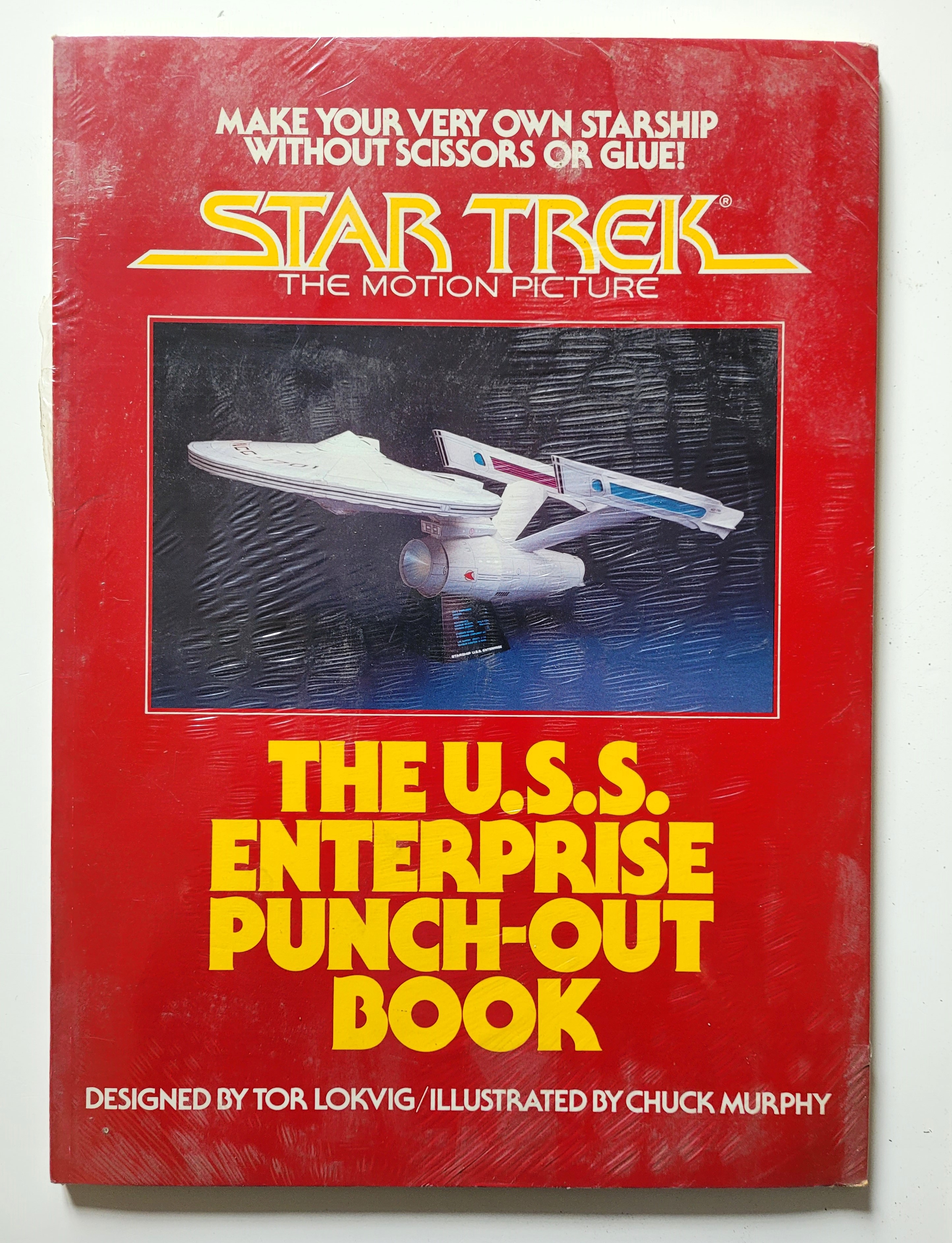
So, I have made my defiantly geeky, silly perhaps but unapologetic confession. The book at the head of this post, which I have mischievously and unsuccessfully listed online (I have many copies) is a 1980 punch-out book from which it is possible to make a Starship Enterprise from card. I tried once and it was a miserable failure but a friend with better skills made a perfect version – he also made me an Enterprise from coat-hangers once which still hangs in my office.
To finish, I once attended a Star Trek mini-convention in a pub in London, where the devotion of fans could be witnessed first-hand. I was one of only a few attendees not in uniform or costume – aliens, crew, officers. Which reminds me of the old saw: if you’re wearing a red shirt (security not engineering, blue was science and medicine, yellow for the captain and other senior officers, although Kirk sometimes sported green, for ceremonial and diplomatic occasions I think) and the captain asks you to go down to the planet with him, don’t. You will not last long. It remains pretty crazy on the other hand that the crew’s most important characters in terms of running the ship always take the big risks. There was plenty of merchandise for sale in the pub – I came away with a Captain Kirk coffee mug, which I still have, and a keyring which made various of the sound effects such as phasers, the doors, red alert, photon torpedoes, the transporter and so on. I may or may not still have that somewhere but this website is insanely comprehensive – I just wish there was an app other than for ringtones (of which there are quite a few on Zedge).
The highlight of the evening for what was obviously a crowd of regulars was a superbly edited video of highlights from various incarnations of the show, immaculately synched with Queen’s Bohemian Rhapsody. At the point when Freddie Mercury sings “Anyone can see…” absolutely everyone stood up and shouted “Except Geordie!”
Leave a Reply