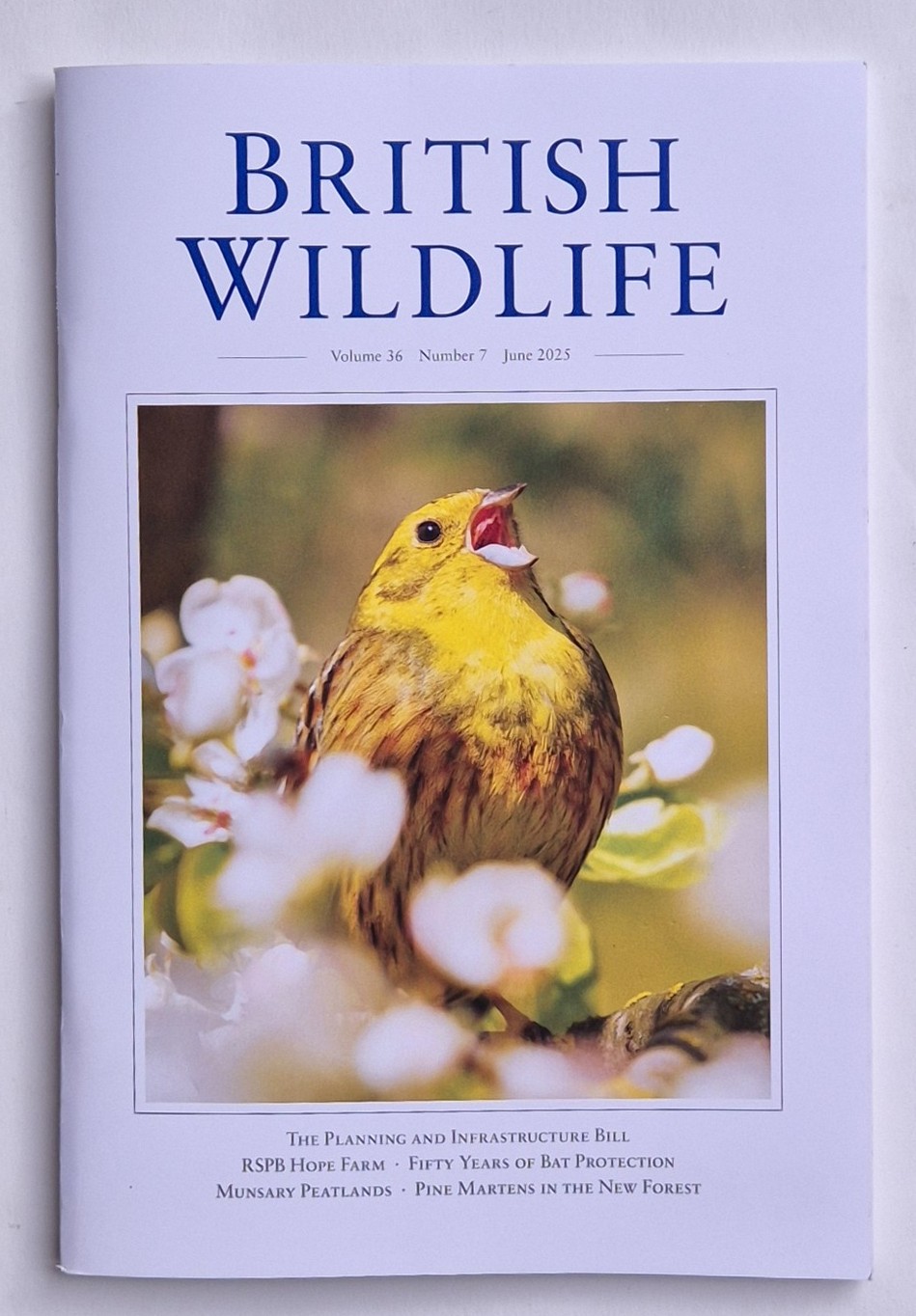
Volume 36 number 7
This is the first of two issues I have waiting for me. I love the magazine but it takes a fair while to read and digest.
The Yellowhammer on the cover seems to be there purely for the joy of it. I have only seen two and those were distant glimpses.
Richard Benwell, CEO of Wildlife and Countryside Link, provides a highly cogent analysis of the Planning and Infrastructure Bill. It’s complicated but in short whilst much is fine in theory, without significant tweaking it will indubitably not benefit the environment. It needs legal and scientific safeguards – as it stands decisions, such as those for mitigation hierarchy, will be purely subjective. And “harm today for promises tomorrow” just won’t do. Starmer and Reeves with their appalling and profoundly stupid comments about bats, newts, spiders and trees have been deeply unhelpful. To my mind, two further issues need to be considered: the competence of Natural England as an overseeing body and the strong possibility of lobbying by the building industry which I think it is safe to say is not always entirely above board.
Brett Westwood writes about his passion for flies. No doubt he would be able to identify this one in the garden on Lesser Spearwort (apparently).

The RSPB bought what became known as Hope Farm 25 years ago. It’s a mix of regular arable farming (with some use of synthetic pesticides and weedkillers) but is also in part managed for nature and the results monitored. It’s a compromise of course, but it’s a start and proof of what’s possible.
I have heard more complaints from homeowners and housebuilders and improvers about the bat protection laws than anything else comparable – it’s not cheap and it takes time. But here campaigner Robert Stebbing looks back at its inception and just how serious the problem was and the obstacles he came up against, including the fact that many people consider bats to be vermin. I have seen them up very close at two wildlife rescues and they are beautiful and wondrous creatures. They were not just not protected, they were persecuted. The legislation has made a difference, but now government conservation agencies are underfunded and there is a need to rely on voluntary groups like the Wildlife Trusts. Not good enough.
Amy Jane-Beer’s piece, ‘Saving Danes Moss’, is a sobering warning about the Bill discussed at the beginning of this post. The wet woodland is host to some 1,600 species but Barratt Homes and Cheshire West Cuncil wanted to build, build, build, even though they would be building on peat. There has been a reprieve but it would be typical if there is a revised proposal to come and if the Bill goes through “any plan might be approved with even less regard for local ecology.”
Munsary Peatlands Reserve, part of the Flow Country, shows how important such sites are and this one to the extent that it was awarded World Heritage Site Status last year. It is also a key research site, described here in depth by Michael Scott and Roxane Andersen.
James Robertson this month admits to an obsession with orchid counting. It’s important, he says, and also “simply fun.”
Good to learn that Pine Martens are doing well in the New Forest and elsewhere. But very disappointing that the “No Galloway National Park” campaign won out and that the plans have been scrapped. See: British Wildlife magazine April 2025, Swift Bricks & the Planning and Infrastructure Bill – Animal Wild.
Leave a Reply