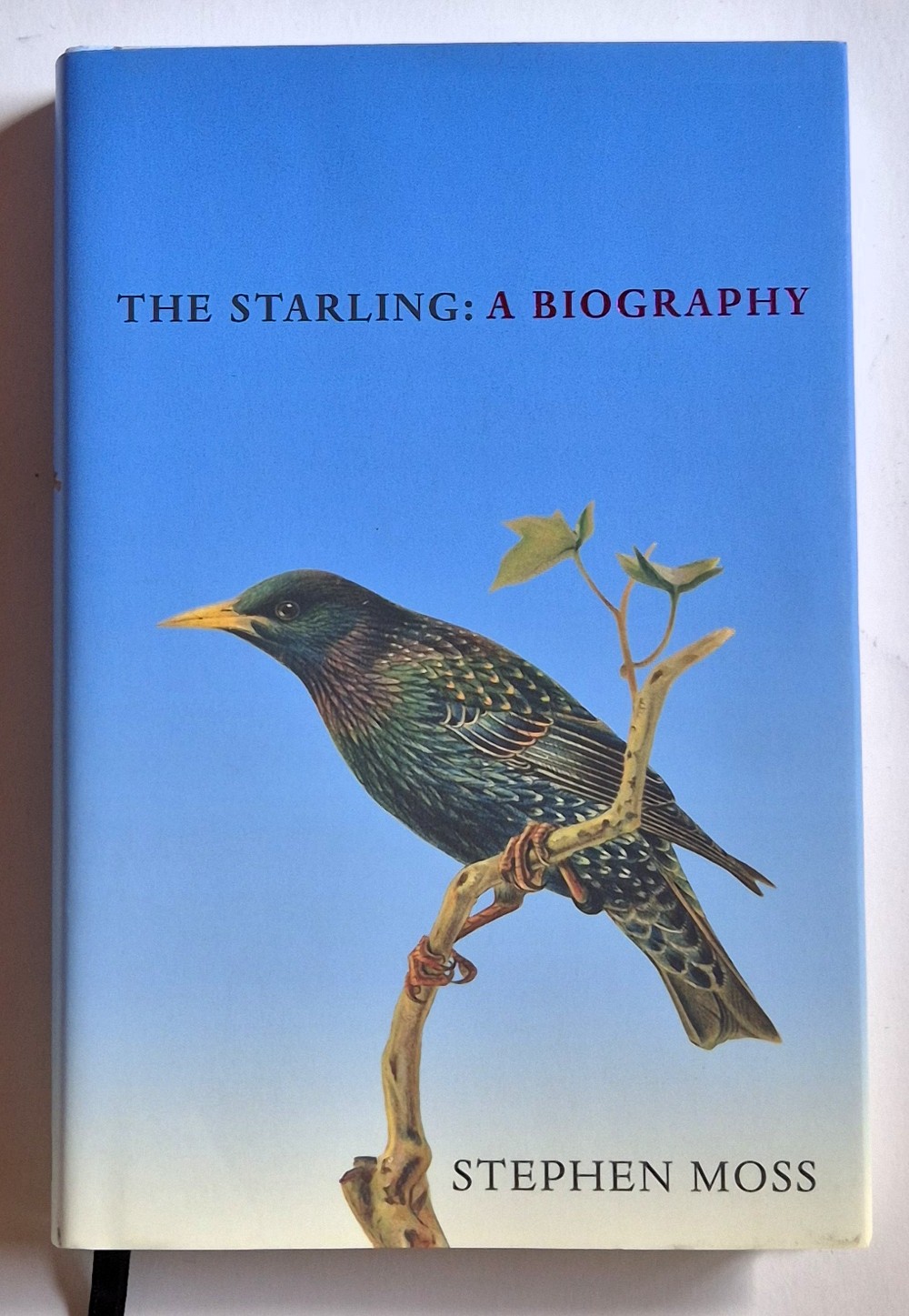
The Starling: a Biography, by Stephen Moss, Square Peg, 2024.
Stephen Moss is a prolific author and I have read and enjoyed many of his works. And I am extremely fond of Starlings. The stunning dust-wrapper image is from: Lilford (Lord, Thomas Littleton Powys). Coloured Figures of the Birds of the British Islands. Seven volumes. Chromolithographs mostly by Archibald Thorburn. R.H. Porter, 1897. And the gorgeous murmuration end-papers are by Gill Williams (Gill Williams Dorset Artist – Home). There are many other beautiful images including a murmuration photo by Daniel J. Lewis.
With apologies to the poet whom I will not name here, the book opens with a pretty terrible poem, ‘Starling’. In the second line he describes a “little coal-black bird” – size is relative but they are not that small and they are far from coal-black as Moss is at pains to point out elsewhere – they are multi-hued and iridiscent.
There’s a map of where to see murmurations which includes Brighton Pier where I have seen such a wonder myself.
Sturnus vulgaris has developed a long, large, strong bill to dig for insects and other invertebrates which enables longer residencies than for those birds which rely on other sources.
This image is my own and was used for the dust-jacket of Animal Wild.

See here for more photos: Gifts of Nature: The Return of the Starlings; A Wren’s Nest; Other Birds, a Ladybird and Flowers – Animal Wild. The young Starlings are of such a different colour that they have often been mistaken for a separate species.

We learn of European sub-species, Sturnus zetlandicus, a more secretive bird which tends to nest more in nooks and crannies than trees, and the Spotless Starling, Sturnus unicolor, which, unsurprisingly, has no white spots and is a resident of the Western Mediterranean. Also the Rosy Starling, Pastor ruseus, which has a pink breast, belly and mantle. Starlings and Mynas form almost all of the Sturnidae family and there some 120 species worldwide listed in Collins Birds of the World, all characterised by their sociability and adaptability. They are also extremely good at imitation, of all kinds of sounds, including the human voice, as well as other birds.
In my review of Sam Lee’s The Nightingale (The Nightingale; Hen Harriers; Breeding Bird Survey; The Canal & River Trust; Birdwatch magazine and Island Gigantism – Animal Wild) I wrote: “I think there is a danger with single species books of just throwing everything into the mix and sometimes this feels a bit that way too.” Moss is more astute than that but there are times when he really pushes it. Did we really need a reference to The Silence of the Lambs, in which he suggests that agent Clarice Starling was so-named by the author since she is an outsider and outcast as Starlings are considered to be in the United States? Is Starling really a very unusual name as he says? I’d be surprised.
Starlings feed in various ways but uncommon is their ability to probe the ground with their bills, then open them and detect prey by sight.
All too often considered a pest, they were classed as vermin as long ago as 1566. As recently as the 1980s they were shot in the UK for export to Europe for consumption. They have plenty of other predators to contend with too. They have been red listed since 2002.
Moss delves into the origin of the birds’ name but little is known. There is no evidence but I like the idea that their white spots are like little stars.
I am perpetually confused when it comes to bird migration. In the UK we have both breeding, resident and migrant populations.
Moss affectionately describes the birds as ‘rowdy’ and ‘unruly’ and I completely agree that this is how their behaviour seems when they visit my garden.
I seem to be damning this book with faint praise although I have enjoyed it … The final chapter, ‘The Global Starling’, begins with an account of how one man was allegedly responsible for the introduction of Starlings to the United States, which Moss goes on to disprove. But there is no denying they cause problems – eating food intended for people and other animals, spreading their excrement and disease and air strikes. They are hated by many on the other side of the pond, but their murmurations seem now to be changing hearts and minds and some of the accusations laid against them are unwarranted or at least exaggerated. There is little evidence to confirm that they outcompete other species to their detriment for example. The comparison with the introduction of the Grey Squirrel here is useful and like me the author wonders if there is some sort of xeonophobia involved.
One thing is certain, the European Starling is an extremely successful species, not excluding in Africa, Australasia and South America, welcome or not. The same is true of the widespread Common Myna – and the same hostility towards them. But in India they are referred to as friends of the farmer, protecting crops from insects. Mynas do seem to more seriously impact endemic species where they have been introduced.
We should tread softly: more than a few species of Starling have been rendered extinct. Bali’s national bird, the beautiful Bali Starling, is in real trouble having been hunted for the caged bird trade and with much of its habitat destroyed by the tourism industry.
A lovely epilogue describes “a spectacle … just as impressive as the nightly murmurations: the daily departure of the birds at dawn.”
Leave a Reply