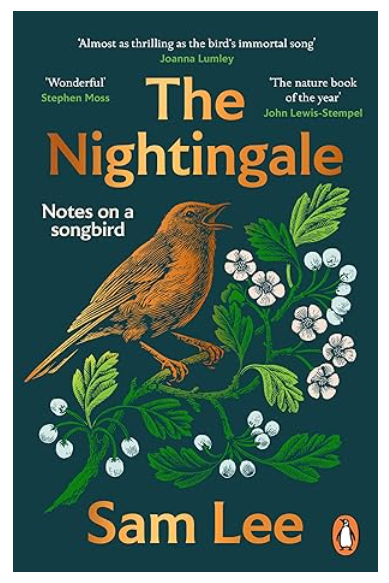
The Nightingale by Sam Lee, Penguin Books, 2023, a book review.
Sam Lee is a folk musician and an expert on the subject and a conservationist. He is passionate about the Nightingale and his song. It is no surprise that his writing is often lyrical and the book wins high praise from other writers about wildlife and Joanna Lumley. I have nothing against English folk music and do not decry it’s artistic and cultural importance, but it doesn’t really float my boat, so there were sections of the book I didn’t mind speed reading. Sometimes he is a little florid or purple in his style for me, and some parts seem overworked.
I think there is a danger with single species books of just throwing everything into the mix and sometimes this feels a bit that way too. I could have done without the complete retelling of the story of the emperor and the Nightingale for example. But his quotes from the song ‘The Tan Yard Side’ are undeniably lovely. As he says, the birds are visually rather nondescript, but I love the idea that their chalk-white throats look as though they have brushed against the white cliffs of England’s coast during their migration. He reminds us that migration was barely understood until relatively recently – it was the arrival of a stork in Germany with an African spear through its neck which opened our eyes. Clearly the bird, the Pfeilstorch, had flown from sub-Saharan Africa.
The author’s excitement and other powerful emotions when he leads groups to listen to Nightingales are almost palpable. I also approved his comment on the naming of Sites of Special Scientfic Interest (SSSIs) – they are of interest not only to science. The Nachtigall is relatively abundant in Germany, even in the cities. How wonderful that the leader of a team researching the birds there is Sarah Darwin, great-great-granddaughter of Charles.

From: Morris (Francs-is Orpen). A History of British Birds. Six volumes. Groombridge and Sons, 1851-1857.
A hugely popular radio broadcast in 1924 involving a virtuoso cellist and the song of the Nightingale prompted Lord Reith to comment that it had “swept the country … with a wave of something closely akin to emotionalism, and a glamour of romance has flashed across the prosaic round of many a life.” He added that “Milton has said that when the nightingale sang, silence was pleased. So, in the song of the nightingale, we have broadcast something of the silence which all of us in this busy world unconsciously crave and urgently need.”

From: Meyer (Henry Leonard). Illustrations of British Birds, c.1835-1844.
There’s list of the names for the bird in a multitude of languages with is the sort of thing that does float my boat. The Nightingale can produce more than 1,500 sounds in total which it uses to generate seemingly random phrases.
I didn’t care for the author’s taking Keats to task for overlooking the “truth of the nightingale” in his beyond famous ‘Ode to a Nightingale’, that just seemed rather superficial and to miss the point. He also says of Aesop that none of his writings survive. I suspect this came straight from Wikipedia (nothing wrong with Wikipedia) but it’s a bit more complicated than that. Aesop’s very existence is uncertain but it is not at all certain that he didn’t write the fables. Perhaps better not to make the comment at all. But the author’s passion and concern for the bird and his expression of his worries in this age of extinction and pleas that we do something about it all are what matters.
Hen Harriers
On which subject, two more Hen Harriers have ‘disappeared’ from an RSPB nature reserve surrounded by grouse moors. Good to know that they and the National Wildlife Crime Unit are working together using drones, metal detectors and detection dogs to try to tackle this terrible persecution. With these tools they can find even buried birds and their tags.
Breeding Bird Survey
The British Trust for Ornithology has published its 30th Breeding Bird Survey Report, which can be found here: BTO-JNCC-RSPB BBS Report 2024
The Canal & River Trust
I was also pleased to receive another newsletter from the Canal & River Trust. I signed up because of my recent little adventures, as I like to think of them, along the Kennet & Avon Canal. There’s a link to a very good report of invasive species: Invasive Plant Species | Canal & River Trust. They spend hundreds of thousands of pounds annually on the problem. The offenders are described in detail along with their effects: Giant hogweed, Japanese knotweed, Floating pennywort, and Water fern. There’s also news of waterside events and even a jigsaw.
Birdwatch Magazine
June 2025, issue 396.

This features the weird and wonderful Bittern on the cover. They are doing quite well. I actually saw one in flight, at a distance, in Norfolk last year at Cley. We had all stopped for lunch at the centre there and our wonderful guide Nick Acheson was rather embarrassed that he had stood up and shouted “Bittern!” across the cafeteria but I thought that was lovely. He spotted a Turtle Dove too, about which Mark Avery writes here. There are promising signs of recovery but it is early days yet. We saw a Marsh Harrier on that trip too. Lakenheath Fen on the Norfolk / Suffolk border has those and Bitterns too and sounds like an RSPB reserve very much worth a visit.
There’s at least one Greenfinch back in the garden by the way, just saying. Update: at least three, one male and two females.
The magazine includes a piece on Bialowieża Primeval Forest and it’s sad to read that its future is still rather precarious. Forestry in the form of logging seems to be the main problem, affecting the populations of bison, lynx and many species of birds. It’s odd that Simona Kossak whose home it was and who fought so hard for it gets nary a mention. See If you go down to the woods today… – Animal Wild and Beastly – Animal Wild
Another sadness is the continuing decline of the Wood Warbler. The greatest factor is nest predation – and they seem to be laying fewer eggs. Protective measures are now in place. Birders and photographers straying from paths is also a real part of the problem.
Island Gigantism
I quoted this phrase in the post before this one, my review of Keggie Carew’s magnificent book Beastly, but the post was long enough already even though I wasn’t quite sure what caused island gigantism. A little subsequent research reveals that it’s to do with islands which can tend not to have large mammalian predators (they haven’t been able to get there) so those ecological niches may be filled by birds, reptiles and smaller mammals. They can afford to grow in size – they do not have the need to remain small in order to hide more effectively since predation pressure can be less intense. Insular dwarfism on the other hand can result from limited prey resources. This is all rather speculative still but fascinating.
A fabulous host of oxeye daisies here this year again, and most have not even fully flowered yet.


And I’m liking this rhododendron, a problem in our forests but fine in a pot in the garden.

Leave a Reply