Flowers
Vibrant carpets of Buttercups and Oxeye Daisies:


The alliums have gifted generously this year too.
This is strikingly coloured Honey Garlic, or Sicilian Honey Garlic, Allium siculum.

These are Drumstick Allium or Round-headed Garlic, Allium Sphaerocephalon:


The colours couldn’t complement each other better it seems to me. Here they are just a day later:


Ladybird
Sadly no longer alive, I had never seen a ladybird like this before, a Cream-Spot(ted) Ladybird. Worryingly I have not seen a single butterfly for several weeks.

They eat aphids but are also especially useful to us as gardeners since they also help to protect plants by consuming powdery mildew.
Birds
The garden is full of juveniles, generally looking a bit scruffy – all of their energy goes into growth in order to be able to leave the vulnerable environment of the nest as soon as possible. I saw a young Blackbird pausing briefly on my car before following his or her father up to the roof, there are juvenile Blue and Great Tits (the latter with yellow cheek patches rather than the white of the adults) on the feeders. Just in the last few days I’ve been visited by a female Great Spotted Woodpecker, Greenfinches, House Sparrows (the adults I have decided are actually not as small as I have tended to think), Chaffinches, Dunnocks, the ground feeders, the Magpie with the broken (but now healed) wing – it’s always the same one and only the one visits, the inevitable Wood Pigeons and unruly Jackdaws, whilst Swifts and House Martins hunt high above the village in the evenings. A pair of Wood Pigeons always sit on the telephone wires beyond my office window in the same place at dusk, behaving in what can only be described as with great affection for each other. There’s a pair of juveniles too. Red Kites soar overhead as usual in this part of the world, sometimes sweeping low enough to make every detail visible.
I like the shadow and light on this Chaffinch.

Male Greenfinches have such very bright yellow undersides, but the females have an understated, subtle beauty too:

The Magpie’s feet, peeping over foliage and showing a surprisingly light blue patch:


She flies ok most of the time, but I think she has a tough life with one wing at a permanently awkward angle. I have just now seen her struggling and failing to get off the ground. I wish I could help her.
A Dunnock, strutting his stuff:

Yellow and slightly ragged juvenile Great Tit:

A female Blackbird, far from uniformly brown and dull:

Looking skywards.


House Martins returned to a nest under our eaves for years, sometimes producing two broods, but not for the last three or four summers, but I noticed a movement as I was walking past and my immediate thought was that they had finally returned or that other House Martins were availing themselves of the facilities. But no, just a few feet in front of me a Wren was perched. I watched as she flew up to her nest which had been built right on top of the defunct House Martins’ nest. I thought this unusual but it seems Wrens are especially adaptable and creative when it comes to their nest sites. I have only seen her the once but will keep my eyes open.

Meanwhile, the Merlin app has additionally identified Goldfinch, Nuthatch and even Goldcrest, all within the space of the same few days. I have felt grateful, blessed. But Merlin also heard Starlings – and so did I. Again for years they were regular visitors, in numbers, but they too have been absent for a long time. I wondered if farmers had killed them all in spite of their being, shockingly, red-listed. They are allowed to do so under licence and some no doubt do it illegally. This is from Animal Wild:
A farmer, reported to the Avon & Somerset Police in 2010 for shooting red-listed Starlings after his licence had expired, rather than being prosecuted, had his licence extended for a further ten years by Natural England. “The problem with Starlings and lead shot falling into people’s gardens was discussed and [the farmer] was asked to shoot only in the direction of the field and not towards the village, and to pursue wounded birds wherever possible.”
Intensive agriculture seems to be the main cause of their decline. I featured a photograph of one on the back of the dust-jacket of Animal Wild.
But then, two days ago, having spent the morning feeding Starlings and other fledglings at HART Wildlife Rescue, I sat in a local pub garden and saw a flock of some thirty land and peck at the lawn for worms. I was pleased to identify them from a distance from their structure alone – I have learnt something at least from all those British Trust for Ornithology ID courses. Would they, I wondered, turn up in the garden as they used to do, as though by magic, to the extent that I worried that neighbours would complain about the racket, whenever I put mealworms out? The feeders are quite well-hidden under a tree. It didn’t take long. A wonderful plenitude of adults and juveniles were there within minutes. I tried again the next day and this time it took twenty minutes or so for the first one to turn up, a few more three and a half minutes after that, the rest just a minute or two later. I don’t understand how they do it, but the system seems to be that a scout will check out the situation from time to time and then, presumably, report to the rest that mealworms were available. Some of the juveniles were being fed by their parents but all were at least beginning to learn to self-feed. The Jackdaws are very keen on mealworms too, but they come and go all the time. Once the worms have all been consumed, the Starlings gradually disperse, having no interest in the seeds and peanuts. I noticed what was clearly a warning call once or twice, about what I don’t know, causing them all to flitter off briefly. On the second day my aim was to capture the act of a parent feeding a child and was delighted to be successful.
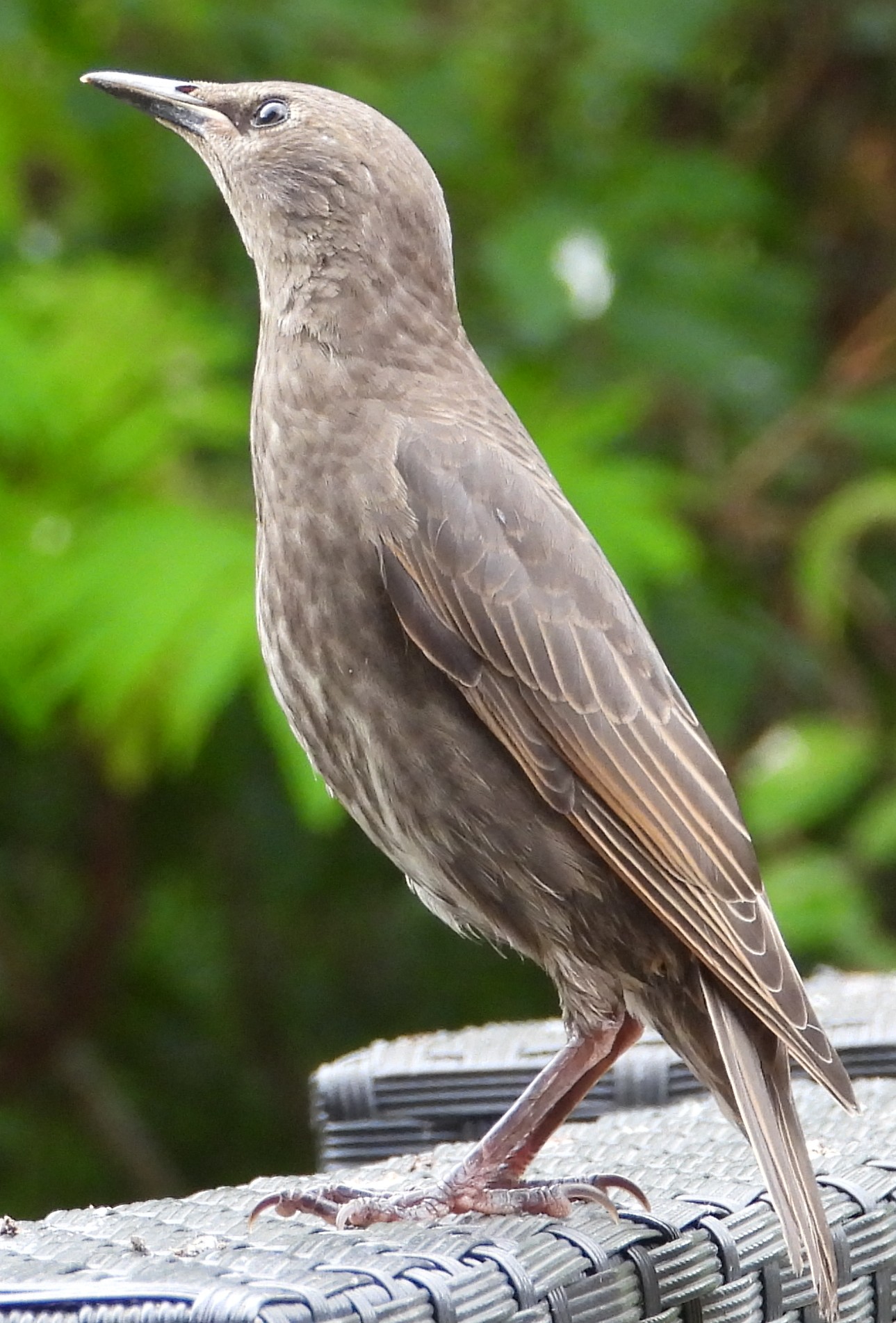
So here are many photographs of Starlings – I was mesmerised. A few days later I estimated the flock to comprise at least fifty individuals. I love their iridescence in adulthood, but the elegance of the shape of this juvenile surely cannot be surpassed:


The feeding begins:

The blur was not deliberate but I am pleased with the effect:


Asking for food:


The juvenile on the left below’s eyes are following the adult who has gone to fetch more food.


An extra gift yesterday. Two young Great Tits. The one on the right must surely have fledged very recently indeed. To my inexpert eye he or she looks to have barely enough feathers to fly at all.

Leave a Reply