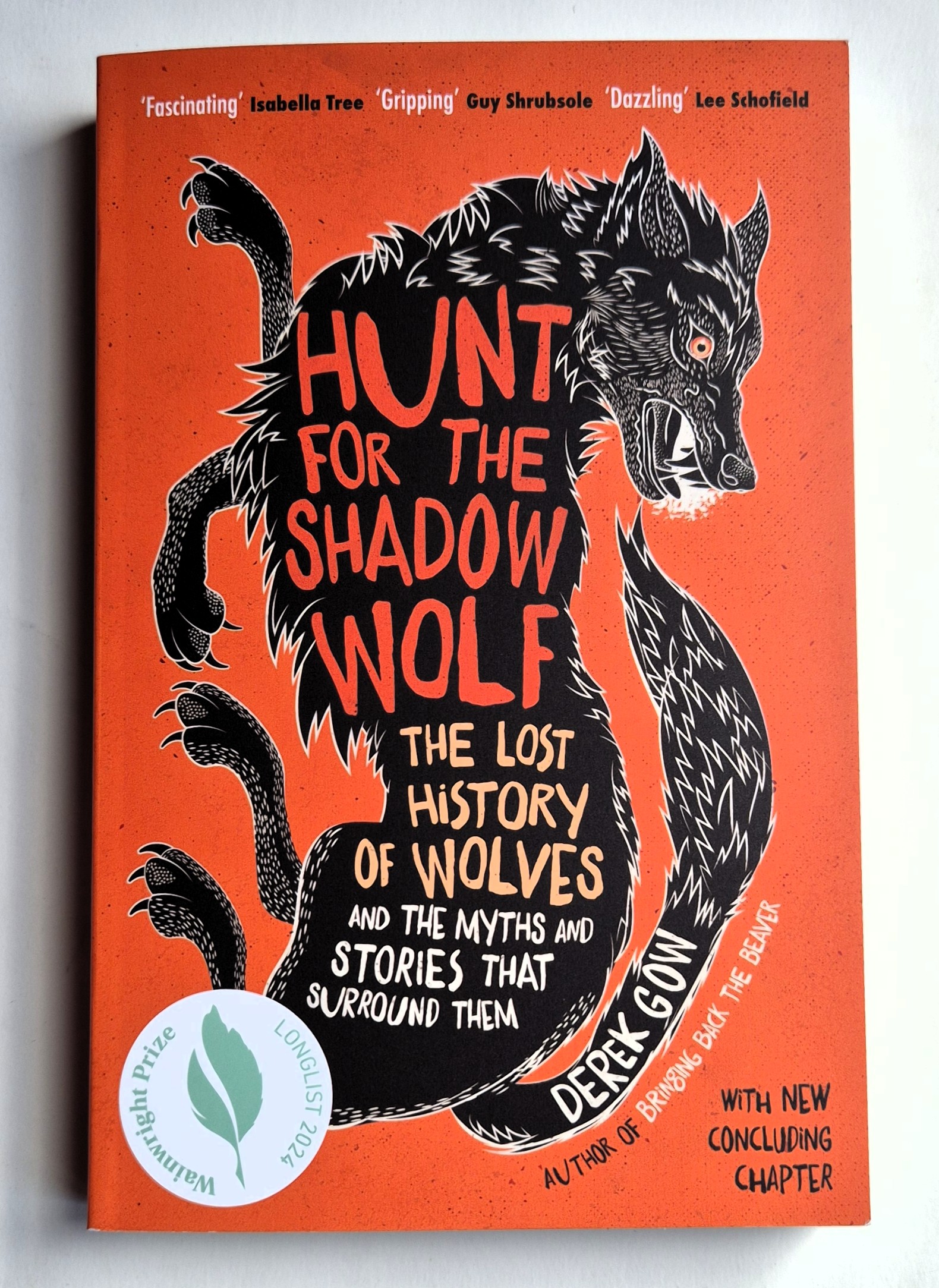
‘Wolf’ is such a wonderful word. Backwards it’s ‘flow’, much used by crossword compilers. Sure enough it came up just the other day: “Metal flux around hammer”: wolfram. It has an irregular plural of course, ‘wolves’, like leaf, knife, loaf, calf, dwarf, roof, life, wife, sheaf and many more.
And this is a wonderful book, Hunt for the Shadow Wolf: The lost history of wolves and the myths and stories that surround them, by Derek Gow, Chelsea Green Publishing UK, 2025. Gow is also author of Bringing Back the Beaver. He is fiery, something of a maverick, who writes with wit and passion whilst delving deep into our folklore and mythology. As one reviewer, Sophie Pavelle says, “This book bites and snarls with truth.”
The absurd myths about wolves are authoritatively dismissed whilst our appalling treatment of them over the centuries is unflinchingly laid bare. They have been (mostly) welcomed back in continental Europe but our farmers’ resistance is proving too powerful here still. As Gow puts it, “the draconian unions of the farming elite will say no and persuade their pals in power to perhaps back them for a while, [but] there are others in increasing number who long for a different future.”
They really don’t pose much of a threat to us or even that much of one to our livestock (no one is saying it never happens) as I wrote rather furiously in Animal Wild:
Wolves inspire fear and loathing in some. Certainly they will take livestock, but attacks on humans are very rare, fatal attacks much more so. There were 36 from 2010 to date, three per year, worldwide. There are that many (between 30 and 50) fatal attacks by domesticated dogs every year [in the UK]. The wolf attacks are classified into the categories provoked, unprovoked, predatory, agonistic and rabid. Six of the fatal attacks are categorised as rabid. The numbers are as nothing compared to human deaths brought about by, in roughly ascending order (the numbers vary depending on where you look): elephants, 500, hippos, 500, crocodiles, 1,000, tapeworms, 2,000, roundworms, 2,500, scorpions, 2,600, parasites of assassin bugs, 10,000, tsetse flies, 10,000, snakes, 138,000, parasites hosted by freshwater snails, 200,000, humans, 475,000, mosquitos, 1,000,000.
Similarly, Gow points out that people are more likely to be killed by a dog, lightning, a bee sting or a car crash than by a wolf. Domestic dogs kill over 50,000 people annually worldwide. Wolf attacks do happen but as with dogs, many of the fatalities are attributable to rabies. His figures, from the International Wolf Centre, give only 26 fatal incidents out of 489 recorded attacks over an eighteen-year period.
Wolves have long been feared, hated and condemned by the Church and to my surprise, the Far Right. That seemed worth looking into. Some Far Right groups identify with the wolf, but others threaten their presence in Europe, wanting only to shoot them, all of them. Their electoral success increases in the aftermath of wolf attacks. The animals were not helped by a wolf killing the President of the European Union, Ursula van Leyen’s favourite pony. For that one instance she had the nerve to see fit to launch a commission which resulted in a downgrading of wolves’ protected status.
William of Normandy has much to answer for as ever. It’s absurd that his passion for hunting and the laws he enacted to enable it are still in place today, which is reminiscent of what is supposedly the ancient British tradition of driven bird shooting in fact being a relatively recent import from Germany by Prince Albert. As Gow writes: “Hunters of all sorts have always attempted to augment the object of their pursuit.” Think fox hunting and deer stalking and fishing. “That they do so today with sad farm-reared pheasants and pitiful green mallard ducks that wheel and turn back to the waters they have flown from again and again to face a succession of blistering fusillades is both obvious and nauseating.” I like Derek Gow’s style. I respectfully salute him in fact.
There’s a terrific story about St Francis of Assisi. A wolf had been troubling the townsfolk but St Francis struck a deal. The wolf would “cease plundering” if regularly fed. This was in Gubbio where a bronze statue shows St Francis stroking the wolf that stands by his side. The wolf’s tomb in the church can still be seen.
We are also reminded of the massive problem of sheep farming here and elsewhere, an ecological disaster. Sheep have been filmed eating the chicks and eggs of Lapwings and Arctic Terns. In the Netherlands, 13,000 sheep are killed, on average, by dogs, per annum, and a figure of 16,000 was given for Britain in 2016.
The British system for sheep production is “nothing short of catastrophic”. I absolutely love sheep but they eat tree seedlings too and toxic chemicals are deployed to protect them from a variety of natural parasites. The whole business would not exist without massive taxpayer subsidies. As I so often say, no business other than farming which I can think of benefits from this kind of governmental support.
The ways in which wolves have been killed hardly bears listing but poisoning, hanging (from special trees) and burning alive to name but three suggest a level of cruelty born of fear and sadism. And then there are trapping in the most appalling ways and torture. They were also baited with dogs, often hamstrung for the purpose (these people never want even a fair fight).
Subjugation, says Gow, was never enough. Wildlife must be wiped out, then and now, and hares, foxes, badgers and deer were and are kept purely for the purpose of hunting them, often “wearing comedy costumes and parping ridiculous trumpets.”
It is only quite recently that it has sunk in with me that bringing back apex predators like wolves and lynx helps to control deer populations through predation, they also, crucially, keep them moving and so fewer areas are completely denuded.
Leave a Reply