Firstly, another mention of Michael McCarthy’s Fergus the Silent, Youcaxton Publications, 2021. I wrote previously that “it’s a novel and the first fiction I’ve read for perhaps fifteen or twenty years. I have discovered that it is common to middle-aged men suddenly to stop reading fiction and it came to me out of the blue that it no longer interested me (I hope I never lose my love of poetry though) in spite of my degree and my job both of which centred around English literature.”

I have now purchased this book three times, which is of course ridiculous, but at least good for Mr McCarthy. Having absent-mindedly left the first copy out in the rain overnight and rather deprecated the slightly cheap feel of the book, I ordered the Kindle version. I have read books on Kindle before, sometimes in tandem with the printed book, but for a work of fiction it just felt wrong and so another dead tree copy arrived yesterday. I don’t know why that is. It’s that fabulous Edward Lear illustration again on the front cover (passim).
I followed up on a reference to the French name for a Gannet: fou de bassan, which probably sort of means, unkindly, idiot of Bass Rock. This took me to a website called academia.edu. I had to sign up to access the excellent relevant article. Basstölpel is the German word and means much the same. And the Latin Morus bassanus is also along those lines. In Polish it’s głuptak (fool) but the Spanish name is alcatraz which refers to the bird’s superlative diving abilities. Although signing up was free, I have rather been bombarded by academia.edu since in attempts to persuade me to upgrade – not free. They keep suggesting that I might be the person mentioned in various other papers which seems highly unlikely. All rather irritating.
I was recently working on a putative pub quiz and needed a new question to replace one that had become out of date and having come across the information asked of what these formed sections: hadal, abyssal, midnight, twilight and sunlit. These refer to the ocean in order of depth (ascending, descending?) and concomitantly darkness. They are more officially known as the Hadalpelagic, Abyssopelagic, Bathypelagic, Mesopelagic, and Epipelagic Zones, but the less formal terms seem positively poetic. “Hadal” derives from Hades.
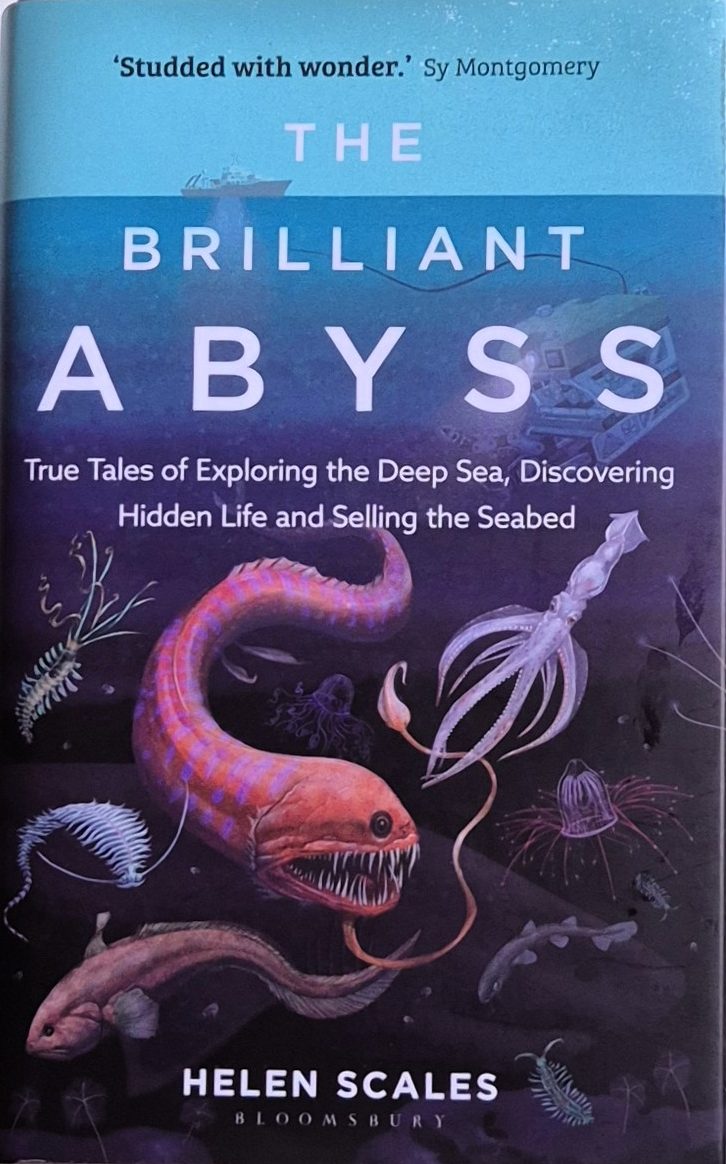
Helen Scales’ The Brilliant Abyss, True Tales of Exploring the Deep Sea, Discovering Hidden Life and Selling the Seabed, Bloomsbury Sigma, 2021, is, as reviewer Sy Montgomery says, “studded with wonder”, and I confirm that from the prelude and first chapter alone. Helen Scales is very eloquent or, to put it another way, she can really write. She’s a marine biologist, teaches at Cambridge University and is scientific advisor to the marine conservation charity Sea Changers and the author of several other books. I clearly remember first coming across the phrase “sea change” in Ariel’s song in The Tempest:
Full fathom five thy father lies;
Of his bones are coral made;
Those are pearls that were his eyes:
Nothing of him that doth fade,
But doth suffer a sea-change
Into something rich and strange.
Sea-nymphs hourly ring his knell:
Ding-dong.
Hark! now I hear them,—ding-dong, bell.
That would have been in my school days and for some reason it has stayed with me ever since. I have always loved the sea and swimming when it is rough is one of my very favourite things to do, that and snorkelling. I mind the cold these days and so have to travel far to enjoy the thrill of diving through waves or letting them buffet me. The sea has nearly killed me a few times which I wrote about here: The Flow. Book review. Part I – Animal Wild.
Even Helen Scales’ description of the tethered (unmanned) submersible is superb. She makes it seem almost a living creature. It’s descent to the seabed is stately: 2000m takes an hour, so progress is at 1.25 mph (I just can’t visualise metric distances or speeds, or heights or weights for that matter, except that I know what a 20kg bag of bird seed or animal feed feels like and I can guess the weight of a hedgehog in my hands fairly accurately in grams). The ship is called The Pelican, the original name too of Francis Drake’s Golden Hind. She writes of sea cucumbers, Enypiniastes, and their ability to slough off a layer of skin when disturbed, “creating a shining ghost of itself”, probably to confuse a potential predator.

New technology is facilitating a golden era of deep sea exploration, of depths we once thought devoid of life (azoic). But it is the domain of jelly creatures “so fragile they would fall straight through your fingers if you tried to pick one up and yet they remain unperturbed by pressure so extreme it would squash your body’s cells and molecules lethally out of shape.” “Here live billions and trillions of small, glowing fish … Here lie entire ecosystems … where worms are 3 metres long …”

As ever with serious books about the natural world, there are dire warnings. “If industrialists and powerful states have their way and the deep is opened up to them, then it raises the ironic and dismal prospect that the deep sea will become empty and lifeless, just as people once thought it was.” Until recently our interactions with and knowledge of the seas were limited to the edges, surface and shallow depths. Typically, Trump has violated international law (according to China, and me) by signing an executive order aimed at stepping up deep sea mining. Do we really need the metals for our smartphones and all the rest so very badly that we are willing to destroy what we do not even yet know?

Sunlight just about penetrates to a depth of 200 metres, on average the oceans are 3,000 metres deep.

In the deep, down there, are mountain ranges, volcanoes, canyons and vast abyssal plains. We enter the hadal zone as we approach 6,000 metres and beyond. Then there are the trenches; the Mariana Trench, famously the deepest, goes down to 11,000 metres.

A footnote about the author’s terminology makes a brilliantly resonant point, although we talk about seas and oceans: “the earth has only ever had one interconnected mass of water.” It’s one global ocean. Full of millions of species of which we know only a fraction.

Without light there is no photosynthesis and therefore almost no growth nor new life, so the creatures of the deep rely for sustenance largely on ‘marine snow’, “a thin trickle of organic matter that falls down from surface seas.”

The second chapter is on ‘The Whale and the Worm’. I have read and learnt so much about cetaceans over the years that much of this was not new to me, but there have been interesting developments as to what factors might be involved in strandings. Solar storms may be one, affecting magnetic fields, although it is not certain that whales use these to navigate as bees, pigeons and sea turtles do. Whale fall is a significant contributor to the diets of certain deep sea creatures. A research team was initially confounded by fuzzy, red invertebrates feeding on the bones of a whale carcass. They turned out to be a previously undiscovered genus of polychaete worms. They have red feathers and green roots. But these were all female, where were the males? Nature is never short of delivering startling twists. Dwarf males live inside the females in their tens or hundreds using hooks to hang on waiting to fertilise the eggs.

The study of implanted whale falls has produced rich results. Already over 120 previously unknown species have been discovered (at the time of the book’s publication).

In the third chapter, ‘Caught in a Jelly Web’, Helen Scales explains that the flimsiness of jelly-based creatures has made them hard to study: they are shredded by nets and collapse and at the surface pressure is so reduced “they can simply melt away.” She’s interested in etymology and usefully often gives pronunciations too. “Plankton” derives from ancient Greek planktos, meaning “wandering”.

We are then introduced to Ernst Haeckel, a zoologist of considerable renown who specialised in marine creatures. He “opened up a whole new view of the ocean and discovered a multitude of delicate life-forms that waft through the deep. He named some six hundred species of gelatinous plankton, some so unique he assigned them new branches on the evolutionary tree of life.” He described and named thousands of new species throughout his career. His most influential publication is Kunstformen der Natur, issued in parts, first published together in 1904. His artwork is stunning, exquisite, connecting people and nature and bridging the worlds of art and science. It was a major influence on the Art Nouveau movement. There are copies on the market for between £3,500 and £5,000. The wonderful Internet Archive allows download of a pdf version. It’s the Smithsonian copy. Sometimes these scans seem a little over zealous, although I am all for completism generally. But do we really need to see each blank preliminary or in this case the plates with and without the tissue-guards in front of them? But that’s being churlish really and I’m delighted to illustrate this post with lithographs and chromolithographs from the work, placed quite randomly.

One group of cnidarians studied and illustrated by Haeckel are the siphonophores which “challenge the notion of what it means to be an individual.” Polyp and medusa stages of life exist simultaneously in one body. The combined “zooids” form long chains (dozens of metres or more) but unlike other colonial animals, like corals, the constituents are not identical. Different zooids have different functions (such as feeding, reproduction, floating, propulsion and steering), so specialised that they are unable to survive on their own. Another tableau included in Kunstformen der Natur is of the ctenophores “(with a silent c)”. They “have their own phylum … and they compete with sponges for being the oldest branch on the animal evolutionary tree.” They are covered in tiny strips of iridescent hairs, hence they are commonly known as comb jellies.

I was surprised to read that scuba diving was a relatively recent invention in the early 1970s. It was an important step forward. Jellyfish were once thought irrelevant to the food chain but they turned out to be highly important both as predators and prey.

Bioluminescence is common from the surface down to the abyss, and eyes have evolved best to perceive it. It can be used to lure or illuminate prey and to defend by confusion.

‘In a Chemical World’ opens with a description of Yeti Crabs (technically not actually crabs) which were first discovered in 2005. They have “stringy colonies” of bacteria on their bodies. The crabs are in fact ‘farming them’ and eating them.

The first hydrothermal vent, where Yeti crabs thrive, was observed in 1977. A geologist on board the submersible, 2.5 kilometres down, Jack Corliss asked “Isn’t the deep ocean supposed to be like a desert? Well, there’s all these animals down here.” What a moment. The vent fields, of which there are hundreds, revolutionised our view of life on earth, life without sunlight. Incredibly “It has been calculated that the entire volume of the ocean cycles through hydrothermal vents every ten to twenty million years.” The fluid emitted is superhot and toxic. The chimneys are formed from dissolved minerals and metals solidifying as it meets cold seawater.

This apparently hostile environment is home to shrimps, a snail with a black shell made of iron and a foot comprising overlapping scales, fighting worms, barnacles, limpets, fish, octopuses, crabs, starfish, anemones and octopuses. Over seven hundred species have been catalogued, eight out of ten of them endemic, many previously entirely unknown, including Xenoturbella which looks like a discarded purple sock and is no more than a hollow bag without teeth or gut.

There is obviously no photosynthesis in these places, but microbes use chemosynthesis instead and they provide the food for other inhabitants. There is much we have yet to learn and possibilities for extra-terrestrial life can be reconsidered.

‘Highs and Lows’ tells us about seamounts. There is no agreed definition for a terrestrial mountain but including large and small there may be as many as twenty-five million seamounts, home to sea lilies, corals, sponges and other species. Sponges may have been “the first animals to evolve, at least some six hundred million years ago” and they have their own phylum. Some of these species can be very long-lived, existing for hundreds or even thousands of years.

One seamount was found hosting a colony of incubating octopuses, who are normally solitary creatures. The warmer water enables faster growth of their offspring. Migrating animals who like to visit may find seamounts by the smell of zooplankton (dimethyl sulphide) floating above them (petrels and albatrosses for example) whilst whales, sharks and turtles may sense them through geomagmetic anomalies they generate.

Seamounts are on the move on the tectonic plates and eventually they fall into abyssal trenches.

There’s more strangeness, more mystery. Hadal Snailfish live deeper down than any other vertebrates. One such, the Mariana Snailfish, was seen alive at 8,078 metres. One way in which animals like these cope with the extreme pressures is through TMAO (trimethylamine oxide) which protects them in complex ways and is also the molecule which makes fish smell fishy. We also learn how fish adapt when they move from a seawater to a freshwater environment.

Snailfish feed on amphipods which have series of legs taking on different forms (as opposed to isopods) and they cope with the pressure by covering themselves in aluminium gel.

Finally in part I of the book we are taken to brine pools, where fish, shrimp and crabs hunt for prey. If they touch the very salty oxygen-free pools though, they die. And yet, when the Pelican visits one in the Gulf of Mexico it just so happened that it began to shrink and then disappear altogether, probably through a crack in the seabed. That left only a “toxic puddle” but life had found a way even there. At the bottom were living sea urchins and acorn worms, the first animals known to survive in such a place.

I approach the three last parts of the book with some trepidation. It’s no surprise that the seas are getting warmer, but that’s not just near the surface. The potential consequences are nothing short of terrifying. The ocean and its denizens sequester carbon in many different ways – they are crucial for our climate. Research suggests that life itself may have begun around hydrothermal vents.

We have been finding new, effective medicinal drugs from the sea, and the deep sea is likely to proffer many more: “… corals and sponges are likely to catch up with plants in their contributions to modern medicine cabinets.” We seem likely to need new kinds of antibiotics which might also be found from the same source like those medicines we already now have which have proven effective in cancer treatments.

The deep sea Orange Roughy, a long-lived, ancient fish, which breeds and grows at a slow pace, is held up as an example of what goes wrong when factory trawler ships operating at the seamounts where they congregate and a lack of regulation lead to massive overfishing. Entire ecosystems are destroyed in the process, mostly irrecoverably. In many cases the industry is heavily subsidised. If that were not the case “the bulk of deep-water trawlers working the high seas would be operating at a loss.” That sounds familiar. We can only hope for regulation and restrictions which will be “an important step towards curbing an industry that yields relatively trivial economic benefits but a fearsome capacity to vandalise our living planet.” Eco-labelling certifications from the Marine Stewardship Council are questionable to say the very least. The MSC claimed the alleged comeback of the Orange Roughy as a success story but dumping and underreporting of the catch carry on just as before.

Lanternfish are the most abundant vertebrates on the planet. They live in the twilight zone. At the time of the book’s publication commercial fisheries had not been successful. But it is still being investigated – at what must surely be our certain peril. Apart from factors such as bycatch, we simply don’t know enough.

‘The Eternal Junkyard’ chapter is very hard to read. The section on plastics and microplastics reveals that the problem is unimaginably worse than most of us might think. Discarded plastic is everywhere, even eleven kilometres down.

Oil from spills and other disasters does not go away, the effects are not short-term either.

It’s a classic case of out of sight, out of mind. Greater numbers of dead livestock dumped from ships are being found in the deep. Then there’s sewage, toxic waste from pharmaceutical companies, ships carrying chemical weapons deliberately scuttled. There are regulations now but these things went on unchecked for decades. Rachel Carson is quoted, from her The Sea Around Us: “The truth is that disposal proceeded far more rapidly than our knowledge justifies. To dispose first and investigate later is an invitation to disaster.” Helen Scales reminds us that the trenches are not “empty receptacles” for our waste. Hiding the problem is not the same as dealing with it but there are suggestions of dumping carbon at sea, consequences entirely unknown. It would only be postponing the problem for future generations to try to tackle.
Then there’s mining. I love the author’s descriptions at Southampton docks: “Cranes stood like headless metal giraffes” and “A cargo ship moored at the eastern dock looked more like a colossal cliff face than a vessel capable of moving.” There at the National Oceanography Centre she enters a room full of jars containing deep sea species preserved in alcohol. Then “rocky nodules”, formed originally perhaps from a shark’s tooth or a chip of whale bone, far heavier than they look as though they ought to be. Over eons layers of metal and minerals accumulated: manganese, nickel, copper, cobalt and others. Both these and seamounts are targets for deep sea mining. There are also plans to demolish the chimneys of hydrothermal vents for the same gains (such as iron, lead, zinc, silver and gold). This book was published in 2021 – since then these plans have become reality and even then permits had been issued. But we still do not know enough about long-term impacts. Our track record on land and the shallower seas is hardly something to be emulated. And the high seas, beyond international borders, which cover more than half the planet, are in any case pretty much lawless.
“It takes ten million years for a nodule to grow from the size of pea to a golf ball”. And now we know so much more than we did when the Law of the Sea, which called for environmental protection and safeguards, was drafted in the 1970s. The nodules themselves are full of tiny life forms. And “they are the foundation stones for an octopuses’ nursery”. It’s not just the immediate and obvious destruction – there are the noise and toxic dust storms which mining would create. And what the mining ships leave behind, introducing toxic clouds which would affect species all the way up to the surface and so into the human food chain. The flawed motion of offsetting, such a failure on land, would simply be impossible.
Comment on the international political elements discussed near the end of the book would be futile without a massive amount of research into what has happened between 2021 and now. The same applies to technological advances to reduce our need for the metals which come from deep sea mining (for electric cars, renewable energy and so on), whilst acknowledging that we do need to wean ourselves off fossil fuels.
The final chapter expresses the hope that the deep sea will be left alone altogether, except for exploration and research. If we over exploit that final frontier, afterwards there will be nowhere left to go.
Leave a Reply