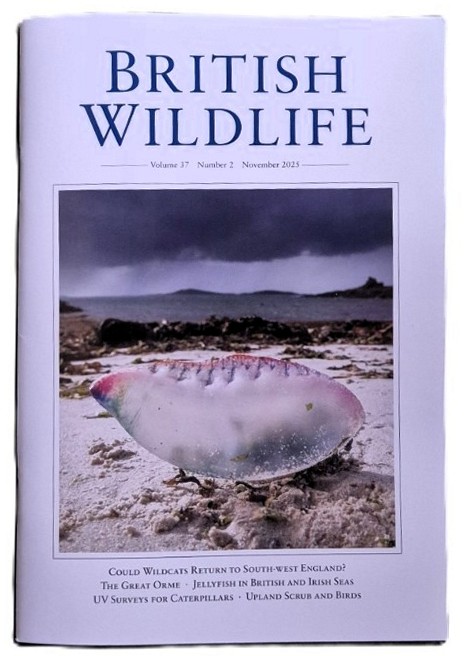
Volume 37 number 2
Cath Jeffs opens this issue asking whether European Wildcats might return to south-west England. They were declared functionally extinct in the UK in 2019 but there are ongoing efforts to restore a population in Scotland. They are a different species from Domestic Cats. They are larger, have thicker fur, a banded, blunt-ended tail and are solitary unless breeding. They have been relentlessly persecuted in the past as pests (in spite of their controlling rodent populations, thereby protecting crops) and for their fur and they only persisted in Scotland because they had been wiped out everywhere else. The First World War took many gamekeepers away to fight and their numbers and range increased for a while, but it was a brief reprieve. Hybridisation with Domestic Cats has also been an issue and the offspring are fertile.
Domestic Cats, I am fascinated to read, are descended from African Wildcats and have been in the UK for over 2,000 years. Felix silvestris, ‘woodcat’, the Wildcat, is an obligate carnivore and a stealthy hunter, rabbits being their most favoured prey – but if reintroduced they may also help with the Grey Squirrel ‘problem’. Their absence is a gap in our ecology and this is a plea to fill it once more.
James Robertson makes the Great Orme (“a snakes’s head of limestone”) reserve in north Wales seem very appealing, whilst the habitat management news section gives advice for installing and maintaining biodiverse green roofs (to my surprise “rooves” is considered outdated and even incorrect).
Jeanette Sanders writes about jellyfish and lookalikes in British and Irish seas. The cover of the magazine shows “a stranded Portuguese Man O’ War”. This is another area where nomenclature is complex with scientists avoiding using the word “jellyfish” at all. The phylum Cnidaria comprises over 9,000 animals defined as gelatinous animals which sting – but not all of them are ‘true’ jellyfish, including the Box Jellyfish and the aforementioned Man O’ War. Their physiology and lives seem nothing short of weird and hard to love to me, but the photographs accompanying this piece are worth the price of admission alone. It is acknowledged that it is hard to know how best to understand them and predict distributions owing to insufficient data. See here for a little more on the subject: The Abyss – Animal Wild
Amy Jane-Beer is in philosophical mood and interestingly points out that she does not use upper case for the English names of species, a habit which I have made myself adopt. She suggests that they break the flow of words and that potential confusion (blue whale, Blue Whale for example) can be circumvented in other ways, although personally I disagree. For me in any case I like to capitalise as a perhaps rather odd form of respect as well as clarity.
Ultraviolet torches are proving useful in surveying butterfly populations for adults and caterpillars alike, whilst scrub creation enclosures are doing wonders for biodiversity in upland areas rendered largely barren by sheep farming.
In other news, here is a piece of typical tabloid hysteria about wildlife.
Warning issued to anyone with magpies in their garden
Magpies are “large garden scavengers [and] instinctive killers, often hunting for other bird eggs, fledglings or nestlings to feed their young.” Well, yes, I am afraid that that is what corvids do. “However, their disruption doesn’t stop within the animal population as they are often seen pecking around in soil. The main damage that they cause is by creating holes in the garden lawn while looking for insects and pests, such as leatherjackets and chafer grubs, with some reported to be a couple of inches wide.” Quelle horreur. And: “Not only do magpies cause garden damage, but they are known for bullying other birds away, often dominating the tables.” Again, that is what corvids will do. But I watch the Jackdaws and occasional Magpie every day and the smaller birds do not at all lack opportunities to feed, just not at the same time. We need to be warned about this? In other words, an article about absolutely nothing.
The government’s animal welfare proposals are certainly to be welcomed, late in the day though they are. Patrick Galbraith (passim) describes this is an “animal rights crackdown”. It is hardly that. But if trail hunting, “cruel” snares (are there any which aren’t?), caged chickens, farrowing crates for pigs, low welfare dog breeding, boiling lobsters alive (decapods were legally recognised as sentient in 2022 but whoever doubted that they were?) and the use of shock collars on dogs are all to be banned, that’s all good of course. But I would characterise this as not so much a crackdown as a raft of long overdue measures to outlaw certain extreme cruelties to animals. It’s worth bearing in mind that this is not long after the appalling Planning and Infrastructure Bill and the proposed outlawing of peaceful protest at animal laboratories and what hasn’t begun to be dealt with (imports from overseas fur farms and a ban on importing hunting trophies for example, the latter having been a manifesto promise).
There has been criticism from the expected sources. Restaurateur James Chiavarini has said that the protection of lobsters is an attack on food “tradition” (oh dear). David Jarrad, the chief executive of Shellfish Association of Great Britain, said: “If somebody’s wanting to buy a live crab or lobster, they’re not going to pay for it if it’s already dead. In practice, there is an inherent advantage to the whole supply chain to look after the product to your best ability without causing crustaceans stress so that we can get top prices for them.” What a giveaway. John Loag of JPL shellfish, which exports lobsters and crabs from Scotland, added: “The Government just hasn’t got a clue. The shellfish business is already ridiculously tough. This is one of the last things you want to be thinking about.” So the last thing he wants to be thinking about is the suffering of the animals from which he profits. Well, I suppose you wouldn’t be able to live with yourself.
Predictably, Tim Bonner (passim), chief executive of the Countryside Alliance, said: “Labour’s animal welfare strategy seems to be driven more by the agenda of animal rights activists, than it does by actually improving animal welfare.”
He has also said: “Animal rights activists have spent 20 years making increasingly spurious claims about the legal activity of hunts without any evidential basis … Trail hunting is a legal activity which supports hundreds of jobs and is central to many rural communities. Especially after its attack on family farms, the Government should be focusing on addressing issues that actually help rural communities thrive, rather than pursuing divisive policies that hinder them … The Government’s own figures show that more people have been convicted under the Hunting Act than any other piece of wildlife legislation, although only a tiny proportion of those relate to registered hunts. However unjustified it is, the law clearly works. There is absolutely no reason to revisit it other than Labour’s continuing obsession.”
To call that disingenuous would be much too indulgent. It is a pack of outright lies. “No evidential basis”? There’s has been a slew of it in the form of drone footage in just the last few weeks. There is actually very little support for Tim Bonner and his ilk in rural communities. His words are such arrant falsehoods that there is no need to delve further.
Environment Secretary Emma Reynolds has said that we are a nation of animal lovers which in practice we clearly are not, although many do make a fuss of their ‘pets’ (a word I have never cared for). Often though they never consider or care about the welfare of any of the rest of the animal kingdom. She also said: “Visiting Battersea Dogs and Cats Home reminded me that millions of families welcome pets into their homes every year. Our strategy will raise welfare standards for animals in the home, on the farm and in the wild.” It reminds me rather just how many cats and dogs are neglected and abandoned – without that domestic animal rescues would not need to exist.
There may also be a closed season for hunting hares. How about banning hare hunting entirely?
Farage has described the trail hunting ban as the action of “authoritarian control freaks”. And the entire package has been described as “a war on the countryside”. It is the opposite of that. It’s the hunters, shooters, aristocracy and farming industry which have been at war with the countryside for decades and even centuries.
As for shock collars, this is from Animal Trust:
Jess is a Border Collie … She is the companion of someone who had always seemed to me a decent and humane man. She was a lovely, well-adjusted, sociable and interactive girl, always pleased to see people and taking a keen interest in everything around her. Subsequently however, Jess had completely changed, to the extent it was hard to believe she was the same dog. She was sullen, withdrawn, uninterested in anything, confused and clearly unhappy. Man and dog had previously had an especially close connection and, on our visit, we were told that their friendship and natural bond of trust was as strong as ever – that’s how the relationship worked. I couldn’t work out what was going on. As we left the house for the beach, I noticed from the corner of my eye that something had been slipped into a palm from the table by the front door with impressive sleight of hand, but I was still none the wiser. As we continued, with Jess off lead everywhere as ever, I became increasingly puzzled. The hand was never opened, but there was something in it. Finally it dawned on me. Jess was wearing a shock collar and in that hand was the trigger device. Thankfully they are not going to be legal in the United Kingdom for very much longer. Everything about her new behaviour suddenly made sense. What other effects would one expect from giving a dog, as far as he or she was concerned, random jolts of pain? I can’t think what brought this about but can only suppose that walking her on a lead was just too much trouble. I suspect the damage to her mind is permanent. Cruel and heartbreaking.
Leave a Reply