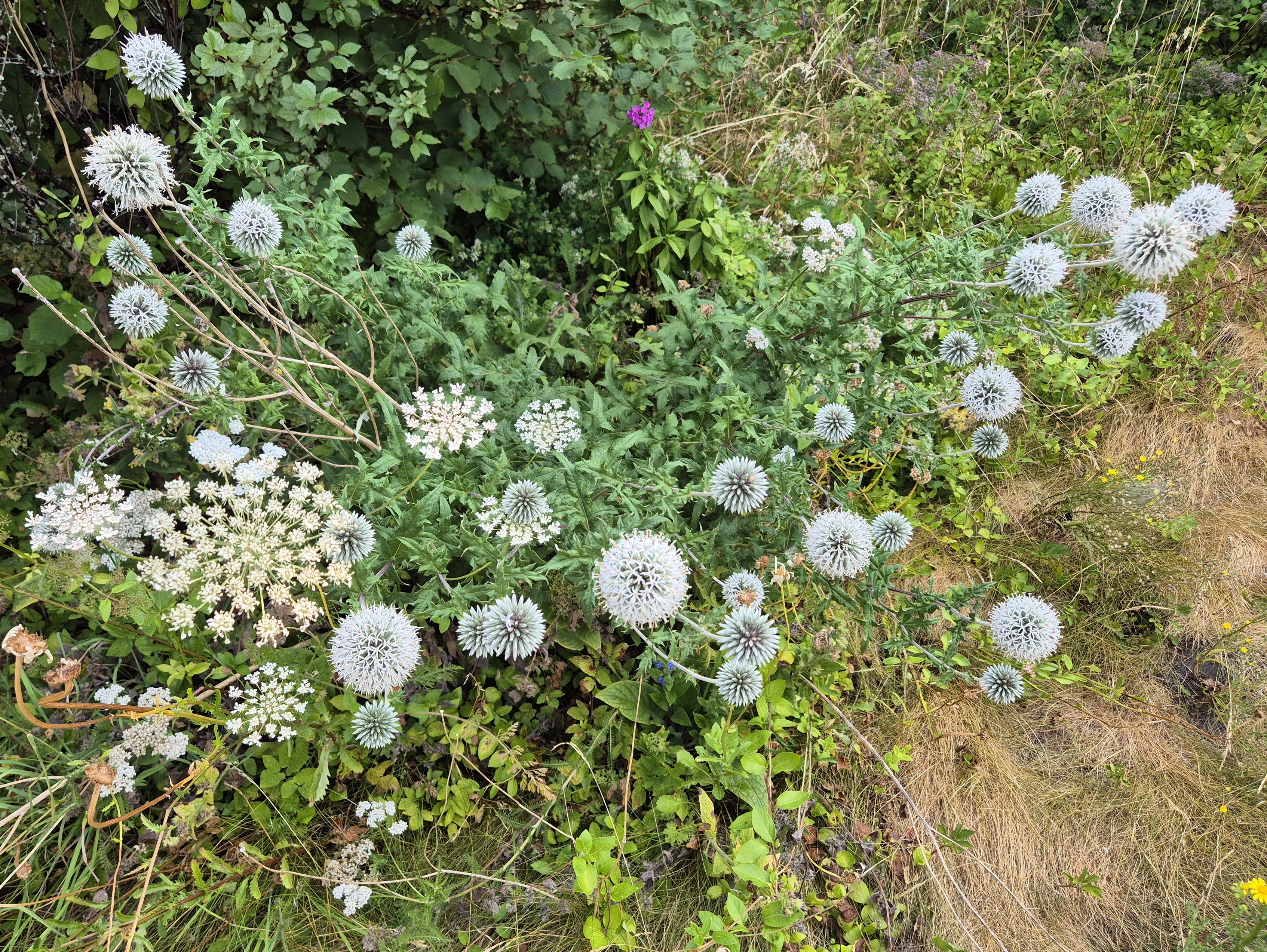
This wonderful display of Globe Thistles and Queen Anne’s Lace was a complete surprise in the garden this morning. I think they make a great combination and are much more splendid and interesting than any number of fancy cultivars.
A lot has been happening. I remained as oblivious as I could to the football. Andy Burnham’s rise to power has been vexing me however. I am no fan of Starmer and do not disagree with some of Burnham’s plans, but the whole shebang exposes, to my mind, a huge weakness in our electoral system. We are of course invited to vote for political parties, not their leaders, and this is not about whether or not I am in favour of particular, actual policies, it just seems unjust that we are subjected to yet another new leader who is effectively unelected with new policies that we definitely did not vote for. I believe that any change of leadership in a governing party should automatically trigger a general election. And we have had rather a lot of this in recent years: since 1990 we have had John Major, Gordon Brown, Theresa May, Boris Johnson, Liz Truss and Rishi Sunak.
Stepping back from politics, there’s more good news about Pine Martens here:

Shrubsole (Guy). The Lost Rainforests of Britain, William Collins, 2023. This was recommended by a friend in our badger group, although Shrubsole himself needed no endorsement – I have praised him often in this blog and elsewhere, not least for his brilliant exposés The Lie of the Land and Who Owns England? This latest has encomia from none other than both George Monbiot and Chris Packham on the cover. I was pleased to notice the Jay on the cover too, an important planter of trees.
As ever he is passionate about his subject and his descriptions of the rainforests so vivid as to take the reader right there. He explains that temperate rainforests have been excised from our cultural memory and that only fragments remain. Much of the book records his attempts to map them properly for the first time.
Rainforest oaks are different from those elsewhere in England: “stunted and small, windblown and ganrled”, “often bent and contorted into outlandish shapes”. Think Arthur Rackham and Tolkien.
Key indicators of rainforests are epiphytes, a word new to me, plants that grow on other plants such as lichens, bryophytes and ferns. Shrubsole is astounded to see trees growing from other trees too, and an “aerial ecosystem, a kind of miniature kingdom in the clouds, sustained by the extreme dampness of the local climate.”
The word ‘rainforest’ did not enter common currency until the twentieth century – the author points out that the former term, ‘jungle’, is just too “freighted with colonial connotations”, imperial baggage.
There’s a nice mention of and quotation from Thoreau: “In wilderness is the preservation of the world.”
There are several answers to the question as to what happened to our rainforests. Those responsible include medieval tin-miners, Victorian charcoal burners and sheep, but some were destroyed much more recently by landowners and the Forestry Commission in order to profit from timber production.
Shrubsole also quotes from John O’Gaunt’s deathbed speech from Richard II. And there are many references to Tolkien, his Fangorn Forest and the Ents.
There’s are useful and memorable bits of etymology. The word ‘amateur’ tends to be used disparagingly but we are reminded that it derives from the Latin for ‘love’, so an amateur who enjoys nature should not be too readily dismissed. I also didn’t know that the suffix in many plant names ‘-wort’ means ‘worth’ and comes from the plants having perceived medicinal value. The word ‘druid’ turns out to mean ‘knower of oak trees’.
German biologist Ernst Haeckel comes up too, the first to coin the word ‘ecology’ and a lichen enthusiast and illustrator amongst many other things, including providing inspiration for the Art Nouveau movement. See here for more: The Abyss – Animal Wild
Here’s an example from Kunstformen der Natur, 1904:

John Ruskin is also cited for his illustrations, such as Study of Gneiss Rock, Glenfinlas, now in the Ashmolean, (the detail cannot really be seen here):

And his extraordinary Study of Moss, Fern and Wood-Sorrel, upon a Rocky River Bank.
I always have to remind myself of the meaning of ‘montane’, a distinct ecological zone comprising forested mountain slopes.
I am no stranger to the whims of collectors, not least my own, and I love ferns, but the Victorians predilection for obsessive, destructive collecting is typified by ‘fern-madness’ or ‘Pteridomania’ which “spread into every aspect of Victorian life”.
Photographs in the books do justice to the ‘green cathedrals’ Shrubsole comes to love so much.
Wordsworth angrily described deforestation to make way for agriculture and industry and degradation by sheep, so eloquently reiterated by George Monbiot. There is some overlap with Monbiot’s Feral here and what Shrubsole says about Tolkien and his citations of Macbeth are not new to me but that is course no fault of his (one tiny criticism is that there is occasionally some repetition or two which could have been dealt with by more careful proof-reading).
In Chapter 7 the author meets Alan Lee, superb illustrator of Tolkien’s Middle-earth and his enthusiasm is almost palpable. Tolkien as early environmentalist is not to my mind a fanciful notion and Treebeard is an eco-warrior. Historian Meredith Veldman points out that “Tolkien depicted the trees not as mere lumber but as living beings whose murder causes sorrow throughout the ancient forest of Fangorn.” Ancient woodlands have long been felled to be replaced by relatively lifeless conifer plantations – all for the sake of filthy lucre.
We are urged to limit the import of ‘exotic’ plants and conifer saplings in particular which has “opened a Pandora’s box of novel tree diseases.” Another threat to our woodlands. Shrubsole argues too that rewilding is not simply about letting go – we need to correct past errors, by taking out conifer plantations for example, and “set in train natural processes so that the ecosystem can take care of itself again.”
He seems to love words as much as I do and there’s a short list of some of the many Scottish words for rain: dreich (dreary and dismal), smirr (a fine drizzle), spindrift (spray whipped up by the wind), stoating (raining so hard that raindrops bounce off the ground) and, slighlty at a tangent, drookit meaning “totally, utterly drenched.”
He also takes apart a widely held belief about our problematic deer populations. Deer-stalking does not reduce populations: large numbers of animals make for easier ‘sport’ and some sporting estates historically introduced non-native species like Sika and Fallow who inevitably escaped into the wild.
Rhododendron, an ecologically disastrous invader was introduced here by a Dutch collector in 1763 and remains of great concern.
The author does not neglect to mention the Clearances which removed people from the land and also “sundered their connection to nature.” The landowners brought in monocultures for profit and sport. In Scotland, “Sheep, deer and and rhododendron ravaged many of the surviving rainforest, erasing places once cherished by the Gaelic-speaking peoples who lived in their midst.”
The penultimate chapter deals with bringing the rainforests back. It is not impossible as the example of Merlin Hanbury-Tenison has shown at his farm by Bodmin Moor. And he now makes more money from his audacious new approach than he did from when the farm was just a regular farm.
Botanist E.O. Wilson once said: “Destroying rainforest for economic gain is like burning a Renaissance painting to cook a meal.” It almost goes without saying that the impact on the climate crisis and biodiversity of restoring rainforests would be hugely beneficial. They are special, even sacred places.
It is hypocritical that we are quick to criticise developing nations regarding conservation but cannot seem to tolerate the reintroduction of our own apex predators but do tolerate huge sporting estates trashing our uplands. The loss of rainforests has been a cultural tragedy too – they have inspired some of our greatest myths and legends and much else besides. They need more legal protection from what threatens them and political awareness and involvement, and they need reconnecting, which is possible through natural regeneration. Shrubsole provides details of many practical means by which we could at least make a start. As I often say, now would be good. Admirably, he is getting heavily involved. And he says that “the growing appetite for change is palpable” although the pace is still far too slow. “Rainforests aren’t just someone else’s problem; they’re right here on our doorsteps. And we shouldn’t simply seek to save them but to restore them, Our mission must be to bring back the lost rainforests of Britain.”
Leave a Reply