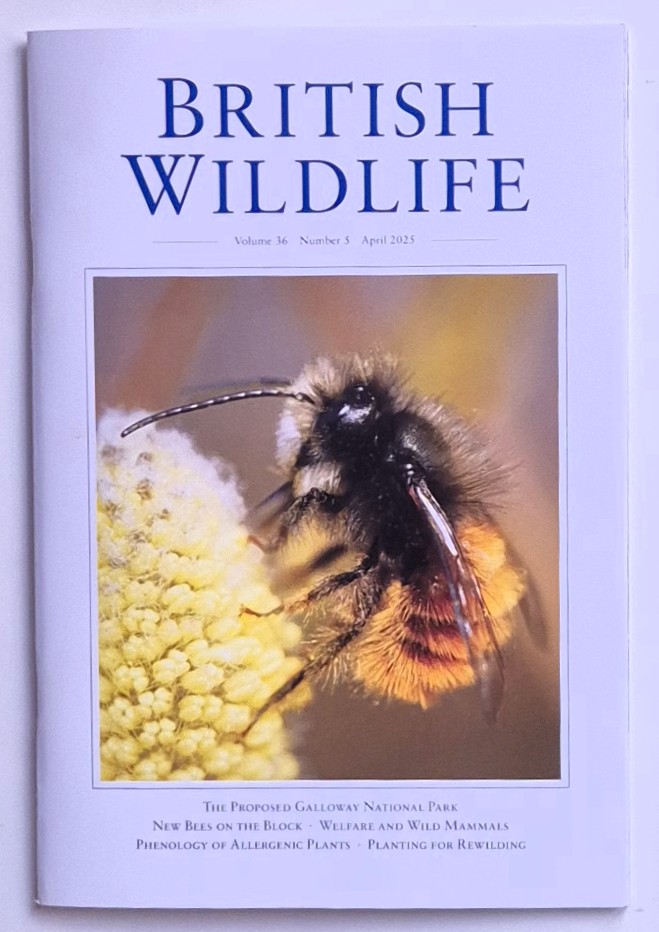
Volume 36, Number 5
Galloway National Park? The myth that our national parks are currently of any benefit in terms of wildlife and conservation have long been busted wide open. Ian Carter writes about the proposal for a new park in Galloway, Scotland. It’s a crucible. Will it be like the ones we already have, something much better, or will it not happen at all? Much of the land is used for livestock farming, especially dairy and that is intensifying – larger herds and more cows being kept indoors for their whole lives. Wildlife is suffering. On the hills there are vast conifer crops. Apart from the SSSIs which may fall within the park’s boundaries, there are only fragments of “semi-natural” habitat. There are possibilities for a good outcome involving planning restrictions, grants to landowners and protection and enhancement of significant conservation areas. But … there’s a “NO” campaign and it’s powerful. Landowners do not want to relinquish even a smidgeon of control and some locals simply don’t want an increase in visitor numbers or any sense of “a new regime being imposed by ‘outsiders’”. There have been suggestions that anonymous wealthy landowners may be financing the campaign. The “hard-hitting PR firm” is being paid for somehow. The worst outcome says Ian Carter would be another national park that does no more for wildlife than those which already exist.
The bee on the magazine’s cover is a European Orchard Bee. Steven Falk tells us of fourteen additions or reinstatements to the British list since the publication of his & R. Lewington’s Field Guide to the Bees of Great Britain and Ireland in 2015. The names are so good it seems worth listing them here: Water-dropwort Mining Bee, Kirby’s Mining Bee, Red-bellied Mining Bee, Viper’s Bugloss Mason Bee, Hawk’s-beard Nomad Bee, Sandpit Nomad Bee and Variable Nomad Bee, Dusky-horned Nomad Bee, Bilberry Nomad Bee, Cryptic Green Furrow Bee, European Orchard Bee, Giant Blood Bee, and Smooth-saddled Dark Bee. One of the volunteers at HART Wildlife Rescue regularly posts great photographs of bees (and much else besides) and there are similarly excellent images within this piece.
The RSPB contributes advice on the proper management of hedges. It is not straightforward, but their being mechanically flailed to within an inch of their lives is certainly not the answer.
Steve Harris wonders why wild mammals are not treated more like wild birds who are at least protected by law to some extent, especially in terms of how and when they are caught and killed. Gin traps were made illegal in 1958 in England and Wales but for foxes and otters in Scotland not until 1973. As though the traps discriminate. Between 1950 and 1953 40 millions rabbits were caught each year in gin traps or snares. Using snares to catch deer was not outlawed until 1963 (the Deer Act) and for some but not all species close seasons were introduced. Badger and bull baiting were made illegal in 1973 but the field sports lobby successfully campaigned for badger digging to continue with the permission of landowners until 1981. It was only in 2002 in Scotland and 2005 in England that the exemption allowing foxhunts to block setts was removed, but of course it is still going on. Those lobbies also objected to the Wild Mammals (Protection) Act of 1996, the aim of which was to make cruelty illegal. No comment necessary.
Close seasons are intended to prevent killing in the breeding season which would leave young to die. In Europe these restrictions exist but in Britain, again largely thanks to the shooting lobby, the shooting of foxes in their breeding season is actually promoted. Hares can still be killed year round in England and Wales and the shoots take 40% of the Brown Hare population including “significant numbers of pregnant and lactating does.” Killing Mountain Hares to protect Red Grouse is fine, but you do now need a licence. Are we or the hares to be grateful for that small mercy? Using strychnine to kill moles was widespread until 2006. Anticoagulants it is now well-known enter the food chain, affecting not just the target rodents. Of course there will be a lot of rats if there are 47 million pheasants to feed with up to 376,000 tons of feed. “A shooting estate on the South Downs requires its four gamekeepers to kill a staggering 10,000 rats a year…” The use of hideously cruel glue traps was banned in England in 2024, but it was still ok to sell them and in Scotland they can still be deployed.
Spring traps, which may or may not kill animals relatively humanely (for many types this has not even been tested and deaths are very far from humane even in ‘compliant’ Fenn traps), are supposed to be placed in tunnels to minimise the effect on non-target species, but more and more are being seen on posts and rails, or across streams and ditches. Then they are of course not selective at all. And they are supposed to be checked every 24 hours but that, even in my own limited experience of seeing the results, doesn’t seem to happen very often. “On Scottish grouse moors alone, it is estimated that 81,500 (49,700 target, 31,800 non-target/protected species) to 160,800 animals … die each year in rail traps, with a further 21,000 to 65,000 dying in spring traps set on the ground, about half of which are non-target/protected species.”
We fall behind most of the rest of Europe as usual too when it comes to neck snaring. In spite of the claims of shooting organisations, from 1996 to 2022, the populations of Red Foxes and Curlews and Lapwings declined by about half.
In England and Wales, again woefully behind Europe in these matters, firearms licences are granted without there being any sort of proficiency test. That’s over half a million people licensed to kill none of whom have known levels of competence. And of course we know how effective banning foxhunting and hare coursing has been – hardly at all. “There has been a long history of resistance from the farming, hunting and shooting lobbies to efforts to end unnecessary or cruel methods of killing wild animals.” Our current government is clearly not in any hurry to end this terrible state of affairs where the horrors continue almost unabated.
Elsewhere in this issue are a calendar of flowering dates of allergenic plants and a prose ode to Wild Garlic by James Robertson. Amy-Jane Beer visits a nature-friendly farm and Max Coleman looks at the arguments for and against planting in wilding projects – how purist should we be? He concludes that it should be a last resort and only carried out with great care and attention.
Simon Barnes reminds us that Rachel Reeves told us in 2001 that she was going to be “Britain’s first green chancellor. No sooner does she get her feet under the desk than she outs herself as anti-nature.” The trouble with saying that the so-called housing crisis is a myth fabricated to assist the flow of capital from the many to the few is that it might sound as though you don’t care about the homeless. Those are the mind games these people play. Labour has just blocked making the installation of swift bricks mandatory in newbuilds. See here: Wildlife Miscellany: Octopuses, Elephants, Beagles, Swifts, a Badger and more – Animal Wild It’s completely nuts. And tragic. A cheap and simple solution to a problem which the party actually supported in 2023. But, no. Housing minister Matthew Pennycock has decided on behalf of all of us that “We are not convinced that legislating to mandate the use of specific wildlife features is the right approach, whether that is done through building regulations or a freestanding legal requirement.” Starmer, having learnt that he can lie without consequence, now does little else. We have all been and are being gaslit. This programme removes any scinitlla of doubt as to whom the Planning and Infrastructure Act is intended to benefit:
Watch Again: Homes for Everyone and Nature Too | Live Panel, Hay Festival
The panel consists of Kevin McCloud who rather repeats himself and goes on for too long although he makes salient points, Sarah Lampy, founder of the homeless charity Shower Box, Rosie Pearson of the Community Planning Alliance who really knows what she’s talking about, and Chris Packham on particularly fiery and resolute form. I wondered if he was actually going to call for a revolution. He does say that we may all have to consider passive resistance, the planning act will take no prisoners. Here is what’s possible:
– 1.5 millon+ derelict homes renovated.
– 1 million+ unbuilt homes already with permission, built.
– 1.2 million homes developed on brownfield sites, first.
– 165,000 empty commercial properties repurposed.
– Millions of homes left undisturbed for nature.
– Country’s entire carbon budget not used up.
As Rosie Pearson says, Starmer’s notion of a “grey belt” is yet another of his deceitful inventions. The building industry (there is a three business cartel when it comes to newbuild housing) can’t possibly deliver 1.5 million homes in the prescribed timescale, nor would it be in their interest to do so. How would they then make money if the problem is solved? They can get away with pretty much anything simply by saying that regulations don’t allow them to make sufficient profit. “Affordable” housing is a chimera too. And a staggering proportion of the wildlife protection measures still in place are simply and routinely ignored. This is not what people want.
Chris Packham: “if that bill goes through we’re in deep trouble and frankly you need to get your chains out because you will need to be tying yourself to trees and you will be needing to sit down in front of bulldozers because frankly that’s the only way we’re going to stop it, we’re going to have to stand up for those newts and bats and the arachnids … and we’ll have to do that at community level and again why this government thinks that there aren’t people in this room or sat on this stage that won’t do that I honestly don’t know…”
Following the extraordinarily extensive and detailed wildlife reports, in conservation news, we learn that DEFRA is dragging its heels on banning the use of lead shot – they are late even responding to the recommendations, whilst in East Anglia industrial livestock farms, intensive pig and poultry units, have breached regulations more than 700 times in the past seven years. On top of all this, the Sustainable Farming Incentive was quietly closed to new applications in March. The government isn’t just not protecting biodiversity, it seems to be waging war on it.
There is some good news at least in the Wildlife Crime section – and end to Natural England’s controversial Hen Harrier brood-meddling scheme, an extension of the Ivory Act to cover five more species (hippo, walrus, narwhal, orca and sperm whale), a presumption against the licences for taking wild birds of prey for falconry purposes, proposed guidelines which would increase sentences for hare coursing and a petition to ban dangerous pesticides in Northern Ireland. Helen Scales writes movingly about rises in whale numbers even around own own shores. Their migratory routes seem to be changing, perhaps following the shifting ranges of their prey but they are exposing themselves to increased risk from ship strikes and fishing nets, especially in the English Channel and North Sea. Could this though be from “…memories of ancestral routes … lodged in the minds of living whales, somehow passed down between generations”? That doesn’t seem terribly unlikely to me.
Leave a Reply