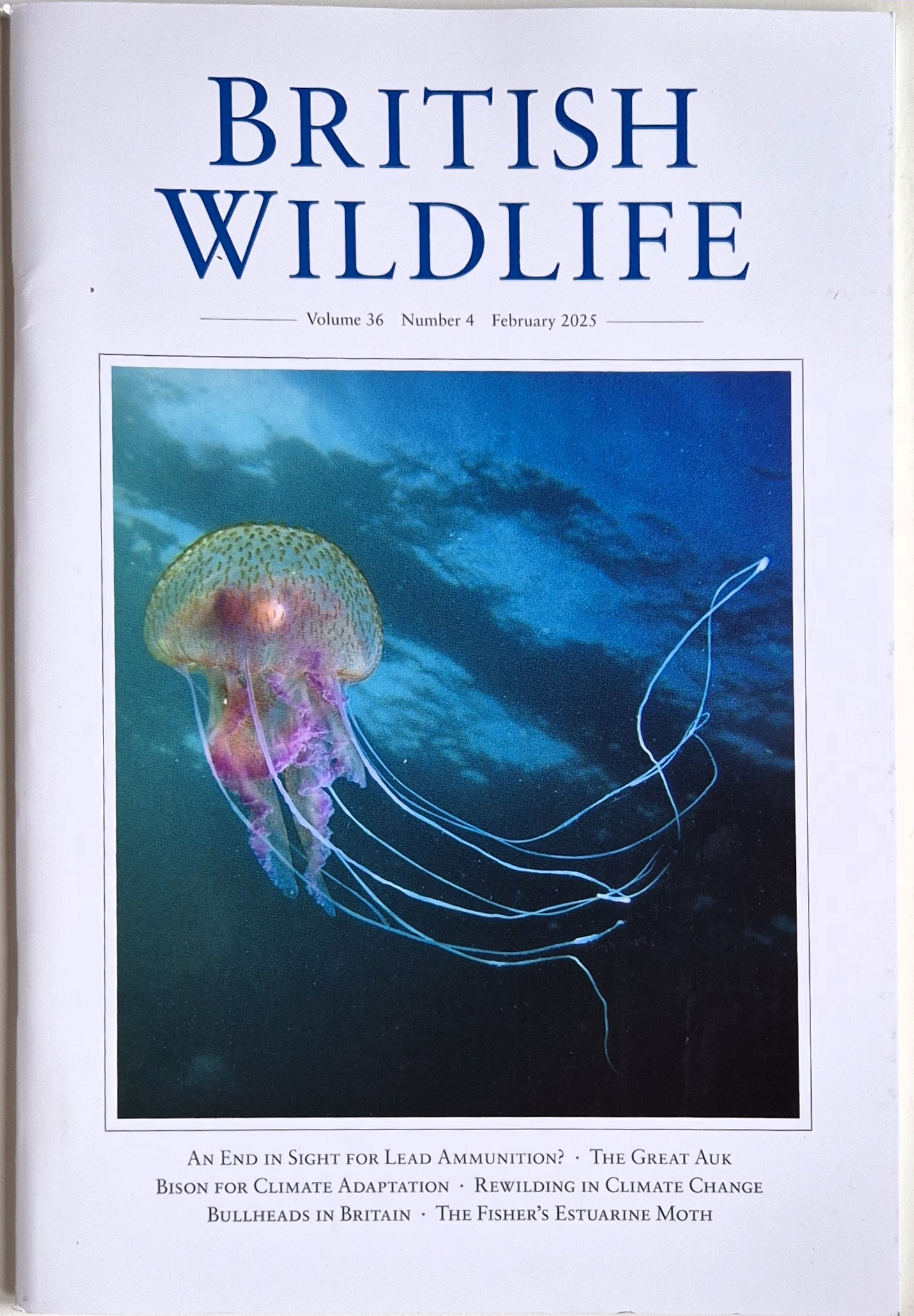
Volume 36, Number 4
Tim Birkhead contributes “A portrait of the Great Auk”, only ever seen by just one or two scholars and ornithologists. It was driven to extinction in 1844 by dealers and museums and it is far from clear what it actually looked like. There seem to be just two images drawn from life from the seventeenth century, neither of which are terribly good or accurate (beaks the wrong size, plumage incorrect and so on). The name of the bird is thought to be onomatopoeic from their calls. In 1985 however three images were found on a cave wall near Marseilles which may be as much as 19,000 years old. Great Auks (Pinguinus impennis) were large, flightless and tasty – they never really stood a chance against us, after their meat and feathers. Taxidermists did little better with their efforts to represent the birds. Tim Birkhead thinks Edward Lear’s image for John Gould’s Birds of Great Britain, 1832-1837, is probably the best we have.

They are thought to have stood at around 80cm or 31.5 inches tall. They remain highly prized: an egg was sold in 2021 for £100,000. Theirs was the first extinction it took for us to realise that these things could happen through human activity and indirectly led to the Seabird Preservation Act of 1869 and “the beginning of bird conservation”. They are not closely related to penguins, that’s a case of convergent evolution, but closer to Razorbills and guillemots, indeed penguins were named for their resemblance to the Great Auk.
I can always rely on this magazine for a new word or three, this time it’s “allopreening”, social or mutual as opposed to self-grooming.
The author’s book, The Great Auk, Its Extraordinary Life, Hideous Death and Mysterious Afterlife is out soon and I have just pre-ordered a copy.
Brett Westwood in his “Natural reflections” feels as I do about twitching (to be avoided) amusingly describing a cul-de-sac as “khaki with rainwear and bristling with telescopes” and wonders if it might actually cause harmful disturbance. Similarly, rare orchids can get flattened and naturalists are understandably becoming reticent about revealing locations of rare birds and plants, just as I would not disclose the location of a badger sett except to someone I trusted completely – there are too many people out to kill them or use them for badger-baiting.
Evan Bowen-Jones makes a powerful case of what we need to do to avoid the complete collapse of our ecosystems, focussing on the release of European Bison in Kent. We need to think big, especially in terms of using keystone species, ecological engineers. Pieces on heathland relocation and conservation in a time of climate change follow, appropriately enough. It is all scarily urgent. I shouldn’t hurry past them but these are matters of great complexity, too much so to attempt to summarise here.
The wonderful Amy-Jane Beer (see my multi-part review of her book The Flow in this blog) writes about “Our missing lynx”. The pace of change, of reintroductions, is so glacial, it is little wonder some people take matters into their own hands. “It speaks volumes about the way in which landed interests dominate the legislative process through insider connections and lobbying power. There is a financial element of course encompassing incomes from shooting and big agriculture, and land as investment and tax dodge.” But 50 million non-native birds every year? No problem at all. Again, we really need to crack on with all of this. We would probably still not have free-living beavers in Britain without the unsanctioned reintroductions happening first. As I wrote in an earlier post:
The very last chapter discusses the reintroduction of wolves and lynx. I am hugely in favour of both. See below for an extract from Animal Trust on the shortcomings of the National Farmers Union and a certain dairy farmer in particular whom I was kind enough not to name on the basis that it was unfair to single her our for a profound stupidity and lack of vision which she presumably cannot help. Minette Batters though, until recently president of the NFU, having put herself in that position of authority and public trust, seems fair game. She also betrays the fear and hatred of wildlife that seems to run through the industrialised farming industry and in no small part through farming before wholesale mechanisation. The lynx, she said, would create “a danger to the public on walks around the countryside.” How, exactly? Our authors point out that “There’s not a single record of a wild lynx attacking humans – nowhere, ever, under any circumstance.”
Beaver bombs part II – Animal Wild
Pádraic Fogerty introduces another twist: since there is no evidence that they have ever existed in Ireland, should beavers be introduced there? To say that they should not, he suggests, is needlessly dogmatic.
Mark Everard and Josh Pickett tell us at length about the Bullhead, a rather strangely shaped freshwater fish (the only sculpins in Britain which do not live in marine habitats) which is entirely carnivorous, largely solitary and capable of existing in complete darkness. The female lays eggs which the male fertilises. He then drives her away and looks after the brood himself for several weeks. The taxonomy is “complicated and contested.” The authors suggest that a charisma shortage may in part be responsible for the slow acceptance of genetic and other evidence of speciation.
Zoe Ringwood and Mark Iley give us an in-depth study of conservation action and habitat creation which have taken place to benefit the previously little-known Fisher’s Estuarine Moth. The moths are dependent on Hog’s Fennel for food and since neither can tolerate a saline environment, sites need to be created which are free of the risk of coastal flooding. There has been a great deal of success. Let’s hope Rachel Reeves doesn’t get to hear about them or she might add them to her list of the wildlife she considers irrelevant and unlikeable.
In the Conservation News section there is mention of the dangers of flea treatments, i.e. insecticides, on pet’s fur which can be used by birds for nest building. I recently read elsewhere of the harm this does when dogs enter ponds, rivers and streams. Grey Squirrel populations are on the rise. They are invariably contentious but one tabloid article went too far, comparing them to the Reds as “vicious grey critters” who “attack birds’ nests, eat their eggs, kill their young and also damage trees by stripping their bark, all while pushing out red squirrels.” All squirrels are opportunistic omnivores, but whether they are red or grey is irrelevant in the context of course. Yet again, animal agriculture is causing problems, this time in Ireland, where nitrogen run-off has led to a collapse in the ecology of Lady’s Island Lake. Other freshwater bodies are also suffering untold harm. “Planning and infrastructure” is almost too depressing to repeat, but 59% of local authorities in England are not meeting their ‘biodiversity duty’ and as I have said elsewhere, a report suggests that “47% of environmental enhancements promised by developers were not present.” I remember all too well challenging developers to tell me more about the “eco-pond” they promised for a new housing estate in the village. How big was it going to be, for example? After considerable pressing, the developers, or rather their firm of spin doctors hired for the purpose (what a way to make a living), conceded that it wasn’t really any such thing, it was just a run-off. They also conceded, to my surprise, that the housing shortage they cited was a myth. At least this government has turned down yet a other request from farmers to continue using neo-nicotinoids, the bee-killing pesticides, in 2025. But it looks as though there as well be no planning rules or safeguards at all in the not too distant future, not that they were terribly effective anyway, with the aim being to push local councils out of any debate altogether. Hannah Bourne-Taylor in “Changing perspectives” asks us to raise our voices for mandatory cavity nesting spaces’ inclusion in newbuild housing regulations (such a simple and inexpensive thing), but is not optimistic after her two-year campaign. House Sparrows, Starlings, House Martins and Swifts are all red listed and risk extinction if the government will not listen.
The only reference I can find to jellyfish in the magazine is in the news that they are doing well, thriving on the nutrients in coastal waters from industry and agriculture and faecal waste from farmed salmon. I had thought the cover photo was of a Lion’s Mane Jellyfish, “The Adventure of the Lion’s Mane” being the Sherlock Holmes story where the great detective identifies one as the killer of a local teacher. I once sold the original manuscript of the story for a large six-figure sum. The catch is that they do sting but are not generally fatal to humans. I swam out rather too far off the French coast with a friend back in my student days and we encountered one. We were instinctively terrified and swam back to shore as fast as we could. The creature is identified on the back cover, it is in fact a Mauve Stinger. They can deliver long-lasting, painful, albeit non-fatal to human stings and are bioluminescent. Swarms have been known to wipe out entire fish farms (which is ironic in light of the above).
The wildlife crime roundup by Dr Ruth Tingay of Wild Justice and Raptor Persecution UK neatly summarises the abysmal failure of NatureScot’s grouse shoot licensing scheme – not a single one of the promised compliance checks has been carried out. The good news is that the entire shooting industry is under attack like never before this year and it isn’t looking good for them in terms of the financial and other failures of the shoots and public opinion. Wire snares are now banned in Scotland, as in Wales, but I wonder how effective enforcement will be. Nor does Dr Tingay neglect the shameful secret deal between the Warwickshire Police and Warwickshire Hunt, which I wrote about in Animal Wild. A report was finally published in January this year after two years’ of campaigning, parliamentary questions, serving officers speaking up and a feature on Channel 4 news:
Another e-mail from the HSA days later explains that a senior officer stepped in and came to a ‘gentleman’s agreement’ with the Warwickshire hunt, producing the following watered down, non-legally binding protocols:
- Warwickshire Police have agreed to forewarn the Warwickshire Hunt and give them a heads-up an hour before if they intend to come out and police the hunt.
- The police have agreed to inform the hunt if any complaints have been made against them.
- The hunt has demanded monthly meetings with a Chief Inspector.
- The police have agreed that the hunt can have an on-demand liaison officer for any given day.
- The Police have agreed to joint training regarding road safety with the hunt.
- From the hunt’s side, they must inform the police with a calendar of all their meets.
- They must inform all members of the hunt of their responsibilities regarding dogs on the highway.
As a result, thus emboldened and enabled, the Warwickshire hunted and killed a fox on 9th October 2023 according to the HSA, in spite of the best efforts of saboteurs. Special treatment for the elite? Surely not. Except that the police don’t usually forewarn criminal gangs of their presence in advance, provide gang leaders with meetings with a Chief Inspector, promise them a liaison officer whenever they like, nor give special training, all of course at the taxpayers’ expense. I am sure the fact that the Police and Crime Commissioner for Warwickshire is a member of the Countryside Alliance had nothing to do with it, there is no conflict of interest there..
There are now calls for a proper enquiry.
And finally, just because, this was one of those evening skies which just called out for a photograph.

Leave a Reply