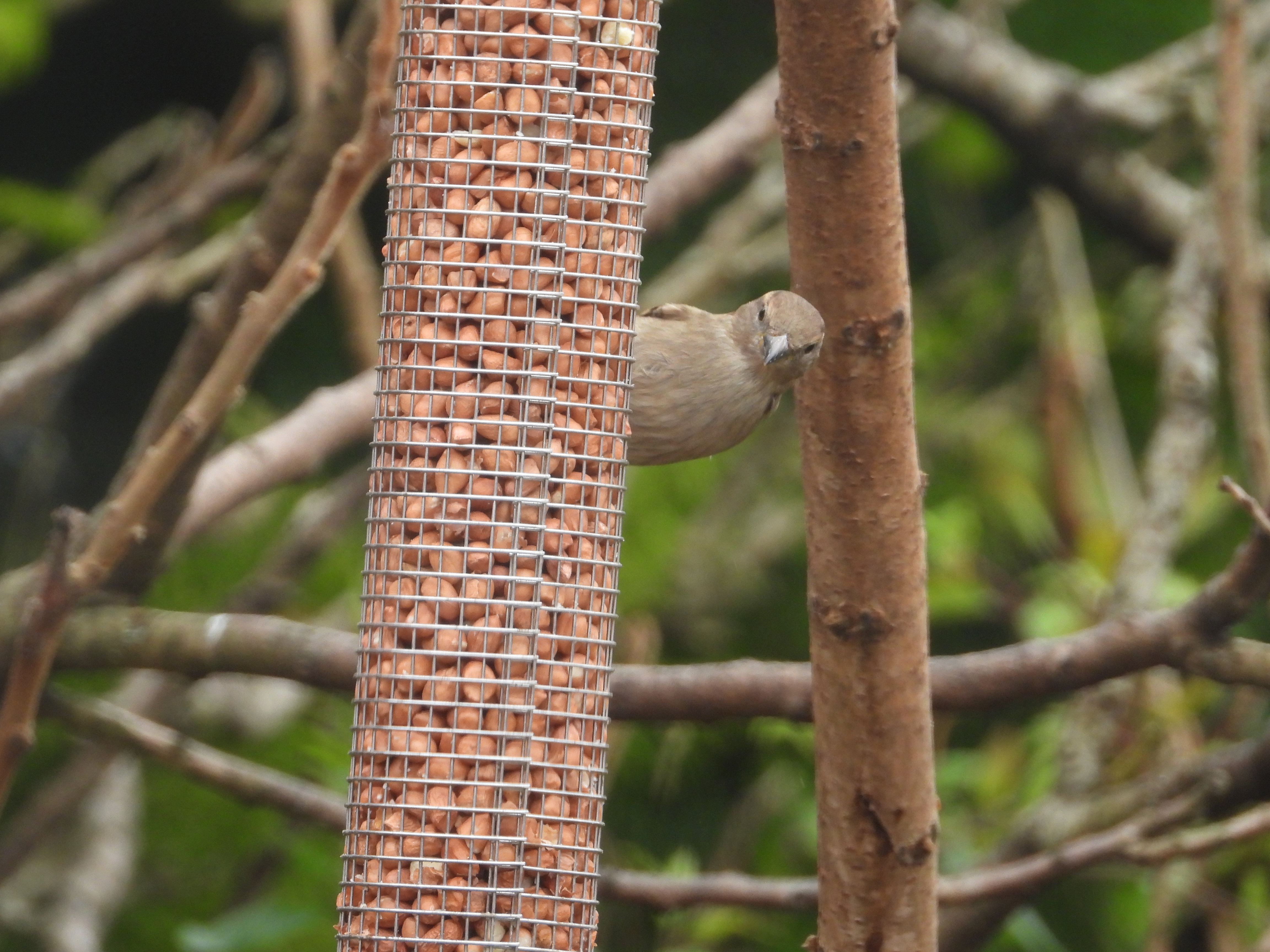
I do think this female House Sparrow seems to have attitude, as in “What do you think you’re looking at?”
BirdWatch magazine
Bird Watch magazine is here again, issue 394, April 2025. I think I am coming to an end with it. It seems increasingly to be almost all about twitching rarities. That’s not really a criticism, it just isn’t for me and I no longer feel I am learning from it, nice enough though it is to scan through the photographs. David Campbell is pretty good on whether travelling internationally to see birds is justifiable in terms of carbon impact. Mark Avery wonders about the forthcoming Breeding Bird Atlas to cover 2027-2031 from the British Trust for Ornithology. He says that he consults the three previous heavy atlases often, but suggests a “rolling atlas programme that produces online updates every five years into the future” – the atlases are expensive to produce and to buy (I assume the BTO makes a profit on them). As a bookseller this goes against the grain, but I can’t help thinking he has a point.

Ring Ouzel
from: Morris (Francis Orpen). A History of British Birds. Six volumes. Groombridge and Sons, 1851-1857.
David Steel writes at length about the history and activities of the bird observatory on the Isle Of May which sits at the mouth of the Firth of Forth. It’s an excellent piece but even here there is, for me, too much concentration on rarities, interesting and indicative of change though their appearances may be. I would be pretty happy to see a Ring Ouzel though, on which there is a whole article by Josh Jones. They seem easy enough to identify – a large, dark thrush with a distinctive white bib and “silvery grey fringing to the flight feathers”. Susan Myers* tells us that the name comes from the Old English for Blackbird, osle, via Old German. I am not sure about the rather prescriptive statement that they “should be on the target lists of all birders out in the field this April…” I can’t pretend however that the arrival of another garden visitor species here doesn’t excite me – it does.
*Myers (Susan). The Bird Name Book, Princeton University Press, 2022.
Tim Birkhead again foreshadows his book on Great Auks, for which see here (I have my copy now and am looking forward to it):
British Wildlife magazine February 2025: the rest of the issue – Animal Wild
I am tempted by an updated edition of Field Guide to Mammals of Europe, North Africa and the Middle East, Bloomsbury, 2025, cetaceans now included (forty species), with revised taxonomies and accounts of 447 species in total, excluding the cetaceans, quite an uptick from the 401 of the previous edition of 2009. The scope is probably broader than I need but the reviewer, Ed Stubbs, describes it as “without doubt the mammalian equivalent of Collins Bird Guide, which is high praise. The authors are Stephane Aulagnier, Patrick Haffner, .J. Mitchell-Jones, François Moutou and Jan Zima. The two other books reviewed are Pocket Guide to British Spiders by Richard Lewington, Bloomsbury, 2025, and Bird Tracks, a Field Guide to British Species, by John Rhyder and David Wege, The History Press, 2024.
There are also photography advice, as usual, and a piece on hybrid birds by Chris Harbard. Wildfowl and ducks in particular are especially prone to it. And the breeding habits of Ruff intrigue: there are three genetically distinct types of male, independents, satellites and faeders, being respectively “aggressive territory holders, submissive collaborators and female mimics”. Data now shows that the males travel far and wide, some covering up to 9,000 km and visiting as many as 23 sites (parental care is entirely down to the females).
I seem to have derived rather more from this issue than i realised on my first read through, so I will not be cancelling my subscription just yet.
Bird sounds
A short piece on the frequency ranges of bird sounds reminds me of the BTO Sound ID Early Spring course. I attended the Zoom session earlier this week. The thrust of it was that the way to learn and remember is to describe, visualise and memorise. As expected, I did pretty poorly in the quizzes but I am certainly less confused than I was. There was a great deal to absorb and I am sure this is one of those things that requires practice above all. Of course the Merlin app can do all this for you (imperfectly) but that is not quite the same. The memory aids are very clever, it’s just a question of, erm, remembering them (although of course you can come up with your own). I could already manage the Wood Pigeon and Collared Dove, and will now never forget the song of the Greenfinch (I am looking at one right now, their beauty never ceases to dazzle me). Others will prove more difficult I think and what I am hearing in the garden right now are largely calls rather than songs. I have homework to do.
Water
Our utterly appalling government has again kiboshed a hope for our environment. MP Clive Lewis submitted a private Water Bill, suggesting that companies responsible for major sewage spills on a three strikes and you’re out basis should be renationalised. Emma Hardy, the minister for water and flooding, has explained that that would cost a lot of money. Over £200 bn. Another MP, Dame Meg Hillier, said: “The nationalisation argument sounds appealing to many on the face of it, but there is a cost, and it’s not a hidden cost.” Well thanks so much for enlightening me. Of course there will be a financial cost. Why would it be hidden in any way? What’s been hidden are details of the bonuses and dividends which have brought about the crisis (perhaps refunds would be in order, payable into a nationalisation fund). Plenty of money for HS2, but not to mitigate the ongoing destruction of our waterways, lakes and seas. The argument is not “appealing”. The argument is that it’s an absolute necessity, before it’s too late. Since I quoted Joni Mitchell’s Big Yellow Taxi yesterday, I’ve had it on my brain ever since, wondering how Rachel Reeves would reply to it. When she’s not too busy eviscerating the poorest amongst us.
Greyhounds
More idiocy in the paper today in the editorial comment on this subject. Greyhound racing “will soon be only a memory” the headline wistfully announces. Not a moment too soon. It will shortly be banned in Wales altogether. “Now the dogs are pampered with guaranteed retirement homes…” Pampered? As opposed to being killed or abandoned? And “… the sport is regulated by drug testing and veterinary inspections” – as though that were a bad thing. And with no hares to chase “Will the breed grow obese while the sport starves?” I can’t even be bothered to answer such nonsense. Equally bizarre was the comment from a friend who works at a dogs’ rescue centre that the cruel pastime should be phased out gradually so as not to have rescues inundated. Not only does that speak volumes about the practitioners, but it ignores that kicking these things into the long grass all too often means they don’t happen at all. In Spain there is an annual ritual whereby the galgosare are tortured to death.
Here is what I had to say in Animal Wild:
On my way northwards, I happened to notice a sign for a greyhound rescue. I screeched to a halt, turned round and drove in. Bearing in mind that this was a random visit, I did not expect a proper, guided look around, but that was exactly what I got from the manager for whom nothing seemed to be too much trouble. She clearly loves and has a deep understanding of the dogs in her care and is thoughtful and unrushed in her dealings with people. I apologise for what may seem like a betrayal of her good heart: I will therefore not name but do have a reservation about the place in that it was founded by the owner of the a major greyhound stadium and is I believe largely funded by the greyhound racing industry. There is a great deal about welfare on the stadium website, but the cynic in me wonders if there is an element of lip service here from what is to my mind an inherently cruel ‘sport’. Certainly I would not decry the work being done – over 2,500 ex-racing dogs rehomed since foundation in 1999 is 2,500 better than none. I have no experience of tracks and stadia myself and wouldn’t presume to comment on how the dogs at that particular stadium are generally treated, but PETA’s article on the subject makes grim reading. In America, there were over 15,000 documented injuries between 2008 and 2018. The real figure is almost certainly much higher. Florida was home to over half the tracks in America, but the requirement to report and record injuries is relatively recent. In that state alone more than 1,000 greyhounds have died on tracks since 2008. Thanks to the instigation of the greyhound protection organisation GREY2K USA Worldwide and its more than a quarter of a million supporters though, dog racing is now outlawed in 41 states. There were 60 tracks, “soon there will be just two.” According to the campaign website “End Greyhound Cruelty”, in the UK in 2019 there were 4,950 injuries and 710 deaths. The League Against Cruel Sports records at least 120 deaths and 4,422 injuries in the UK in 2021, and in their 2014 report the main findings included small, barren kennels, lack of proper, basic care and health care, ineffective industry sanctions, poor maintenance of tracks, and revealed that thousands of retired dogs are ‘unaccounted for’ in spite of many being successfully rehomed. I think and hope it will all go the way of bear-baiting eventually. There’s a campaign right now (July 2023) gathering signatures by the League Against Cruel Sports to have it banned in Scotland. It has always seemed very strange to me that any animals are forced to race so that people can bet on them, the outcome depending merely on who is the fastest. I just don’t see how that is in any way interesting.
Leave a Reply