This was a recommendation from another volunteer at HART Wildlife Rescue. At HART a female Mallard has been taken in having been found impaled and immobilised by two fishing hooks (one with three prongs), the line wrapped around or somehow attached to a tree. Some anglers think nothing of abandoning their gear like this, used in their peculiar “sport” of hooking fish by their sensitive mouths, hauling them out of their element and then, for some extraordinary reason which I have never understood, throwing them back. Either eat them if you must catch them this way, or leave them alone. The finder intends to report the anglers to the landowners. The hooks have been successfully removed and she is on pain relief and antiobiotics but as of Monday the duck, in the isolation room where I spent the morning, is not eating anything, presumably because she is so traumatised. This week at least, rather than failing to weigh a pigeon as I did last time, I successfully weighed three without too much drama (just a few feathers in my hair): two Feral Pigeons and one Wood Pigeon.
The impressive statistics for HART in 2024 are these:
3230 patients in total, including
575 hedgehogs
130 birds of prey
197 waterfowl
51 swallows and 40 house martins
61 wood mice
Others were songbirds, including corvids, foxes and more.
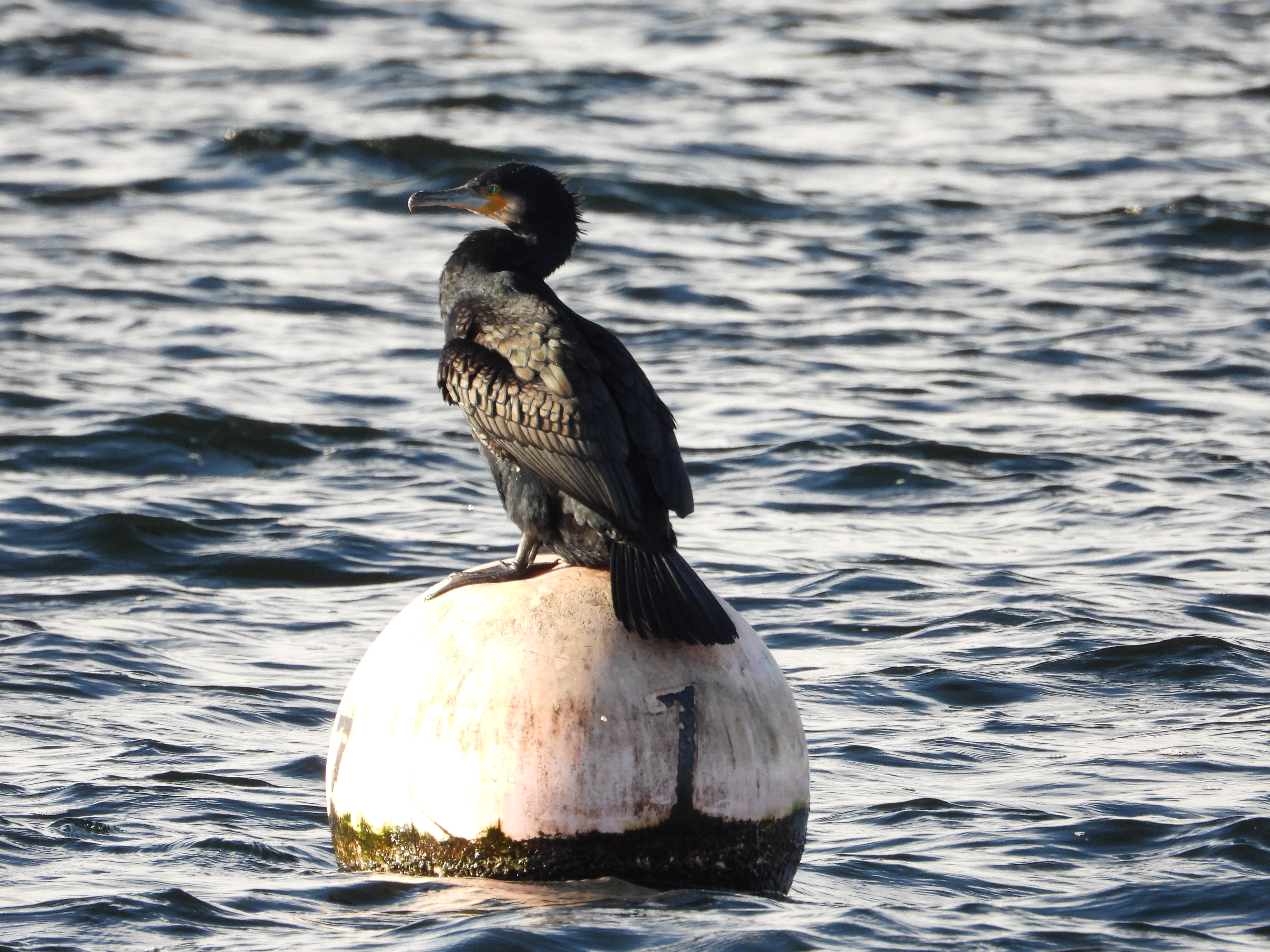
On Tuesday I decided to take advantage of the bright sunshine and headed for Farmoor Reservoir, which lies between Eynsham and Cumnor in Oxfordshire. I imagine it would look a bit grim on a wet, grey day, but it looked lovely and in spite of my initial doubts, there were a lot of birds. Hundreds of Tufted Ducks and many hundreds of Coots – it was Coot central. I would not be surprised to be told there were 1,000. There were at least two Cormorants (one pictured at the head of the post), possibly four. They are large birds but also powerful fliers reaching speeds of 30 to 35 mph. The reservoir is roughly 0.7 miles wide and a mile long, bisected by a causeway, short work for a Cormorant.

Tufted Duck


Tufted Duck and Coot
No matter how many times I see a Coot on land, I am always surprised by how long their legs are. They seem a bit out of proportion.


I was very happy to see this solitary Great Crested Grebe, the crest a mere hint at this time of year.
The Cormorants were a delight:


I had seen a Kestrel hovering over the verge of the A road on my way up, here was another just beyond the reservoir.


Not my best pictures of a Pied Wagtail, but this one was extremely unobliging. It took me ages to get even a halfway decent shot but if I had carried on any longer I felt I would have been harassing the bird.


I am generally reasonably confident in my corvid identification but I am still not 100% sure about these. Either juvenile Rooks or Carrion Crows. Even Collins Bird Guide admits that they are very hard to differentiate and that in flight the differences are minute. Adult Rooks have paler beaks but according to Collins the culmen, the upper part of the beak is the best hope, straight for the Rook, curved for the Crow. I have already changed my mind a number of times, but on that basis I will hazard that these are immature Rooks. But I could be wrong.

Farmoor Reservoir is owned by Thames Water and whilst for obvious reasons I am not anxious to be fair to them, they do seem to look after the place for wildlife and there are even hides. It will be good to revisit at different times of year. The website suggests that January will bring Water Rail and Little Egret but there were none on my visit.

A rather outrageously artificial use of the exposure dial to create atmosphere but I couldn’t resist.
I stopped for lunch a rather lovely old hotel and pub, The Bear and Ragged Staff (“ancient fireplaces, flagstone floors and mullioned windows with carved lintels”). I liked the idea from the menu of a “smidgen” of cheese (actually rather more than that), a word which came up in a crossword recently and had me wondering if I had been misspelling it all my life, but it seems variants are acceptable. I wondered about the name – there are lots of pubs called The Bear, but what was the ragged staff all about? The bear and ragged staff form the heraldic emblem associated with the Earldom of Warwick and feature on the county flag. Wikipedia tells us that the ragged staff “is believed to refer to Morvidus, an early legendary Earl of Warwick who is said to have slain a giant with a young ash tree torn up by the roots.”
On my way home I happened to notice a large banner protesting the proposed building of another reservoir, Abingdon Reservoir. The Group Against Reservoir Development claims that 53 miles of hedges and lines of trees, 200 ancient trees and 36 miles of watercourses would be destroyed.
Their website, abingdonreservoir.org.uk, has been suspended. I would love to know why. This website fills the gap, although the most recent post dates back to 2022:
Abingdon Reservoir – Act Now! | CPRE Oxfordshire
The £2.2 bn project is still a long way off and development consent has yet to be granted.
2024 was pretty disastrous for fox hunting – they must have hated all the publicity and have reacted as usual with violence and lies. The list of violent crimes provided by Protect the Wild is properly shocking, but PTW and Wild Justice will be paying particular attention to the shooting industry in the year head. Anglers, after much resistance, stopped, for the most part, using lead following a change in the law, but the shooting industry continues to use lead shot dumping some 7,000 tonnes of it into the countryside every year, with the obvious disastrous consequences for wildlife. Of course there are alternatives available but these people have resisted change every step of the way. My answer would be to ban shooting altogether, along with the battery farming, import and release of tens of millions of pheasants and partridge per annum. With a following wind I hope the industry will be brought to its knees. I am highly optimistic that fox hunting really is on the way out – even to get this far has taken twenty years since it was first made illegal.
Mark Avery, recently highly critical of the direction he perceived BirdFair has taken, has launched a pretty withering attack on the RSPB, published in BirdGuides latest digital news.
Mark Avery: we need to talk about the RSPB – BirdGuides
I recently wrote that I found the latest issue of the RSPB’s magazine the best I had seen, but Mar Avery has written: “I read most things that the RSPB sends to me, including the magazine, social media and press releases, and it seems to me that RSPB communications no longer are written, checked or approved by people with much bird or conservation expertise. There is a lot of management speak and emotive language but not much about conservation and far too many factual errors which suggest that the RSPB doesn’t know its subject very well.” Staff feel undervalued, he says and core values may be being abandoned. I have a friend or two who work or volunteer for the RSPB and will ask them what they think. I wrote about this briefly when it was first published in Birdwatch, October 2024. I am a fan of Mark Avery and do not doubt that he has good reason to be concerned. I hope he will be proved wrong. He has a lot of support in the comments on his piece mostly written in sorrow as much as anger. The charity has meanwhile launched this excellent interactive map showing tagged Hen Harriers between 2014 and October 2024.
Satellite Tagged Hen Harrier Fates
Excluded are the live birds being tracked now and dead birds which are the subject of police investigations. The red squares on the map show those known to have been subject to illegal persecution. It paints a very sorry picture.
Lucy McRobert again writes well about collecting (also previously published in Birdwatch), in particular books this time, which I do know something about through my career as a bookseller and as a collector. She speaks of clandestine collecting and indeed I once had a client who would bring his expensive acquisitions home wrapped up. He would then hide them away until he judged the moment was right to reveal them to his wife.
There is snow here at last. I don’t like to be cold, but I do love snow and the transformative beauty it brings.


The birds have been busy keeping their core temperatures up – huge percentages simply don’t make it through the cold snaps.

And it has been nice to photograph them against a different, whitened background, in wonderful light, especially when not on the feeders. Collared Dove, Wood Pigeon, Blackbird, Blue Tit, Dunnock and Robin.


Leave a Reply