At HART yesterday morning I was once again in the Isolation Room (is someone trying to tell me something?) then washing up in utility – a process also governed by strict protocols. I have been watching Joanna Page’s series about her experiences volunteering at Wildlife Aid and finding it quite relaxing. Her reactions to various situations and challenges at the beginning seem typical of those of any new volunteer at a wildlife rescue. She doesn’t seem to do much cleaning or washing up, a huge part of what we do, but that doesn’t make for good television I suppose. One thing I learnt (and checked with HART) is that finches, unlike other songbird fledglings, do not stop gaping once they have had enough to eat. It is usually fairly obvious when a bird has had enough and loses interest, although it is important not to assume anything and give up too soon, but it all too easy to kill a finch through overfeeding. At HART two of the pigeons I looked after last week have been released or soon will be along with, I am very happy to say, the female Mallard that was rescued having been found caught up in discarded fishing gear. She had not been eating but then recovered. So this week one young Feral Pigeon and four hedgehogs, one with coccidia parasites. We are the quietest I have ever known with those birds (plus a Pied Wagtail, a cat victim and a concussed Nuthatch, both doing well), four mice and otherwise only hedgehogs.
Protect the Wild announces that the Eggesford Hunt has begun the year with “a killing spree”: a fox was torn in half on January 4th and of at least three Roe Deer chased and one killed on land on which the hunt was trespassing. The last had suffered dog bites and on the same day badger sett entrances were damaged.
Camp Beagle which I visited last summer
has issued its annual round-up. Four short films were released in 2024 as a result of MBR Acres whistleblower exposés in Huntington, Scotland and the USA. It’s a horror show, or as one commentator put it, “pure evil”. We are reminded of the parliamentary debate in February – we can only hope that the government lives up to its manifesto pledges in terms of animal experimentation. The track record is not good. The beagles in the UK are transported by a firm called Impex. The hidden location of their depot was found and protests began and Impex have now moved to another secret location. Camp Beagle has reached out and given talks at a variety of conferences, festivals and fairs, three of them on the continent. Thanks to donations the camp itself has had a number of richly deserved upgrades. “Camp Beagle is the longest running UK Animal Rights protest camp in history and will continue to be until MBR Acres is closed down and ‘every cage is empty’ .”
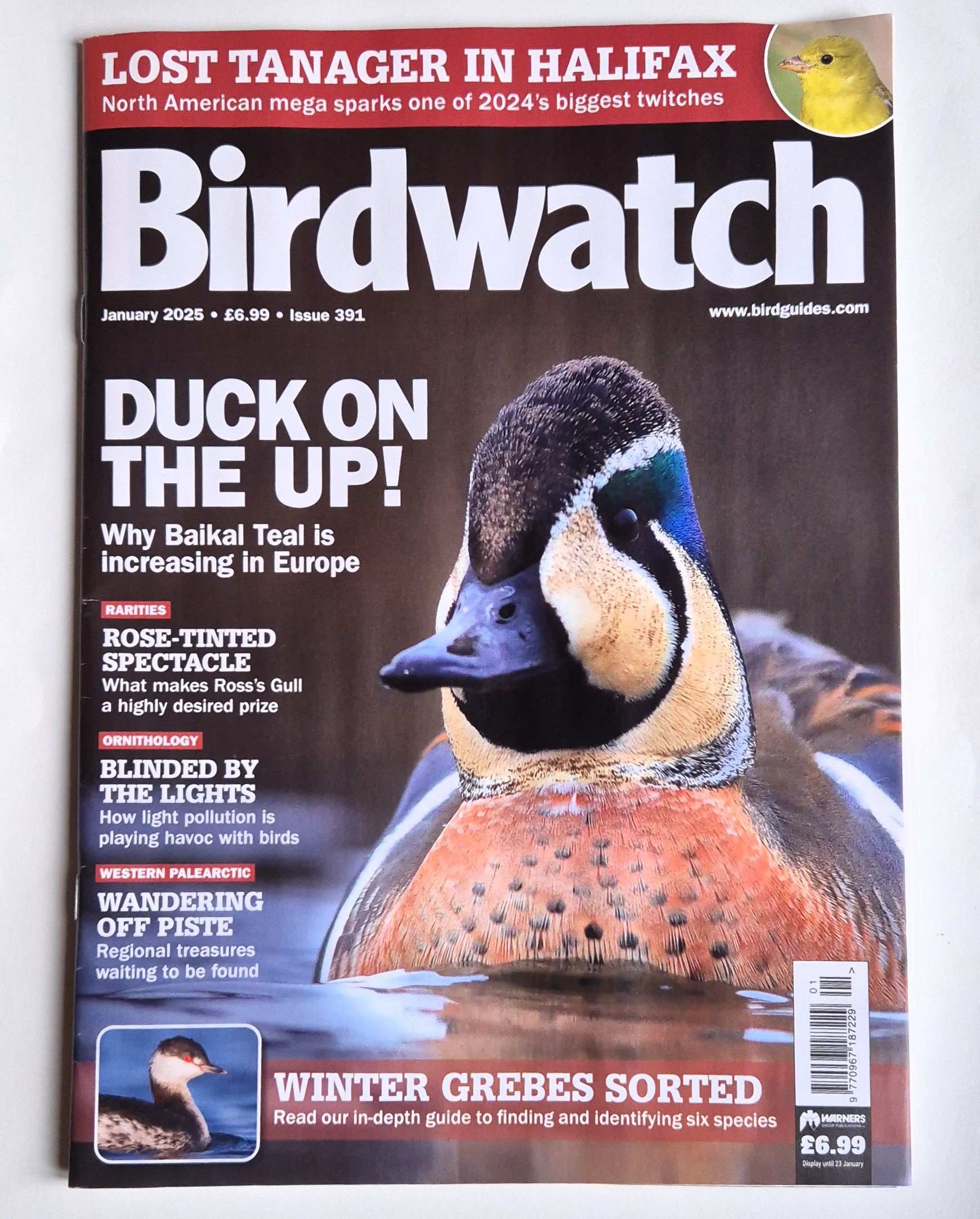
Issue 391 of Birdwatch, January 2025 has a Baikal Teal on the cover (and a lovely pun which I only noticed on uploading the head image above – “Lost Tanager in Halifax”). A twitch in Kent in 1989 involving a Golden-winged Warbler and thousands of people is fondly remembered, the bird’s first and only recorded appearance in Britain. Late last year hundreds turned up to see a Scarlet Tanager outside Halifax and other birds which caused particular excitement elsewhere in the UK included a dark morph Booted Eagle, a Rough-legged Buzzard, various harriers, a Bufflehead, an American Coot, an Eyebrowed Thrush, Ring-necked Ducks, American Wigeon, a Green- winged Teal, Ferruginous Duck, scoters, grebes, divers, Lesser White-fronted Geese, Taiga Bean and Tundra Bean Geese, Cackling, Snow and Todd’s Canada Geese, Leach’s Storm Petrels, Grey Phalaropes, Glaucous and Iceland Gulls, Cory’s Shearwaters, White-rumped Sandpipers, Wilson’s Snipe, American Golden Plovers, Long-billed Dowitchers, Lesser Yellowlegs, Pectoral and Spotted Sandpipers, a Black-winged Stilt, a Pied and a Desert Wheatear, a Red-breasted Flycatcher, a Siberian and a Suffolk Amur Stonechat, Eurasian Penduline Tits, European Serins, various warblers and shrikes, a Black-bellied Dipper, Hornemann’s Arctic Redpoll, a Greater Short-toed Lark, an Olive-backed and a Red-throated Pipit, Richard’s Pipits, Shore Larks, Red-rumped Swallows, Little Buntings, Hoopoes, Pallid Swifts, Bonaparte’s, Ring-billed, Laughing and Kumlien’s gull, a Spotted Crake and Purple Herons. I list these birds here having seen hardly any and not having heard of most, but I do love the names and Sam Viles, the writer’s enthusiasm is infectious. I have recently learnt that the Swift is the world’s fast bird in level flight, reaching speeds of up to 69 mph – an oddly precise figure.
A little excitement here this morning too. I thought I had noticed a bird over the last couple of days which was neither House Sparrow nor Dunnock. I am pretty sure that he or she is a juvenile Reed Bunting – in fact three or four of them are visiting. Unlike the adult male last year, whose preference was the peanut feeder, these are feeding exclusively from the ground, perhaps because of inexperience.

There are reed beds quite close to us which is probably where they are coming from.
In Birdwatch, David Campbell wonders if now is the time, with the proliferation of bird identification apps and the boom in birdwatching as a hobby, for acceptance of sightings of unusual taxa to require photographic evidence or sound recordings. It would mean verbal records would be excluded but accepted records would be based solid evidence.
Mark Avery is on fiery form again, commenting on the frrst six months of Labour government: “this lot is better than the last lot, although that isn’t saying very much.” DEFRA (DETHRA) and wildlife are still at the bottom of the pecking order, and so much more could be done for the environment and mitigating climate change. The building industry, like the farming industry, is once again all-powerful. He mentions the badger cull. See here for my short and angry post about it:
Betrayal of badgers and voters by the Labour government yet again – Animal Wild
Mark Avery concedes that there are two ‘allies’ in the form of new DEFRA ministers and is encouraged by the proliferation of petitions, for example that set up by Wild Justice to ban driven grouse shooting altogether, since those people will not self-regulate. Sometimes I suffer petition fatigue, but it only takes seconds: petition.parliament.uk is the place to go.
There is a species profile of the stunningly beautiful and very rare Ross’s Gull, which is the only species in its genus, Rhodostethia, which means rose-breasted. There is the most delicate pink tinge to the birds’ breasts. They are Arctic birds, first recorded by explorers James Clark Ross, after whom they are named, in 1823 (he was shooting them sad to say) and Fridtjof Nansen towards the end of the century. Breeding grounds were not located until the twentieth century. The species exhibits a black neck ring, red legs and a small jet black bill. Where they winter remains something of a mystery. They do appear in Europe and the UK most years, usually causing a twitching frenzy. Ed Stubbs, the author of the piece, wonders if Ross’s Gull might be “one of the most charismatic birds on Earth”.
Dr Kez Armstrong is president of Northern Ireland’s only bird observatory, Copeland in Co Down, and he writes about it for the magazine. The small islands are home to important breeding colonies of Arctic Tern and Manx Shearwaters, the latter not digging their own burrows but using those previously created by rabbits. Volunteers help with ringing, conservation and maintenance and records have been kept for 70 years, showing that one Manx Shearwater was at least 55 years old, making it the oldest known living wild bird in the northern hemisphere until 2004.
Five species of grebe are regularly seen in Britain during the winter (scarce Black-necked, Red-necked and Slavonian and commoner Great Crested and Little Grebes), a sixth is a very rare visitor from North America, the Pied-billed. Miles Cluff offers identification tips. “Large inland reservoirs are irresistible to wintering grebes” as I found out on my recent visit to Farmoor Reservoir when I saw a solitary Great Crested:
Farmoor Reservoir – Animal Wild

Baikal Teal, once a “mega rarity”, are on the rise in Britain and Europe. Dabblers, they originate from East Asia and are very striking and so often included in captive collections. Records and sightings have been controversial over the years but the birds are now accorded Rare rather than Mega status.
Dr Emily Joáchim writes of the devastating impact of artifical light at night (ALAN), on the increase and worsened by the widespread introduction of brighter LED lighting. This is not just bad for astronomers and amateur enjoyment of the night skies but affects nocturnal animals, gives predators an unfair advantage over prey, disorientates many species and is partly responsible for the catastrophic decline in insect populations, killing a third of insects lured by light. Migrating birds are very badly affected, being disorientated and attracted to urban areas at night resulting in massive numbers of fatal collisions with buildings. McCormick Place in Chicago, which is a glass-fronted building, is alone responsible for getting on for 70,000 bird deaths since 1978. There are many other side-effects but the answers are not complicated: turn the lights off. I must do better myself. I have never understood why shops and businesses leave their lights on all night. We now urgently need a mandatory ruling to counter the rising death toll.
There’s a review of a new tripod which costs £499.99. Definitely too rich for my taste. Mine is made by K & F, purchased in 2017 for a fraction of that. It is beautifully made and more than sufficient for my purposes. It is not made of carbon fibre but it really isn’t terribly heavy either.
From the book reviews, The Vanishing Mew Gull; a guide to the bird names of the Western Palaearctic, by Ray Reedman, Pelagic, 2024, stands out and could hardly be more up my street and is clearly comprehensive, but with just under 400 pages and just 17 black-and-white photos, seems to me overpriced at £65 (and people think my Animal Wild, which contains over 280 colour photographs is expensive at less than half the price). I am tempted but feeling the pinch like everyone I know – for now sadly it will have to wait.
UPDATE. Well, my resistance didn’t last long. Although I have been telling myself not to buy any more wildlife books until I have read more of the ones I already own, this just ticked too many boxes – ornithology, etymology, what’s not to like? I was ridiculously excited for it to arrive and even waited a day to open the parcel for fear of disappointment. Apologies to Mr Reedman, but disappointment would be an understatement and I will be returning it. Having been an antiquarian bookseller all my life and written and published two books, I do know a bit about these things. Animal Wild, which is priced at £30, cost me £20 a copy. This must have cost a very great deal less. There is no dust-jacket and the quality of the photographic covers is poor. Production values generally are pretty abysmal, the whole thing feels cheap. The paper on which the text and rather fuzzy black-and-white photos are printed is too thin so that there is showthrough. I don’t see how this can have cost more than half what I was charged for Animal Wild, perhaps quite a lot less, and so I am afraid I find the asking price outrageous. As for the text, the entries for each bird are extremely short and for the few that I sampled, explanation of Latin names aside, seem to state the obvious and lack authority. Authors who use publishers have very little or no control over these things. I hope Mr Reedman is not similarly underwhelmed. He would have done better to self-publish, in which there is no shame these days. I have looked at other reviews and whilst they are mostly good and certainly not as damning as this (which I do not feel great about), one says that this feels more like a first draft than a completed work and I have to concur.
Leave a Reply