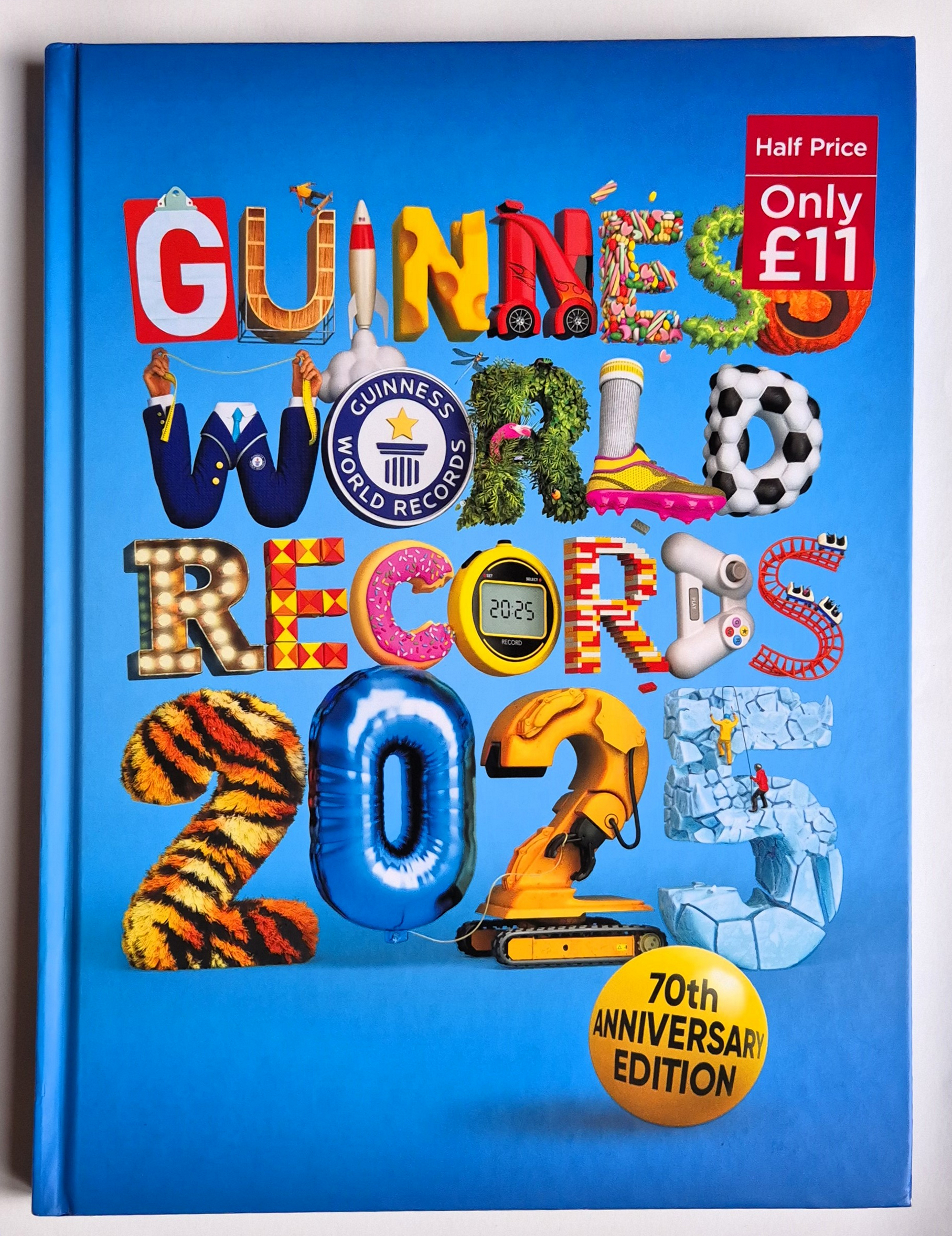
I first mentioned the Guinness Book of Records here:
Wonders of wildlife in Norfolk part IV, Cley, Norfolk Wildlife Trust – Animal Wild
“A much better chance to photograph Golden Plover (below). What a beauty. I had learnt a couple of weeks before that Lord Beaverbrook, out shooting these and other birds (who would even contemplate shooting such an endearing creature – but that’s the entitled elite for you?), wondered which ‘game’ bird was the fastest. Thinking it was the Golden Plover, he could not be certain and on that basis he decided there should be a book recording the biggest, fastest, longest, smallest and so on, approached the McWhirter twins (friends of my parents, one of whom was shot on his doorstep not far from our family home by the IRA) and thus the Guinness Book of Records was born.”

I found myself in W.H. Smith’s some weeks ago and bought a couple of books and some stationery. I have something of a fetish for stationery, see here:
Long Live Dame Hilary Mantel – Animal Wild
The book of records, now called, less elegantly, Guinness World Records, first published in 1955, was offered at half price. I would not have bought it otherwise. The covers are hideous and the layout inside is worse, ugly and chaotic. I have decried the habit of wildlife documentary commentators to feel the need to assign superlatives to every species but thought that I might find some nuggets about wildlife and nature nonetheless. W.H. Smith’s incidentally used to have a certain notoriety for refusing to stock the satirical magazine Private Eye, leading to a friend re-christening it W.H. Smug. The book quickly became a best seller and a hugely successful franchise. I fondly remember watching Record Breakers as a child, hosted by Roy Castle, part of each programme involving the McWhirter twins demonstrating their presumably eidetic memories, answering every question without ever having to look anything up. They were very right wing. Like my parents they were staunch members of the Young Conservatives but they also espoused more extreme causes such as the Freedom Association. As a student I thought the FA’s principles sounded reasonable enough and put my name on a list at a stall in the Students’ Union, but I ran a mile when a couple of thuggish representatives turned up at our flat to pressure me into membership. At their worst, having argued for the right of English cricketers to play in apartheid South Africa without sanction, they went on to try to prevent the BBC from broadcasting the Nelson Mandela 70th Birthday Tribute from Wembley Stadium on the grounds that it might include a message from Mandela or “other anti-apartheid propaganda”. The Provisional IRA assassinated Ross McWhirter after he had offered a £50,000 reward for any information leading to capture of their members. According to Wikipedia, FA pub quizzes are often hosted by none other than Jacob Rees-Mogg.
From Record Breakers I particularly remember Roy Castle’s own records: the fastest tap dance at 1,440 taps per minute, the longest wing walk, and playing a tune on 43 different instruments in four minutes. He also had a small part in Carry On Up the Khyber. Sorry, but I love the Carry On films and their puerile humour. I also recall the appearance of Cozy Powell, the great and very influential rock drummer who played with Ritchie Blackmore’s Rainbow (where I first came across him, live at the Rainbow Theatre, appropriately enough, in Finsbury Park, my first ever gig), Whitesnake and others. He lived in Lambourn, Berkshire, and I am told was most affable when he popped in to our local pub a few miles away. His record was playing the most drums, 400, in under a minute.
Many of the records are of course ludicrous and pointless, although I can see the fun in many of them. Rules have always been strict and the list of records authoritative. But as book sales declined, other sources of revenue were looked to, some of them controversial. Would be record breakers can now pay large sums for fast-track treatment and the lines between content and advertisement have been blurred. It has even been suggested that money has been taken from authoritarian governments for vanity projects and human rights groups have questioned the ethics.
Wikipedia has an interesting list of records now excluded for personal health and safety or environmental or animal rights reasons, such as mass balloon and sky lantern releases, gluttony, camel wrestling, heaviest pets, hunger strikes, food wastage (pie-throwing), and alcohol consumption. It is hard to credit that these were ever included. Wonderfully, “guitar welfare” is cited as the reason for dropping the most guitars smashed during a concert tour, held by Matthew Bellamy of the band Muse – 140 guitars. It does seem terribly wasteful. I’ve seen Jimi Hendrix do it on film (he famously set one on fire at the Monterey Pop Festival in 1967) and Ritchie Blackmore I have seen do it live. There was a bit of a riot (well, chairs were thrown) at one Rainbow gig I attended, when the man in black refused to come on for the encore. He remains, in my mind, an underrated guitarist.
I regret the absence of the world’s most difficult tongue-twister, which in 1974 was deemed to be “The sixth sick sheik’s sixth sheep’s sick”. We had a few editions of the book growing up and I would always go straight to the words and language section. This now seems, sadly, to be absent altogether, and in the arts and entertainment section books hardly get a mention, there being only the world’s smallest bookshop in Japan and the fastest selling non-fiction book which, worryingly, is prince Harry’s Spare. Influencers and gaming each get two pages and paintings are ranked only in terms of prices achieved.
To the Natural World section where, as elsewhere, history is renamed “Flashback”. I am trying but failing not to be too withering. Take “in the world” as read in what follows. The foul smelling, parasitic Rafflesia arnoldii, Giant Padma or corpse lily produces the biggest flowers, some over three and a half feet in diameter. The smell attracts pollinating carrion flies. The largest living animal and probably the largest ever is of course the Blue Whale, some thirty times the weight of an African Elephant, the largest land mammal. The tallest is the Giraffe, the Anteater has the longest tongue, the Orca is the fastest marine mammal (Californian Sea Lions are the fastest pinnipeds) and Tarsiers can rotate their heads the furthest, almost 180 degrees (some owls manage 270 degrees), the Philippine Tarsier also boasting the largest eyes relative to body weight. The largest order of mammals is Rodentia. Whales are also the deepest divers and the longest living mammals.
It is no surprise that Passeriformes constitute the most taxonomically diverse order of birds, but I am astonished to learn that Tyrant Flycatchers, native to the Americas, are the largest family with 450 species. Never heard of them. The Marsh Warbler, able to imitate 80 other species, is the most capable mimic, and the Emperor Penguin is the deepest avian diver.
The Stonefish is the most poisonous fish having “venom that can cause the highest levels of pain” and the statistics for the largest known fish colony are mindboggling: a colony of Jonah’s Icefish covers 93 square miles near Antarctica with some 60 million active nests producing perhaps 100 billion eggs. King Henry I is supposed to have died from a surfeit of lampreys, also known as vampire fish with circular rows of teeth with which they latch on and suck blood. The largest is the Sea Lamprey which can grow to almost four feet long. The Greenland Shark is the longest-living fish and indeed the longest-living vertebrate – “up to 392 years (and perhaps longer).”
From the world of reptiles, Leatherback Turtles dive the deepest and the Taipan is the most venomous terrestrial snake.
Invertebrate record holders include the Eumillipes persephone, a millipede, with the most legs on any animal: 1,306. The largest land crustacean is the Coconut Crab which can crack open the food after which it is named.
Moving swiftly past “Animals in Action” (cats, dogs and others performing undignified ‘tricks’) and “Pet Pals” (mostly similar and I hate the word “pet”) and cacti (more smallest, largest etc., this is quickly becoming tedious) we end with fungi. Penicillium digitatum has obviously saved the most lives, Amanita phalloides (Death Cap) has claimed the most. In Oregon there there is a Honey Mushroom which occupies 3.7 square miles and is estimated to weigh between 7,500 and 35,000 tons (which seems pretty vague, another problem with many of these entries). Most interestingly, the fungi kingdom was only classified as recently as 1969.
Leave a Reply