Delightfully, the entire travel group had been given free membership of the Trust for a year, including an excellent welcome pack. It’s a smart idea – I suspect most of us will happily renew when the time comes. The pack consists of a very full calendar of wildlife events, a sticker, a guide in the form of a proper book, Where to See Wildlife in Norfolk, and the magazine Tern, the spring issue, produced to very high standards. There are articles on the fight against what would be the disastrous proposal for a tidal barrier across the Wash, the necessity of protecting our peatlands, wildlife round-ups, gardening advice and in this issue a good deal on climate change. The purpose-built visitor centre is terrific with a well-stocked shop (especially with books, there were three I could not resist), a café serving great food and drink, and extremely hard-working staff who manage to be absolutely lovely at the same time. Thanks especially to the lady who provided a bag so that I could have my huge slice of lemon cake as a takeaway. No doubt she realised that tour leader Nick Acheson, ambassador for the Trust, was the one indicating that I needed to get a bit of a move on, but even so she could not have been nicer.
The visit was also an opportunity to learn more about just how much careful strategy and management is need to conserve these reserves. There is a very great deal of it and none of it comes cheaply. Major works are all the more important to combat rising sea levels, including the relocation of drainage systems. They will even be installing a hide on wheels so that it can be moved when a major storm threatens. It is by no means only all about birds, much is also done to preserve nationally important coastal shingle habitat, protecting smaller organisms and rare plants.
The bird life was however stellar. I saw a Bittern for the first time (in flight, in the far distance), a flock of hybrid Greylag/Canada geese with the parent of each species at the front and back of the skein, and of birds not already mentioned for the trip (of which there were plenty), Mute Swans, Shovellers, Cattle and Great Egret, a Buzzard, Water Rail (H), a Skylark, Jackdaws, Crows and Rooks, Gadwall (another first), Wigeon, and Moorhen. We had already seen Wood Pigeons and Collared Doves and a Grey Squirrel on our way out from the hotel. We constantly heard Bearded Tits amongst the reeds. They are reluctant to show themselves but one did. I only saw him or her in silhouette – not sure if that counts. Many people have said to me how beautiful they are but I have to confess I cannot really see it. To me they just look weird. They are not tits and they are not in any sense bearded. Really they should be called Mustachioed Reedlings. Having said that I am not that crazy about very popular Puffins either. They share a certain look to my eye.

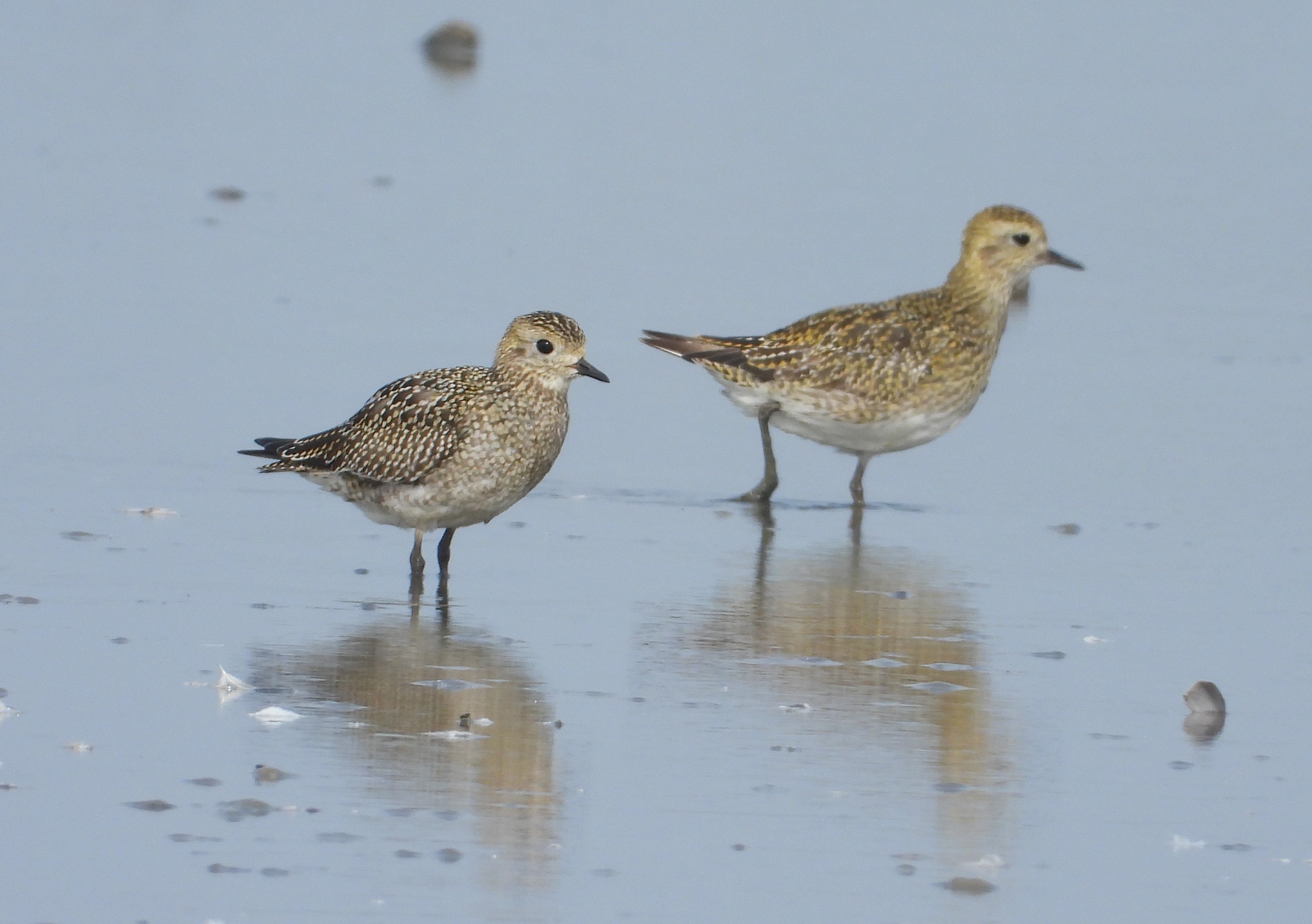
A much better chance to photograph Golden Plover (also featured at the head of this post). What a beauty. I had learnt a couple of weeks before that Lord Beaverbrook, out shooting these and other birds (who would even contemplate shooting such an endearing creature – but that’s the entitled elite for you?), wondered which ‘game’ bird was the fastest. Thinking it was the Golden Plover, he could not be certain and on that basis he decided there should be a book recording the biggest, fastest, longest, smallest and so on, approached the McWhirter twins (friends of my parents, one of whom was shot on his doorstep not far from our family home by the IRA) and thus the Guinness Book of Records was born.
Snipe:

Lapwings, much greener than I had previously realised:


Gadwall:

Wigeon:

A pair of Mallards, with the drake looking very ungainly in flight:


Common Redshank:


Black-tailed Godwit:


There were insects and plants to marvel at too.
Migrant Hawker Dragonfly:

And this, which at first I completely failed to see even when it was very directly pointed out to me – to be fair, the camouflage is extraordinary:

It’s a Long-winged Conehead, previously not present in Norfolk.


There is beauty even in decay as this Bramble shows:

Leave a Reply