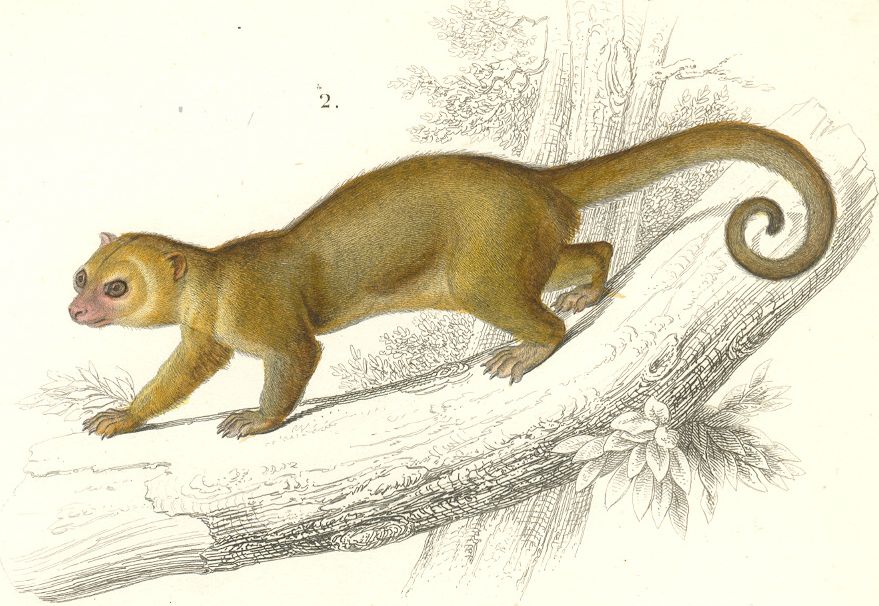
The illustration above is from Dictionnaire Universel d’Histoire Naturelle by Alcide d’Orbigny, first published in 1849 and which runs to sixteen volumes. D’Orbigny travelled extensively in South America and was a correspondent with Darwin. Not for the first time, messages from my friend volunteering at an animal rescue in Costa Rica have sparked my interest. He sent this video:
They are rather alarmingly muscular creatures, reminding me of a Fossa I once saw at Marwell zoo (I have not returned there having seen animals exhibiting stereotypical behaviour) which is probably the most terrifying animal I have ever seen. They also have the highly unusual ability to rotate their feet 180 degrees which together with their prehensile tails makes them perfectly adapted to their arboreal environment. Only a few other animals can do this, such as sloths and bats. Kinkajous are the only species in their genus (Potos flavus) and their closest relations are raccoons, coatis, olingos, ringtail cats and cacomistles (similar to ringtail cats). Olingos look similar but are smaller and do not have prehensile tails. My friend, somewhat apprehensively, put the hanging wooden mobile into the enclosure for enrichment – Kinkajous are highly intelligent. It was quickly destroyed, twice. They are mostly frugivorous and are also known as honey bears, night apes and night walkers. The Fossa is a Madagascan carnivore, the taxonomic classification of which has been controversial and remains somewhat blurred. This is a royalty free stock image:

I was also sent a heart-warming video of the release of two Capuchin Monkeys, mother and baby, from the same sanctuary which, as my friend said, is what it is all about.
At HART Wildlife Rescue (no Kinkajous of course but recently a Herring Gull) meanwhile I noticed these interesting fungi growing in a tub by the front door.

There has been some good news to start the year – the traditional Boxing Day hunt meets were generally poorly attended and ITV News asked the question, “Will they be the last?” We can hope. Labour has done one good thing for the environment by extending the deadline for recording historic and thereby preserving tens of thousands of miles of unregistered footpaths to 2031. Inevitably, landowners and farmers are up in arms, bizarrely describing this as an attack on the countryside. What we need of course is a Right to Roam, as exists in Scotland. Less happily, Conservative government plans to restore our rare and precious but polluted chalk streams have been shelved by the present incumbents, which seems an absolute disgrace.
I have recently been enjoying Vinne Jones in the Country on television with its colourful cast of characters. The footballer and movie star seems a decent guy and wants to do all he can for wildlife on his farm. He gets very irate about some harmless ramblers however, fearing that they will cause disturbance, seemingly unaware of the irony of his clay pigeon shooting and attendance at a game fair. The programme remains a pleasing antidote to the toxicity of Jeremy Clarkson however. It amused me no end that his apparently drunken and certainly incoherent comments on the new inheritance tax rules for farmers led those he was representing to ask him not to comment any more.
2024 has been a tough year for me personally, particularly the last six weeks or so, but a report by Yasmin Choudhury in The Times lists “52 ways the world got better in 2024”, and goodness knows we need this in the light of global events and the looming spectre of Trump in power, incredibly, again. There are medical breakthroughs but more relevant here are happy pieces of news such as the slowing of Amazonian deforestation, the planting of sphagnum moss in Greater Manchester improving water quality, the gradual return of the Giant Sei Whale, seen off Argentina’s Patagonia coast, likewise of the Iberian Lynx, wind power in Britain has for the first time become our largest source of electricity, eco-friendly concrete now seems a real possibility according to researchers at Cambridge University, the reintroduction in Wales of the Marsh Fritillary Butterfly, the birth of a Black Rhino in Rwanda, the mother having been raised in North Yorkshire (I admit it, zoos are not all bad), thanks to campaigning the last elephant in South Africa’s national zoo has been released back into the wild, beavers are doing really well in the UK, and Water Voles, it is hoped, will make a comeback following a release of more than 100 in Northamptonshire. Global beef consumption seems to have peaked, a first wooden satellite developed in Japan has been launched, the ozone layer may be recovering, turtles are making a comeback in Cyprus as are oysters in the Firth of Forth, Turtle Doves, and a tiny Polynesian snail species, snares have been banned in Scotland, whilst from Thailand 961 highly endangered, illegally trafficked tortoises and lemurs have been returned to Madagascar.
For more good news see the PETA, Wild Justice and Protect the Wild websites for their annual reviews and finally, kudos to Chris Packham and Megan McCubbin, as ever, this time for joining the North Hants Hunt Saboteurs for a day observing the notoriously violent Cottesmore Hunt. Watched by many it seems to have had an even wider impact on social media.
Finally, my family are all too familiar with my obsessions and I was delighted to receive for Christmas and my birthday, which I share with one of my daughters two days afterwards, prints of a Black-headed Gull and a variety of finches, a gorgeous birthday card from my brother- and sister-in-law featuring a flock of Oystercatchers by Robert Greenhalf and beautiful artwork by my daughter showing the Rastafarian flag and the Lion of Judah, all of which will be framed, a fluffy sheep to add to my ever-growing keyring collection (which includes one about my preferring people to animals, another gift a few years ago), and as requested the promise of a trip to the Rampion wind farm off Brighton which should make for some good photos I hope. I cannot leave out the bookmark made by hand by my eldest daughter to remind me of the days when I used to read to her in bed from Old Possum’s Book of Practical Cats. The genius of his more serious poetry is not in doubt, but the rhythms he achieved with such wit there (she and) I have always found hugely pleasing.
Leave a Reply