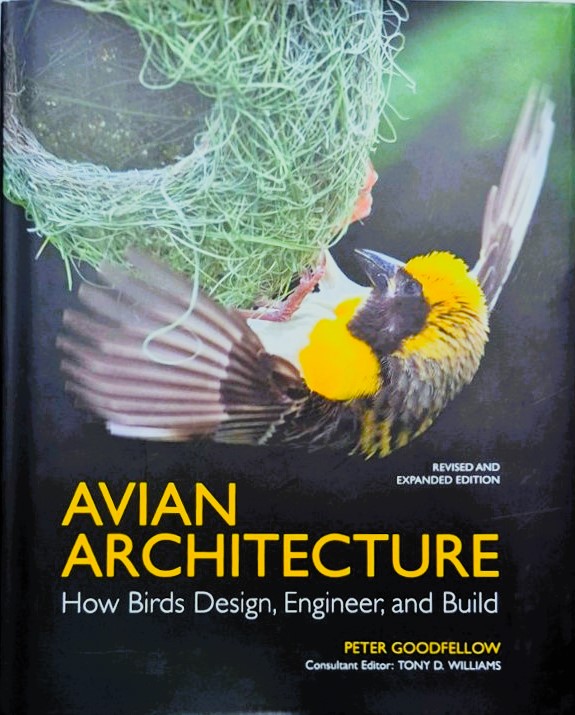
Avian Architecture, How Birds Design, Engineer and Build, by Peter Goodfellow, Princeton University Press, 2024, revised and expanded edition. With a foreword by consultant editor Professor Tony D. Williams.
See earlier post:
Avian Architecture. Book review. Part I – Animal Wild
I began Part I with this: “In a sense it is a bold title. Whilst no one has ever denied that birds build nests, the abilities to design, plan and engineer were thought to be exclusive to the human species, like tool-making, tool use and language, all long since blown out of the water. I have never subscribed to that anthropocentric view but Charles Darwin was ignored in a similar respect in terms of animal emotions and sentience for over two centuries.
The use of the word “architecture” is of course considered (it was the word which kept coming into my head when I properly saw a badger sett for the first time).”
Picking up where I left off an inexplicably long time ago, we move on to cup-shaped nests, the classic and most common type, engineered from a variety of materials, often insulated (the Carrion Crow uses feathers, down and wool) and in some cases attached to the tree – the Common Chaffinch uses spider silk. This is a shape which is vulnerable to predators and parasites, but the Ruby-throated Hummingbird, for example, ingeniously camouflages the nest with grey lichen. The cups may seem simple, but the construction is a complex and fairly lengthy process – some results are tidier than others.
Domed nests exploit the advantages of the cup-shaped and cavity nests. The Eastern Meadowlark (not a lark) aligns the entrance away from the prevailing winds to protect the chicks whilst other birds do the opposite for ventilation. There are some extraordinary defence strategies: Rainbow Pittas in Australia use the scent of wallaby droppings to hide their presence, the Yellow-rumped Thornbill from the same continent creates a kind of fake cup nest on top of the actual nest, the entrance to which is concealed by a hood. Long-tailed Tits’ (apparently not actually a member of the tit family, like the Bearded Tit, which I have renamed before, the “Moustachioed Reedling”) nests are famously intricate, using moss and silk which work together like velcro. The numbers are astonishing: approximately “3,000 lichen flakes, 600 or more silk spider egg cocoons, 200-300 sprigs of moss and about 1,500 feathers”. I am sure I once read somewhere that we humans would not be able to construct such a thing if we wanted to.
Mud nests – or pottery – have the advantages of being capable of being shaped as desired, adhesion and durability. Swallows have built nests in our eaves for many years although they have been absent the last couple of springs. It is easy to see how they have been built up in layers, each added once the one below has hardened. One case study here is of the Magpie-Lark, neither a magpie not a lark. These bird names! Mud nests take a long time to build but they can be reused year on year. It is entirely possible that the first human mud houses were inspired by these creations.
Weavers and tailors create elaborate hanging (pensile), woven and stitched nests. As the author says, these are “the most sublime expression of nest-building skill”. Their construction requires a great deal of craft; the results are strong, light, and flexible and they can be located out of danger from predators. The tailors such as Goldcrests use spiderwebs as a stitching material. I confess I had no idea that spiders were so useful to birds in the ways described above. The tiny Goldcrest begins its work by attaching a single strand of silk and moss to a twig, added to to form a framework. The blueprints in this section of the book show a variety of shapes: globular, kidney-shaped, retort-shaped and so on. Some birds use pellets of mud as counterweights for balance. It seems the various weaving techniques are entirely instinctive, not learned: incredible really when one reads for example that the Baltimore Oriole makes a nest using tens of thousands of stitches. The Common Tailorbird first sews together and shapes a leaf, then builds the nest within. These types of nest seem to me nothing short of miraculous.
Mound nests, built on the ground, may be incubatory where the eggs are buried and temperature regulated, or the nest may be created on top of a pile of gathered materials. The former can be very large, with heat generated by rotting vegetation. Some mounds are made from stones and there is a record of a 1 oz Black Wheatear somehow carrying a 1.333 oz stone. Temperature control, presumably also instinctive, is no mean feat either: outside temperatures may fluctuate wildly, but within an incubator mound they must be carefully and precisely controlled. Some chicks emerge precocially, fully feathered and able to move and feed independently, perhaps never even seeing their parents. Adélie Penguins gift each other stones for their mounds and may steal from others. The Horned Coot deserves special mention – they build artificial offshore islands making hundreds of trips to do so. It is estimated that they may weigh as much as one and a half tons.
The tenth chapter concerns not so much structure as the nature of colony and group nestings, which bring obvious benefits and risks and show varying degrees of co-operative behaviour. The author interestingly equates some to human cities or apartment blocks.
Courts and bowers seem to me right up there with woven nests as sources of wonder and they represent the ultimate combination of nest building and courtship. Males build to impress and seduce: display is everything, comprising decoration, song and dance and the results are ostentatious and beautiful, but the techniques take years (as many as seven) to learn and many failures may be the precursors of success. For the decoration, berries, glass, shiny stones and shells may be collected, as well as man-made items such as coins. Some birds exhibit yet another skill, painting parts of grass stems using saliva and chewed grass – and some bowerbirds even use twigs. The Satin Bowerbird seems particularly aware of the importance of colour, collecting mostly blue objects (some yellow but never red) and they paint in blue too using crushed bark, charcoal and blue berries. The Vogelkop Bowerbird is exceptional. Only ten inches long, the male makes a “maypole” structure which may be as tall as six and a half feet. Decorative materials can be a variety of colours but these are then arranged in a co-ordinated way and maintained for up to nine months – faded or rotten items are discarded and replaced.
Finally, the author turns his attention to edible nests and food stores (“pantries, granaries and orchards”. So what exactly is bird’s-nest soup, long prized by himans as a delicacy? The nests in question are those of White-nest and Black-nest Swiftlets and they constitute solidified threads of their own saliva. They are the only birds in the world to create their own materials. Woodpeckers are particularly renowned for food storage, but there are many other species which do it, including Eurasian Jays, shrikes and, as I learnt recently, the Nuthatch. The Yellow-bellied Sapsucker provides a good example of orchard farming: lines of wells are created from which sap is taken until the tree’s wound heals and new wells must be begun.
I wish I could have illustrated these two posts with images from the book, but copyright forbids of course. Like so many things in wildlife and nature, the more one learns, the more one realises you will never look at nests or trees or feathers or leaves in the same way again. This book is a joyous, detailed and beautiful tribute, which never anthropomorphises, to the various and sophisticated architectural and many other skills of birds. They are painters, designers, engineers, tailors, weavers, farmers, collectors, potters, upholsterers and, of course, architects.
Leave a Reply