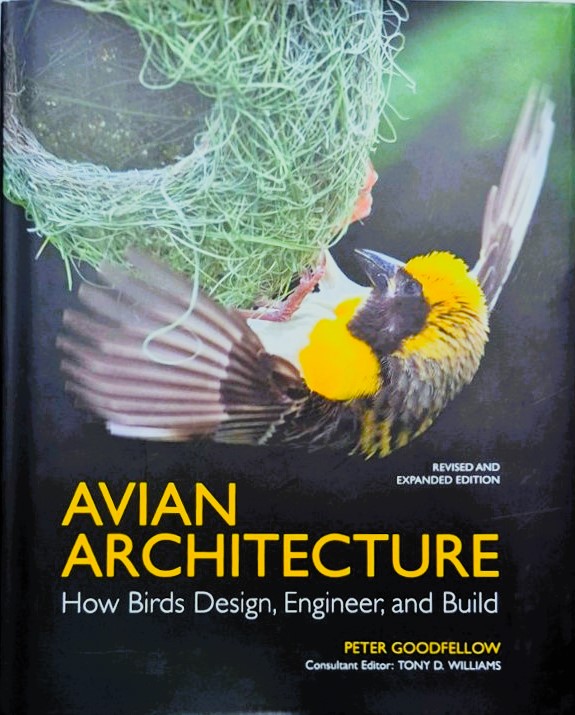
Avian Architecture, How Birds Design, Engineer and Build, by Peter Goodfellow, Princeton University Press, 2024, revised and expanded edition. With a foreword by consultant editor Professor Tony D. Williams.
Having had a fair few disappointments in my reading lately, this is one I have been saving up and it absolutely does not disappoint. Unsurprisingly, given the publisher, the production values are high in terms of the physical book, the paper and the quality of the many spectacular photographs and the beautiful illustrations by Coral Mula (who surely deserved some credit on the title-page, not just a mention in the acknowledgements).
In a sense it is a bold title. Whilst no one has ever denied that birds build nests, the abilities to design, plan and engineer were thought to be exclusive to the human species, like tool-making, tool use and language, all long since blown out of the water. I have never subscribed to that anthropocentric view but Charles Darwin was ignored in a similar respect in terms of animal emotions and sentience for over two centuries.
The use of the word “architecture” is of course considered (it was the word which kept coming into my head when I properly saw a badger sett for the first time). Designing and engineering are clearly things that birds do. Professor Williams gives examples in his introduction: tunnels, ventilation, cement, hinged beams, cables and guy ropes, counterweights, apartment blocks and painted structures. “Birds also tie knots, weave, and even stitch material together in constructing their nests.” They have also inspired us to imitate them.
The cover illustration, above, shows a Baya Weaver at work.
The book is divided into sections according to nest type, each comprising a summary, blueprints and case studies. What follows is a mere smattering of the gems of information with which the book is filled. The first and most basic are scrape nests which might seem to stretch the definition of architecture, consist only of a shallow indentation scratched out of the ground. But even these are excavated to very precise depths. They may also be lined with leaves and grasses or down and they can be elevated, hidden or open. Of course their nature makes them highly vulnerable to predation but for that reason the eggs tend to be very well camouflaged. There are other means of defence. The killdeer, for example, performs a distraction display in the presence of a potential predator, pretending to stagger about with wings flailing as though broken, returning to the nest once the threat has been lured far enough away. Ostriches also employ an elaborate distraction display, especially the male who will start “flapping its wings, dropping to the ground, and running about erratically.” This ostrich nest was photographed in Kenya a few years ago:

Arctic Terns will defend their nests collectively, as a colony, with considerable aggression: gulls, skuas, crows, Peregrine Falcons and even humans will be mobbed chased, struck and ” ‘dive-bombed’ with excreta”.

The next chapter covers “Hole and Tunnels”, chiefly in trees or river banks. Primary cavity nesters such as kingfishers and woodpeckers create their own, second cavity nesters use existing holes, but with modifications and customisations: the Great Tit for example creates a thickly lined nest using moss, grass, hair, wool and feathers.

Security measures can also be included such as enclosed entrances and long, sloping tunnels, but predation still occurs from such creatures as snakes and weasels – but there is no need for the eggs to have evolved to be camouflaged. The tunnels constructed by Kingfishers must be high enough to avoid flooding. They also slope downwards, as the blueprint shows, from the egg chamber so that waste matter sluices away.

Some species make their nest holes inside arboreal termite nests or wasps’ nests.
The female Great Hornbill, having found an existing suitable cavity, seals it almost completely with mud and her own faecal matter and remains there for months, dependent entirely on the male for food and water. The narrow slit that is left open also serves as a waste disposal outlet and a temperature controller.
Red-cockaded Woodpeckers (this seems to be one of those strange, misleading names since their caps and napes are entirely black with not a trace of red) may take between one and three years to finish a nest cavity which may then remain in use for as many as twenty years. Breeding only in living trees in pine forests, they use the sap from the trees as a sticky defence against predators such as the Black Rat Snake.
Surprisingly, Common Eider and Mandarin also fall into this category of nesting, using tree cavities.
Platform nests can seem chaotic, shambolic even, especially in the case of the Osprey’s huge, apparently random assemblage of twigs and branches. For birds of prey, high locations are usually chosen to give a good lookout point and the nests are surprisingly enduring. Common Woodpigeons exhibit good examples of the “piled lattice” platform, constructed from as many as 200 twigs, chosen with great care, mostly by the males. Females bend the twigs to lock them into position and droppings from the nestlings help to cement it all together. Reed bed platform nests such as those of the Magpie Goose are constructed from reeds and rushes, skilfully woven into a radial pattern. The White Stork famously often uses manmade structures, gluing the branches and sticks of the nest together with earth, turf and dung. Older nests can be deep enough for Spanish or House Sparrow to build their own nests at the bottom of them. The builders tolerate this and the sparrows can be aggressive towards other White Storks which come too close.
To digress, at HART Wildlife Rescue during a coffee break last week, when someone mentioned braking for pigeons in the road, I said this was unnecessary because they always fly away in time, albeit at the last minute, which prompted me to investigate what I had understood to be an apparently different perception of time in other species than our own. This does not seem to be something fully understood by anyone, but this is very illuminating.
Why you can’t take a pigeon to the movies | OUPblog
Pigeons are just one example, but they have a much higher threshold for detecting movement and so would not be fooled by the series of static images (24 frames per second is the industry standard) which we perceive as continuous motion. It isn’t just birds: other animals are thought to see the world in what, to us, would seem slow motion.
Aquatic nests, whether reaching the bed or floating but often anchored, have the advantages of being protected by the surrounding water and may be well hidden, but they are rather flimsy and vulnerable. The chicks therefore hatch in a “highly developed state” (they are ‘precocial’) and leave the nests early, whilst the adults tend to be highly and aggressively protective. New to me was the fact that Grebes are unusual in that they carry their young on their backs until they can fend for themselves. The rate of egg loss in African Jacanas because of the insubstantial nature of their nests has led to female dominance. She mates with multiple males and may produces as many as thirty clutches in one season. The males are left to incubate and care for the young.
Leave a Reply