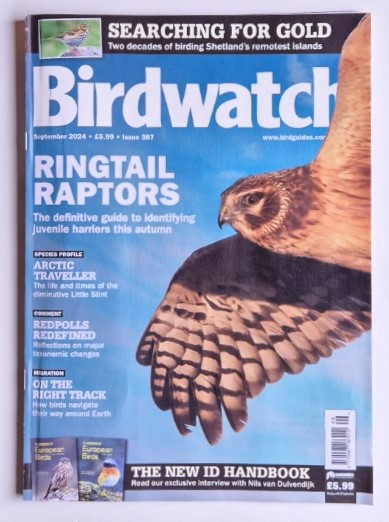
The recovery of the Peregrine Falcon, a species which faced extinction in the UK in the 1950s (pesticides and illegal persecution of course), is welcomed – there are now 1,402 pairs, 62 of them thriving on man-made structures. There is much excitement about rare seabird sightings tempered with a concern that climate change is probably the cause.
David Campbell writes wisely about a decision to group three species of Redpoll into one, Lesser, Common and Arctic. They are clearly different from one another but genetically science has shown they are one species, “effectively morphs of the same bird, a product of and a perfect match to their environment”. There has been disquiet but as Campbell points out, that is to ignore what is actually an advance in our understanding. It does not detract from our enjoyment of the birds.
Mark Avery writes rather scathingly about Birdfair, or at least damns it with faint praise. It tallies exactly with what I have been hearing from friends who have been stalwarts for years. Increasingly it has become about travel companies touting birding trips abroad and high-end optics salesmen pushing their wares with hardly a sign of the RSPB, BTO, WWT or Wildlife Trusts. I am looking forward to Migfest in Yorskhire in a few weeks time which I hope will be more akin to what I believe Birdfair used to be like.
A long, detailed piece, beautifully illustrated, follows about the Little Stint, a tiny, gorgeous wader.
The mysteries of how birds navigate their migrations are explored in depth. We are gaining only some understanding of how they perceive the planet’s magnetic field, how they sense it, but it seems clear they are able to establish their location from it. All we have are hypotheses. It is somewhat easier to imagine how they use the Sun (utilising their internal biological clocks – it is believed they possess an ‘internal compass’ as well) and the night sky, but even these processes are incredibly complex and by no means fully understood. How exciting that there is still so much more for us to learn. There is infrasound too and pigeons in particular are excellent at recognising visual landmarks including buildings and trees. They do not always travel by the most direct route, instead preferring to follow “edges and linear features, such as hedgerows and main roads”. They also use their sense of smell to great effect as do, for example, tubenoses like the Manx Shearwater.
There’s a guide to identifying various species of juvenile Harrier and a follow-up article on attempts to conserve the European Turtle Dove.
A major new ID Handbook of European Birds is “set to become the new gold standard”. I am managing to resist, just about and so far. It looks stunning.
There’s hope that an increase in the Goshawk population (if people are prevented from carrying on persecuting birds of prey) is proving an effective, natural solution to the grey squirrel “problem”.
Finally, Lucy McRobert writes a second piece about collecting with the same sympathetic humour as before. Pin badges are very popular (“it probably starts quite harmlessly”) it seems. I’ll confess one of my weaknesses in this area – fridge magnets.
Leave a Reply