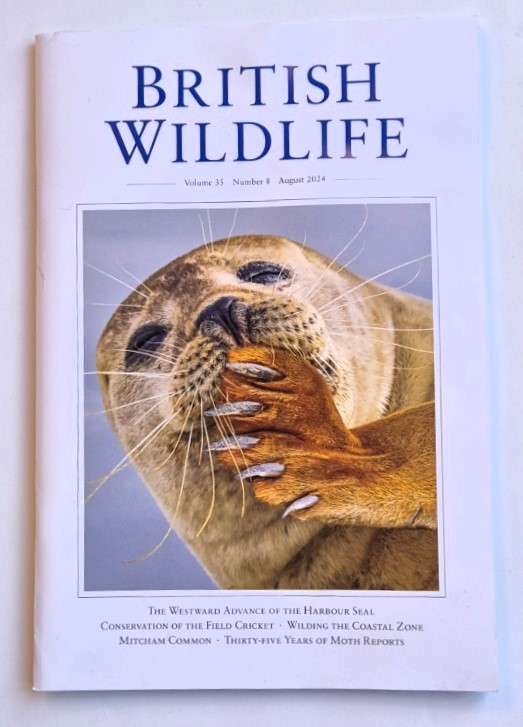
Volume 35, Number 8
Another terrific issue. I have illustrated this post with various recent wildlife photographs of my own.
“The surreptitious westward advance of the Harbour Seal” is the title of the lead piece by Stephen Westcott. Harbour and Grey Seals were not treated as distinct species until as recently 1936. The former, which swim almost immediately after birth, are not easy to count and so population surveys are undertaken during the annual moult when they spend more time ashore, using various methods including aerial thermal imaging. The two species, happily, co-exist peacefully. Which reminded me of reading elsewhere that in North America, specifically in Washington State, by contrast, a horrific decision has been made to resolve the perceived conflict between Barred Owls and Northern Spotted Owls. The “management stragey” is to kill 450,000 Barred Owls. Whatever the question, this cannot be a good answer. Cruelly, they will be lured with recordings of their calls, shot and “buried on site, according to the plan. This will be done by placing the carcasses under duff, branches, or logs to secure the carcass without disturbing the soil.” In other words, they will be left lying around. I wonder what unforeseen consequences there will be – there always are when humans interfere like this. Public hunting will be barred – people hunt them for fun? The Barred Owl is expanding its range it’s true, but the Northern Spotted Owls were already in decline through habitat loss (logging and land development), and in any case the two species, it is thought, prefer different types of forest. Little is known about the feasibility of habitat management to help both species – perhaps they should try to find out more before instigating a massacre. Furthermore, some argue that the range expansion of the Barred Owl is largely due to human interventions in the first place – climate change, wildlife suppression and tree planting. There is some hybridisation too, but that is thought to be more or less inconsequential.

Buddleia leaf as autumn begins
Field Crickets, the subject of another article, are, on the other hand, counted purely by their chirps. Dedicated volunteers are crucial to their survival in terms of long-term habitat management and support, release and translocation. A word new to me: “stochastic”, which Wikipedia defines as “the property of being well-described by a random probability distribution.” Another new word from an earlier issue of this magazine was “philopatry” – the tendency to return to or remain in a certain site or area.

These leaves and seeds have finally allowed me to identify the Linden tree which suddenly appeared at the end of the garden and has grown at an extraordinary rate. No amount of googling or app use had enabled me to do so.
Graham Weaver’s lively and passionate piece about the wilding of coastal zones explains that they are of course places of natural change and that in the event of a storm, calls to save and restore beaches are superfluous: “Although longer timescales may be required, left to their own devices most beach-dune systems will happily do the job for us.”


A fly (of some sort) and an Ilybius ater, a common aquatic beetle.
Amy-Jane Beer never fails to delight, this time recalling the Restore Nature Now march, see this and other posts:
Restore Nature Now – Animal Wild
Chiming perfectly with my own view, she describes the Biodiversity Net Gain scheme as “a licence to obliterate existing wildlife” and argues that the building industry should instead prioritise nature within developments, for example by leaving trees and hedges where they are and “providing sustainable energy and drainage systems, and accommodation for wildlife.” She reminds Steve Reed and the government that the word “ecology” derives from the Ancient Greek oikos, meaning home.

Forgive the blur, but this minute creature is, I am pretty sure, a Harvest Mite. I am familar with them from them habit of infesting the ears of cats.
Roger Morris makes a heartfelt plea that Mitcham Common in London, with its extraordinary abundance and variety of wildlife, be designated as an SSSI. The many lovely photographs are testament to his dedication.

A simple burr – not so simple and so very effective.
Hugh Raven, on the subject of Scottish marine preservation, is properly and rightly angry. “Perhaps Britain will return to the tradition of our governments upholding the law … Prior recent incumbents, or should I say one in particular, have struggled with the principle that those who make our laws should keep them too.” In desperation, Morris founded the small charity Open Seas and went to court, where the judge agreed that the government must act in accordance with its own National Marine Plan. The government with an outrageous display of cynicism and bravado, had the gall to appeal, unsuccessfully. We await actual enforcement and action.

I took these having noticed the extraordinary, burr-like ability of these Hairy Willowherb seeds to attach themselves to my clothes- and stay there. Close-ups of their complex structure surprised me.
Dr Paul Waring looks back at thirty-five years of moth reports for British Wildlife. The photographs confirm my suspicion that it is not my photographs but moths themselves who are rather fuzzy and ‘blurry’.

Sometimes the sky catches you unawares and takes your breath away.
In Guy Freeman’s “Conservation news” compilation, he bemoans the lack of mainstream media coverage given to the Restore Nature Now march and comments on the unduly harsh sentences handed out to the Just Stop oil activists. The long-awaited government plan for Lough Neagh, featured in a recent issue, is pitiful, failing completely to address the causes of serious toxic algal blooms and dreadful water quality: “Intensive agriculture, creaking wastewater infrastructure and faulty septic tanks”, instead pathetically suggesting voluntary measures such as tree-planting and education. There is also the thoughtful suggestion that the government’s new ‘greybelt’ designation of former greenbelt areas is likely to ignore the importance of high value wildlife habitats, like scrub, which may be considered aesthetically displeasing. The previous government’s decision to authorise, yet again, the use of a banned insecticide by sugar beet farmers, did not even assess how this might affect important nature sites. Who knows what it will take to persuade any government to act upon the pollution of our rivers from farm run-off? There is not much escape here from the relentless feeling that the current government are not offering much, only that they must surely be better than the last.

There is a darkly comedic twist to news about raptor persecution: the Moorland Association has been “expelled from the police-led Raptor Persecution Priority Delivery Group … after posting an inflammatory blog falsely accusing the police of ‘bypassing regulations’ in relation to the police’s recent attempts to tackle the illegal killing of Hen Harriers on grouse moors in England.” In other wildlife crime news, the League Against Cruel Sports has added its eloquent voice to the campaign to strengthen the law in regard to foxhunting, citing 1,400 eye-witness reports, 526 of which referred to suspected illegal hunting and 870 to ‘hunt havoc’ in public spaces. It seems a sterling idea to include a “reckless provision” – it would be illegal not only to hunt wild mammals with dogs, but also to be reckless by not preventing them from doing so.

You can’t go far wrong with photos of Collared Doves.
A review of Richard Mabey’s The Accidental Garden: Gardens, Wilderness and the Space in Between, Profile books, 2024, quotes the author: “We still struggle to find a gesture in our relations with the world which is more like a hand-shake than a clenched fist.”
Finally, a garden note. I have noticed a persistent woodpecker-like tapping on the other side of the fence and also the summerhouse – it is happening right now and goes on for several minutes many times a day. It is a Blue Tit. The question is, what on earth is it doing? Research revealed that they will adapt the entrances to nest boxes in this way but there is no box. Is he or she announcing their presence or following instinctive behaviour in a rather bonkers way? If anyone knows, I would love to hear from you.

One final, unrelated note to express my delight that a business (a pub) which I suggested would be worthy of inclusion on Protect the Wild’s website has now been added.
Leave a Reply