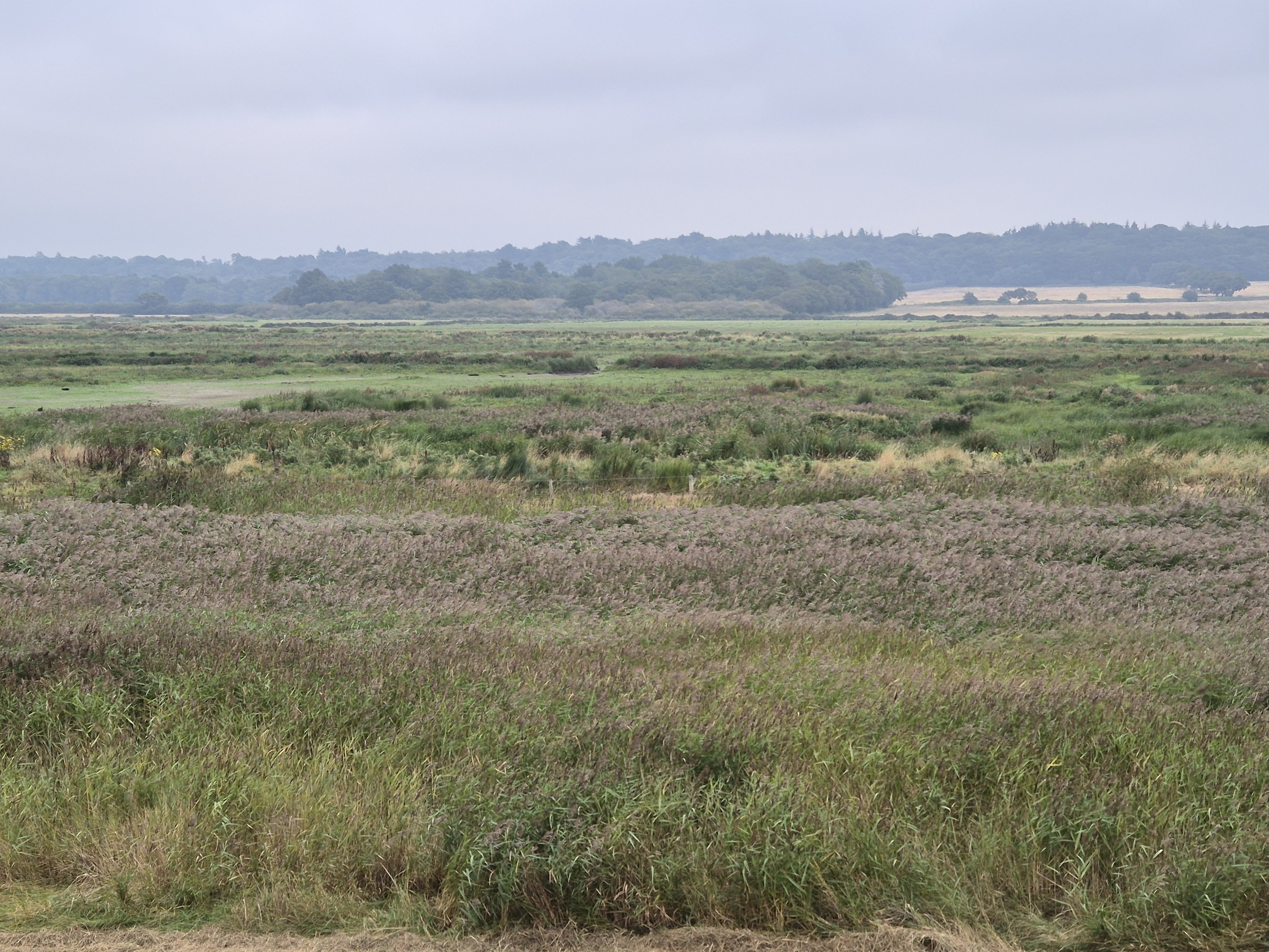
This was a trip lasting almost five days with Wildlife Worldwide, a firm I have travelled with before, with mostly great results. They were twelve other wildlife lovers (we all got along very well and the spirit was positive and good-humoured) and two excellent and supremely knowledgeable tour leaders, Nick Acheson and Ed Hutchings. Nick knows Norfolk rather better than the back of his hand, works for the Norfolk Wildlife Trust (NWT) and is active in countless other ways in protection and conservation. As well as being thoroughly likeable, he barely draws breath without identifying a bird species, by sight or sound, a plant or an insect. Some birds he identified from seemingly impossible distances – he can do this because he knows them so very well. There was so much to learn both from him and Ed, a softly spoken and gentle man, with whom I was pleased to digress talking about music one or both of us liked. Once upon a time, he used to shoot birds, but see here for his thoughtful and unassailable attack on the ‘sport’ in a guest post on Mark Avery’s blog.
Guest Blog by Ed Hutchings, ex-shooter – Mark Avery
Both Nick and Ed love and are incredibly well-informed about wildlife in all its forms and so the whole trip was a joyful learning experience for me and not just about birds, of which I saw an astonishing 76 species, many of which I had never seen before.
Talking of learning, I would like to recommend this blog and this post in particular. The author writes self-deprecatingly and shares what she has learnt in the best possible way, in this case about the bizarre and little-understood world of slimemoulds. Her tone is something I aspire to and I hope sometimes achieve in my own writing. “I mean, what are they? Animal? Vegetable? Alien? They used to be classified in the Kingdom of fungi, but on further study, scientists decided to put them in the Protists. Probably because they really didn’t know where else to put them.”
absolutelynotnormal | ’cause after all, who’d want to be the same as everyone else? (wordpress.com)
There was somewhere I wanted to visit on my way up to King’s Lynn, Camp Beagle, on the outskirts of Huntingdon, which I wrote about here:
Your Neighbour Kills Puppies; Inside the Animal Liberation Movement – Animal Wild
The protest site has existed outside Marshall Bioresources (MBR) Acres, a factory breeding puppies for cruel and pointless experiments, since June 2021 and it will not be going away. It even has its own official traffic signs on the busy road on which it is situated. I felt it would be intrusive to photograph the four army-style tents in which the protestors live, but these pictures show the terrible lie plastered onto the gates of the factory and the responses on the other side of the road.


I tentatively squeezed through the barriers and walked past the tents beginning to think that no one was there. Then, “Hello?” from behind me, so I turned to reassure the two women that I was there only to express my moral support and to thank them for what they are doing. They have both lived there for two years. They very kindly offered me a drink but I was running late – there is a huge new road system which had completely thrown my satnav and me and I had driven back and forth along and around it, adding twenty miles and half an hour to my journey and in any case I didn’t feel that my car was parked very safely. So off I went, arriving at our hotel just three minutes before the appointed two o’clock.
Best Western have certainly upped their game since I last stayed in one of their establishments many years ago – I really couldn’t fault it. My room was spacious and comfortable with a small balcony, food and service were excellent.
It was not long before we were off on the first of three visits to RSPB Snettisham. We stayed behind the embankment beyond which lay the sea – the Wash. There is beauty everywhere if you know where to look (or are with people who do) and keep an open mind as to what beauty is. As Ed said, why be interested in cultivars when there are so many beautiful, wild, natural plants? Why play God? And there is enough, so much to learn from and about wild plants alone. A feeling I have had for a long time but never really formulated.

We saw the very rare Hoary Mullein and this is Robin’s Pincushion, a growth formed by the larvae of Gall Wasps on Wild Roses, creating a perfect home for them to grow. They emerge as adults in the spring.

Also pointed out were Sea Buckthorn and, below, Carline Thistle and Fleabane.


We were treated to seeing a Marsh Harrier soaring over a field and were told that for example of two chicks, even from the same parents and nest, one might never go far from its place of birth at all, the other might turn up in Senegal. There seems to be no rhyme or reason to it and scientists have been unable to predict patterns. Also they are rarer in the UK than Golden Eagles.
I will try to avoid too much repetition – we saw many of these species more than once in various locations – but on this first day alone we saw too a Kestrel, Shovellers, juvenile Swallows, Starlings, Mallard, Teal, Chiff-chaff (H – “H” indicating heard but not seen), Greylag and Egyptian Geese, Long-tailed Tits, Linnets, Little Egret, Black-headed Gulls, Wood Pigeons, Snipe and Curlew.
On our way there and back we also saw Hereford and Redpoll Cattle, and a Reeves’s Muntjac. It was a very good start. These trees are blackened from a fire some years back.


Leave a Reply