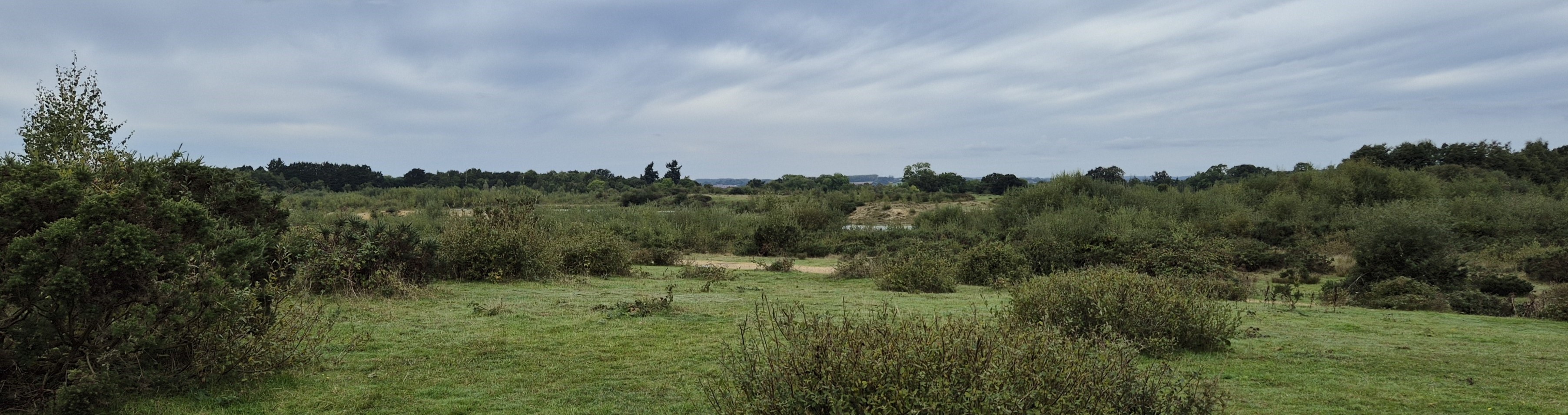
For obvious reasons, locations of our surveys and especially the locations of setts is left deliberately vague but the combined presence of badgers and supposedly bio-secure (according to at least one farmer) free-ranging cattle on Greenham Common in Berkshire is so well-known and controversial that there seems little harm in saying that we spent some hours on the former RAF Greenham Common Airbase, now designated as public parkland with, relatively, an abundance of wildlife. Notoriously, it was used by the United States to store nuclear weapons (it had even become USAAF Station AAF-486 during the second world war). The majority of American ground launched cruise missiles in the UK were stored here from 1980, giving rise to the heroic women of Greenham Common Women’s Peace Camp, on which subject, coincidentally, I discovered my eldest daughter is about to write as part of her history degree. Happily, the control tower is now used for historical and cultural exhibitions. My younger daughter, many years ago, to her great credit carried out a sponsored walk/run/cycle around the airfield in aid of immigrant refugees. It certainly looks very much wilder now than it did then.


From a surveying point of view, it was a strange day, although I left an hour early and may have missed some happier findings. We came across a number of setts, mostly created around the bases of trees, each one, we think, disused and partially collapsed, although possibly currently used by smaller mammals. I could not help but wonder if the cattle farmers may have had something to do with it.
Sett entrance


I was surprised to find myself in a somewhat heated discussion with another member of the group, one of our most active and passionate badger supporters. I deplored the betrayal by the new Labour government who had given the very strong impression that the cull would end in 2026 but almost immediately extended it to 2029, not wanting to upset the National Farmers’ Union. We discussed Brian May’s documentary and she explained the problems: the need to satisfy and appease not just the farmers but DEFRA and various other bodies. I moderated my immediate response but what I meant was, “F*** all that.” We need to reduce the power of the NFU, she said, which of course I wholeheartedly agree with and endorse, but in this case I believe they should simply be ignored. In Wales the cull was ended if not overnight then very quickly indeed. We know that the cull is completely ineffective and that bringing an end to it would not make the slightest difference to the incidence of bTB in cattle. The time has surely come. Make ending it your starting point, then deal with any political ramifications. Only the Green Party, I said, had committed to ending the cull altogether. She and her partner would not vote for them, she said, because of Green MP Caroline Lucas’ expressed wish for a women only parliament. This was new to me and didn’t sound quite right, and indeed it wasn’t. What she did was to invite a number of female politicians to form an emergency cabinet to try to block a no-deal Brexit. She subsequently apologised for not having invited any BAME women. I was very surprised that my friends had fallen for such headline anti-Green propaganda. For the record, the Conservatives committed to continuing the cull, the Liberal Democrats made no commitment, Plaid Cymru pledged to extend the cull to include other wildlife, the Reform Party made no comment. A parodist could not have created a better summary of the nature and values of our political parties.

Borage (?)
This is the time of year to see fungi everywhere. Identification is difficult and so these are only best guesses on my part (even human science’s best understanding of how fungi function and their place in the ecosystem is still very much in its infancy) but I was pleased to spot them anyway. These seem to be Common Inkcaps.


Quite wrongly, I insisted that the examples below were not Puffballs, but I should have known better – they are not all round, white and the size of footballs. There are of course a number of varieties and stages of growth.

One of our number plucked one from the ground, which seemed a strange thing to do as a lover of wildlife, and so very unnecessary, unless of course she planned to cook and eat it. But she simply cast it aside. Picking fungi on the reserve is specifically prohibited by BBOWT, the Berkshire, Buckinghamshire & Oxfordshire Wildlife Trust. It was one of those moments when I was too appalled to say anything, but I should have done. We are supposed to be a wildlife group. The ‘football’ version is the Giant Puffball, I have now learnt, Calvatia gigantia. Once those start to turn yellow inside, they are no longer edible and will make you ill. Confusion species: rather similar Earthballs are the cause of most of the mushroom poisonings in the UK each year. Amanitas such as the Death Cap and the Destroying Angel are deadly with no known cure. Puffball spores are dangerous too. They have microscopic spines which can have serious consequences if inhaled in sufficient quantity (dogs have died from this and people have become extremely ill) and are not great if they get into one’s eyes either. I am still far from certain of the species of the fungi pictured above. Puffballs are delicious but I would not take any chances without expert advice.
I am rather more confident that these are Birch Polypores or Razor Strops.


By chance, I noticed these from my car the following morning in a hedgerow as I waited in a queue of traffic.

Meripilus giganteus or Giant Polypore. These are common and huge, typically growing at the base of trees of their stumps, with the caps capable of growing to half a metre in width. Also edible, apparently, but again …
Bird life on the common was not exactly prolific – we saw Red Kites, a Kestrel, various Corvids and Linnets. I had only seen the last in flocks in the air at some distance and so it was good to see a female on the ground at relatively close hand, although not close enough for a decent photograph.

Leave a Reply