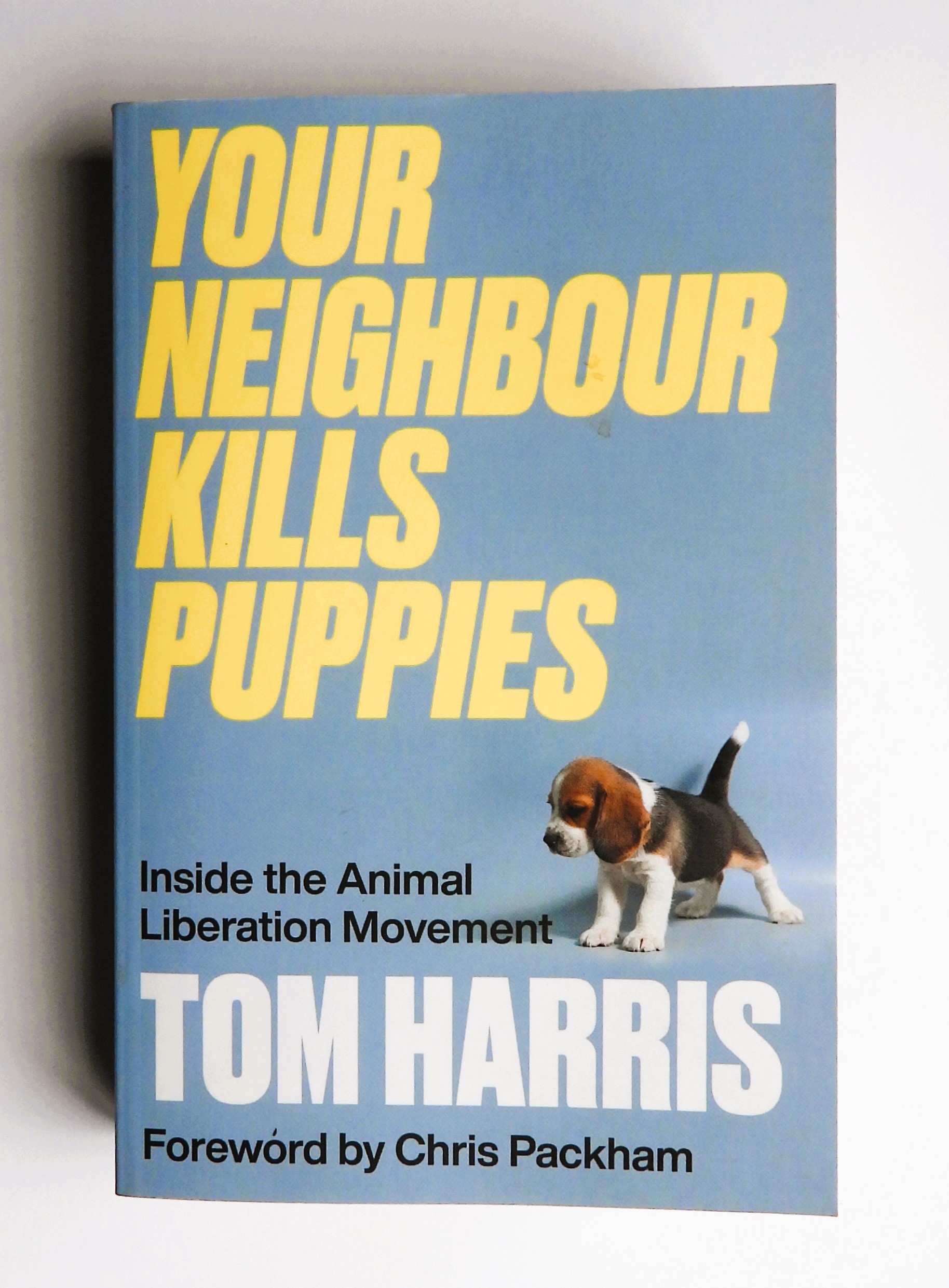
Your Neighbour Kills Puppies; Inside the Animal Liberation Movement, by Tom Harris, Pluto Press, 2024, with a superb foreword by Chris Packham. He’s good at forewords, amongst many other things, which is why I asked him to write the foreword for my first book, Animal Trust.
This is a boisterous, rollicking, relentless account of protests of various kinds and degrees of ingenuity against Huntington Life Sciences (HLS), principally by Stop Huntington Animal Cruelty (SHAC) and the attempts by UK and US governments in particular to suppress and silence them by any means. This is a long review, but it is a long and important book.
Let me say at the outset that I am totally against all forms of animal experimentation, no matter how humanely conducted (which is rarely the case) and no matter for what purpose. It is important to remember that all of them are completely and utterly pointless, in spite of what vested interests may say, most of them are off the imaginable scale of cruelty, and the only beneficiaries are the people who make money from it. Some of the experiments dreamt up and carried out over and over again for absolutely no reason are so perverse, sadistic and vicious that those who think them up and execute them must be clinically insane. Anyone who carries them out must be utterly devoid of an iota of compassion or empathy.
One consequence, we read, is that mother cats in laboratories often kill and eat their kittens. It is suggested that this a result of psychosis brought on by stress from living in such sterile and appalling conditions. These animals live in a constant, wretched state of fear and squalor. I would suggest that the infanticides may instead be the result of rational thinking: death is better than the life these kittens would have to endure.
A theme which runs through the book is the relation of the very many broken promises and indeed involvement of the Labour government under Tony Bliar (sic – his lies did after all lead us into an illegal war forever widening the tragic gap in understanding between the Muslim and Christian worlds in particular, and he has freely admitted that he ensured that the Hunting Act of 2004 which was supposed to bring an end to hunting with dogs, especially of foxes, was deliberately badly worded so as to be completely useless as we see evidentially to this day). I don’t understand how he is not behind bars, let alone making a fortune, partly through association with some extremely dubious dictatorships.
In 1996 Bliar, then leader of the opposition, signed up to the Plan 2000 pledge to end vivisection, and with an election in the offing produced a pamphlet, New Labour: New Life for Animals and his representatives even met with protestor Barry Horne who called off his hunger strike on behalf of animals as a result. Flushed with false hope, when Labour was elected, the Royal Commission report into animal experiments was eagerly awaited, but Labour were already backtracking and also failed to find funding for alternative research models which even the director of the Research Defence Society, a pro-vivisection lobby, described as a “damning indication ‘of how much importance it attached to alternatives’”.
God knows we don’t want the bunch of criminals in power in the UK at the moment back again, but Keir Starmer worries me – he has already backtracked on environmental promises before he has even got into power.
In 1999 Glaxo Wellcome, the big Pharma company, having had a new flu drug fail to be approved by the National Institute of Clinical Excellence, put pressure on Bliar, who then set up the Pharmaceutical Industry Competitiveness Task Force, an act of abject appeasement.
In the same year, Home Secretary Jack Straw promised to that he was going to ban puppy farms which supplied animals to research establishments and even suggested that experiments would cease altogether if dogs were not obtained legally, then changed his mind, stating that animal researchers were “decent people doing legitimate jobs”.
It gets worse, much worse. It turned out that the Labour party was a major investor in HLS. No wonder their licence was not revoked.
By 2000 the promised Royal Commission was confirmed to have been abandoned. It was a terrible betrayal.
HLS was in trouble and had become toxic to investors, and even to the banks. Who stepped in to save them? The British government, with our money. Normal trading rules were also changed so that in this case, investors would be permitted to remain anonymous. Biotech billionaire Lord Sainsbury was made unelected minister for science, from which position he did everything he could to ensure the survival of HLS.
There’s a nice quote at the head of one chapter from the actor, comedian and writer Alexei Sayle (I had no idea he was so-minded): “I think for what they do vivisectionists deserve to be harassed, persecuted and pursued.”
The resistance, by SHAC and others, was by no means confined to the UK and the USA, it was very much a global phenomenon, spreading in particular to continental Europe, Canada and Japan. HLS’ employees, directors, lenders, suppliers of all kinds, animal breeders, customers and insurers were all targeted. The same tactic of protesting to insurers has been followed more recently by those against fox hunting and by Ekō who are using it against the oil giants.
It is hugely important to remember that SHAC never espoused the more extreme tactics of groups like the Animal Liberation Front (ALF), indeed in spite of their best efforts the police were never able to prove the slightest connection between them. Just as they have done with hunt saboteurs and demonstrators at the coronation, police strategy was to arrest protestors on the flimsiest of grounds and then release them without charge.
The crux of the issue is that activists were up against that fatal triumvirate: money, power and some very, very bad people.
As veteran campaigner Mel Broughton wrote, “HLS would not be torturing animals now without the backing of the government.” He rightly predicted that the nearer the demise of HLS came, “the dirtier the tactics of our enemies will become.”
In 2002, Brian Cass, managing director of HLS, was awarded the CBE. Renowned screenwriter and animal protector Carla Lane (see Animal Trust, pp. 200-202), portrayed by the press as a crank, returned her OBE to Tony Bliar in protest.
Laws regarding protest were tightened (as has also happened again very recently to deal with climate change campaigners) but the Real Countryside Alliance (a militant version of the Countryside alliance) were unscathed by consequences of their actions, some of which went much further than those of SHAC.
The insurers of HLS were Marsh, then the world’s largest broker. By the end of 2002 they cancelled the contract – it was making them $100,000 per year but costing them $2 million per month on security because of the campaign against them. So the government insured HLS instead, the first time in history this had been done for a private company.
When HLS was left with no auditors, they were permitted not to have to file returns for two years.
The Japanese Pharmaceutical Manufacturers’ Association wrote to Tony Bliar threatening to withdraw investment in Britain and HLS altogether unless action was taken against SHAC. Bliar, in cahoots with Lord Sainsbury, set up a task force to help companies reinforce their security. When in 2003 Bliar was handed a petition to close HLS signed by an astonishing 1.2 million people, he simply failed to respond.
In the same year a National Forum was set up to deal with the policing and prosecution of animal rights activists. This marked the beginning of prosecution and sentencing based not just on the actual offence but also on the basis of what the protest was about. All animal activists were to be tarred with the same brush. The Forum was exempt from the Freedom of Information Act.
As Neil Woods, “former detective sergeant and spycop”, writes, “…when big business directs our policing and our wider legal system, it should terrify us all. To which I would add that it was directing the media too, ever willing to demonise animal rights protestors as extremists and even terrorists.
I was all too aware of it myself, as I wrote in Animal Trust:
For many years though I’ve noticed, along with the vitriol and violence hurled at the ‘antis’, the nature of almost all the main media coverage of any confrontation, demonstration or protest. Those for the animals are almost invariably demonised as fanatics and extremists. My bookshop was once the subject of a letter-writing campaign. We have done business with the Bodleian Library in Oxford for decades, carrying out valuations and negotiating the sale of archives. There was a movement to protest some particularly barbaric animal experimentation taking place elsewhere at the university. We were asked to boycott the Bodleian. My stance was that if I thought that boycotting the Bodleian would make a real difference, I would do it, but that I was not convinced it would have any effect, the library being too far removed from the laboratories in both senses. The protestors did rather jump the gun, and heralded this as a great victory for them. I didn’t mind in the slightest. Months later I had a call from a tabloid journalist, who had heard about the letters I had received. “You must have been very scared. Were they threatening and abusive? Did they write in green ink?” she asked. “No,” I replied, “I received about twenty letters. They were, without exception, extremely polite, cogent and informed. They requested that I boycott the library, but only if that was what my conscience told me to do, and they thanked me for my time and attention. I replied individually to each of them.” No story there of course – she tried a few more times to get the answer she wanted (that my correspondents were all rabid extremists), then hung up on me mid-sentence.
Special and specialist units were set up to spy on and combat all forms of radical protest, but one such as the National Tactical Coordination Unit concentrated almost exclusively on SHAC. It is worth repeating at this point that SHAC was always a totally non-violent organisation, that was kind of the point. It was violence, against animals, that they were against.
Two outspoken critics of vivisection, a surgeon and a professor of philosophy, were simply banned from the UK.
ASBOs were issued and the National Association of Pension Funds offered a bounty of £10 million for information leading to the arrest and conviction of any animal liberation activist, all of whom continued to be lumped together. Again, no links between SHAC and the ALF were ever found, no matter how underhand the methods – because there were none. The queen even referred to “animal rights extremists” in an annual address.
These crackdowns and persecutions, whilst awful and terrifying for the victims, served only to make SHAC and others more determined and more creative.
Such actions by SHAC as were outside the law were planned and carried out mostly by an undercover infiltrator, an agent provocateur, following the orders of his police handlers.
Brutal police raids and arrests occurred in both the UK and the US for people doing pretty much nothing at all, in one case for attending a barbecue. The US government went as far, too, as to set up a fake auditing firm to prevent HLS from going out of business.
In 2006, a meeting of the Ministerial Strategy Group attended by government officials and pharmaceutical executives was addressed by Lord Sainsbury, who set out a ‘five strand approach’ to deal with the problem, but any mention of it was redacted from official documents and the details of the strands remain a mystery, although the consequences manifested soon enough.
Homes were secretly broken into by police, such as that of SHAC’s septuagenarian accountants, and the raids became ever more violent, destructive and brutal. In one instance around fifty police officers raided an animal rescue, Freshfields. Volunteers offered them keys but the police preferred to smash locks, doors and windows. Vulnerable dogs were released and when one manager tried to stop the police from leaving gates open which would allow pigs to escape, they broke his collarbone.
The charges became those of conspiracy to commit blackmail but the cases brought to court were so flimsy and absurd that the effect would be to criminalise virtually every protest group in existence. Perhaps that was the idea. It was in 2004 that the Serious Organised Crime Agency was announced, with Bliar stating that for “big enough” cases, the “normal burden” (of proof) should not be a concern. Government hopes hinged on conflating the actions of SHAC and those of the ALF.
Gagging orders and long prison sentences ensued and the system was rigged against SHAC at every level of the justice process. Police even informed the media without any foundation that one SHAC prisoner had befriended the child murderer Rose West. Animal rights inmates were subjected to serving their time at the harshest prisons.
When certain prisoners were released they appealed to the then Director of Public Prosecutions, none other than Sir Keir Starmer – he had to come up eventually – hoping that the use of the undercover agent, not revealed in court, amounted to an abuse of process. As well as refusing to engage, he later used his position as leader of the Labour party to stop MPs voting against a bill allowing undercover operatives to commit serious crimes, including rape and murder, with impunity.
By 2012, any form of protest against vivisection was seen by the government as an act of extremism. As a result of SOPCA, the Serious Organised Crime and Police Act of 2005, shouting during a protest was treated as a serious crime.
Ultimately SHAC was defeated by this raft of oppressive measures, but HLS disappeared too, sold to a rival – a hollow victory since that rival, LabCorp, continued to kill and exploit animals in their tens of thousands.
Priti Patel was bound to come up as well, was she not? “I don’t support protest” she declared, before bringing in a host of Draconian new laws, targeting in particular now Extinction Rebellion and Black Lives Matter.
But no government can suppress dissent everywhere and forever and the book ends on a hopeful note: “… a new era is dawning. The grassroots anti-vivisection movement is poised for a resurgence and is determined to finish off what its predecessors started.”
Leave a Reply