Kean (Sam). The Disappearing Spoon and other true tales from the Periodic Table, Black Swan, 2011.
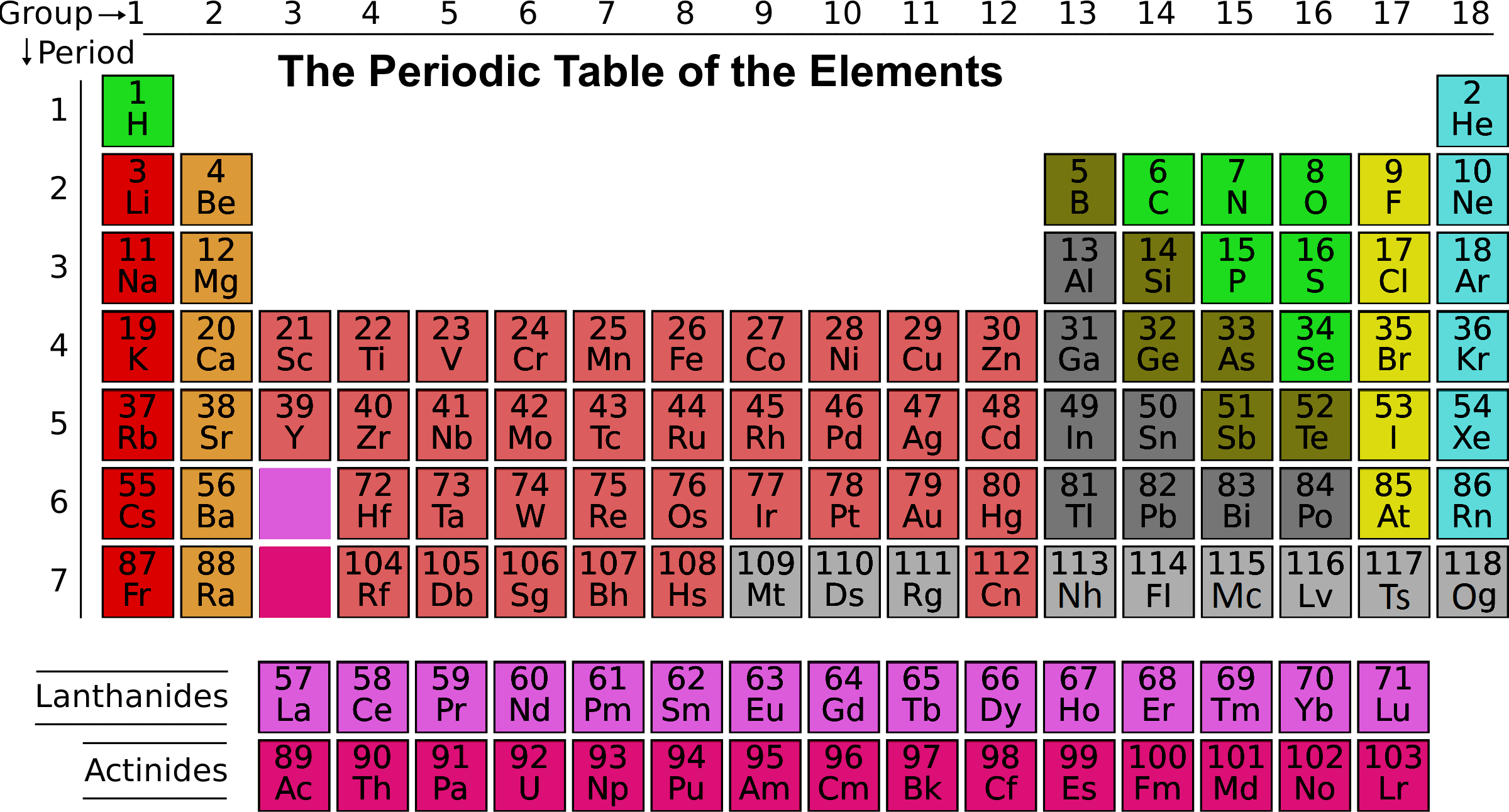
The colourful table above is taken from ExplorersInternational.
This wonderful website, List – Periodic Table, goes much further – you can click on any element to see a wealth of information: applications, properties, isotopes, emission spectra, flame test colours, histories, atomic properties, electrons per shell, electron configurations, etymologies and more, and even photographs.
The full list below was alarmingly difficult to make into a table or even columns (I used Microsoft Word, cut and paste in the end). I would have liked to have made it more colourful too, but WordPress won’t have it. Increasingly I am becoming quite frustrated with the software. Why can’t I have more fonts, more colours? The AI that comes with it is worse than useless, consuming a good deal of time but producing nothing, the opposite of what AI is supposed to do. It seems I am not alone. Astonishingly, it seems around 43% of all websites run on WordPress – but many, especially younger users, are moving to better, simpler platforms. For me I think it’s better the devil I know, but clearly WordPress is too big for its own good and it has been beset by corporate legal battles. I think they need to address core issues, to make the user experience friendlier and more intuitive, or they will be left behind altogether.
| Hydrogen (H) | Helium (He) | Lithium (Li) |
| Beryllium (Be) | Boron (B) | Carbon (C) |
| Nitrogen (N) | Oxygen (O) | Fluorine (F) |
| Neon (Ne) | Sodium (Na) | Magnesium (Mg) |
| Aluminum (Al) | Silicon (Si) | Phosphorus (P) |
| Sulfur (S) | Chlorine (Cl) | Argon (Ar) |
| Potassium (K) | Calcium (Ca) | Scandium (Sc) |
| Titanium (Ti) | Vanadium (V) | Chromium (Cr) |
| Manganese (Mn) | Iron (Fe) | Cobalt (Co) |
| Nickel (Ni) | Copper (Cu) | Zinc (Zn) |
| Gallium (Ga) | Germanium (Ge) | Arsenic (As) |
| Selenium (Se) | Bromine (Br) | Krypton (Kr) |
| Rubidium (Rb) | Strontium (Sr) | Yttrium (Y) |
| Zirconium (Zr) | Niobium (Nb) | Molybdenum (Mo) |
| Technetium (Tc) | Ruthenium (Ru) | Rhodium (Rh) |
| Palladium (Pd) | Silver (Ag) | Cadmium (Cd) |
| Indium (In) | Tin (Sn) | Antimony (Sb) |
| Tellurium (Te) | Iodine (I) | Xenon (Xe) |
| Cesium (Cs) | Barium (Ba) | Lanthanum (La) |
| Cerium (Ce) | Praseodymium (Pr) | Neodymium (Nd) |
| Promethium (Pm) | Samarium (Sm) | Europium (Eu) |
| Gadolinium (Gd) | Terbium (Tb) | Dysprosium (Dy) |
| Holmium (Ho) | Erbium (Er) | Thulium (Tm) |
| Ytterbium (Yb) | Lutetium (Lu) | Hafnium (Hf) |
| Tantalum (Ta) | Tungsten (W) | Rhenium (Re) |
| Osmium (Os) | Iridium (Ir) | Platinum (Pt) |
| Gold (Au) | Mercury (Hg) | Thallium (Tl) |
| Lead (Pb) | Bismuth (Bi) | Polonium (Po) |
| Astatine (At) | Radon (Rn) | Francium (Fr) |
| Radium (Ra) | Actinium (Ac) | Thorium (Th) |
| Protactinium (Pa) | Uranium (U) | Neptunium (Np) |
| Plutonium (Pu) | Americium (Am) | Curium (Cm) |
| Berkelium (Bk) | Californium (Cf) | Einsteinium (Es) |
| Fermium (Fm) | Mendelevium (Md) | Nobelium (No) |
| Lawrencium (Lr) | Rutherfordium (Rf) | Dubnium (Db) |
| Seaborgium (Sg) | Bohrium (Bh) | Hassium (Hs) |
| Meitnerium (Mt) | Darmstadtium (Ds) | Roentgenium (Rg) |
| Copernicium (Cn) | Nihonium (Nh) | Flerovium (Fl) |
| Moscovium (Mc) | Livermorium (Lv) | Tennessine (Ts) |
| Oganesson (Og) | ||
I have left the Americanspellings, sulfur (S) and aluminum, (Al) unedited. Kean uses “sulfur” throughout but “aluminium”. He is quite scathing about the American version of the latter. Instead of naming the element in parallel with other discoveries of the time such as barium (Ba), magnesium (Mg), sodium (Na) and strontium (Sr), American chemist Charles Hall, who made a fortune from it, decided omitting the second “i” aligned it with platinum (Pt). “As always in the United States, money talks”, says Keane. Or it may just have been a typographical error. “Sulphur” though is pretty specifically British and is now considered rather old-fashioned. It seems we mistook the origins of the word for Greek rather than Sanskrit via Latin.
Many of the names refer to ancient myths (promethium (Pm) for example), some are amalgams of Latin and Greek, “the names of the noble gases mean ‘stranger’ or ‘inactive’”.
Following a section on the Manhattan Project which I did not know developed and used an entirely new scientific method, there’s a history of the race to discover new elements, the jealousies and bickering, often jingoistic, which I found all rather tedious and disappointing.
Most people will have heard of the Bikini Atoll and the appalling history of the testing there and the terrible consequences for the original residents (Nuclear testing at Bikini Atoll – Wikipedia). The bikini, as in the beachwear, incidentally, designed by Louis Réard and introduced in 1946, was named for the shock value.
However I had never heard of the Eniwetok or, more correctly, Enewatek Atoll was pretty much obliterated according to Kean and although huge sums have been spent on a clean-up, rising sea levels are causing radioactive material to leak out from the crater and dome constructed to contain the waste materials.
The widespread use of copper in infrastructure is not just because it isn’t lead. It is ‘self-setrilisng’ – bacteria, fungi and algae absorb copper (Cu) atoms which kill them. That’s “why we have brass doorknobs and metal railings in public places” and so many coins are copper-coated.
There are a very interesting few pages devoted to thalidomide and the role of chemicals in the mitigation of Parkinson’s disease, especially Rhodium (Rh), also on titanium (Ti), used so widely in implants and prosthetics because it does not trigger an immune response and even “cons the body’s osteoblasts, its bone-forming cells, into attaching themselves to it as if there was no difference between element 22 and actual bone.”
A couple of tea tray moments (for me) follow. Of our senses only smell “bypasses our logical neural processing and connects directly to the brain’s emotional centers.” So that’s why remembered smells are so evocative. And taste is really just a combination of smell and touch. An even more idiotic tea tray moment: it had never occurred to me even to wonder why it was called the periodic table. It’s because it has periodicity in the form of increasing atomic weights.
Iodine (I) and its presence or absence in common salt created a massive problem for India with Gandhi’s “shaking of the foundation of the [British] Empire” by encouraging people to make their own, illegal, untaxed salt. By rejecting the West’s practice of adding iodine, they faced grim consequences including higher rates of birth defects and loss of mental faculties. Another hero of mine, Bertrand Russell, cited iodine in his case against the existence of immortal souls: “The energy used in thinking seems to have a chemical origin … For instance a deficiency of iodine will turn a clever man into an idiot.” We are chemistry, he argued, through and through.
Mention of iron pyrite, fools’ gold, took me all the way back to a small cardboard box I was given as a child with a dozen or so samples of rocks, glued to the bottom and labelled, including iron pyrite. It always fascinated me and although still in good condition years later did not survive the attentions of my children. I would now like to buy small samples of various rocks but have decided that online is not the way to go since of course you can’t be sure what shape you’ll be getting – I need to see them in the flesh, as it were. Iridescent bismuth (Bi) is high on my wish list.
Actual gold and the story of the Australian gold rush had me thinking of one of my ancestors who is believed to have been killed for the gold he was bringing back to England from Australia – his widow is said to have died from a broken heart. And also of a dear friend who has spent most of his working life as an assayer at Kalgoorlie, which became the site of the world’s largest gold producer.
Kean is astute on the subject of counterfeiting which has “always attracted people who do not understand opportunity costs – the basic economic law that you can make far more money plying an honest trade than spending hundreds of hours making ‘free’ money.” This reminded me of another old friend. His car was due for an MOT and we spent most of the day driving around desperately trying to find what is perhaps best described as a trailer park near Maidenhead. We entered a caravan to find a guy sat with an unused pad of genuine MOT certificates, for one of which my friend paid something in the region of £30 or £40. Unfortunately for him, he completely screwed up his attempt to fill it in and resignedly decided to take his car to the garage the next day. No repairs were needed, the car passed the test easily and it cost far less than he had paid for the blank certificate.
Kean has inspired me to get a copy of Primo Levi’s The Periodic Table. I have not read him before but am much looking forward to what is generally hailed as a masterpiece. He stole small sticks of cerium (Ce) whilst working in a prison chemical plant, useful for lighting cigarettes since they spark when struck, and bartered them for bread and soup in the concentration camp, saving his life.
As a pen and stationery fetishist (see Long Live Dame Hilary Mantel – Animal Wild), I loved the story of the Parker 51, considered by many the greatest pen ever and “one of the most stylish designs ever; in any field.” The tip was made from ruthenium (Ru), gold, being a soft metal, tending to deform under the pressure of writing. It was a massive success and became de rigueur as a status symbol amongst the elite. I remember my first Parker pen, which I loved. It had a sense of classiness and luxury. The market shrank with the arrival of the typewriter. Mark Twain complained a great deal about his but it was he who submitted the first ever typescript of a book to a publisher, Life on the Mississiippi in 1883.
Kean elaborates. Goethe’s Faust can be taken as addressing humans’ incapacity to use technology properly and responsibly (have we, with AI, opened Pandora’s Box?) and Twain wrote “short stories about inventions, technology, dystopias, space and time travel, even, in his bemusing story ‘Sold to Satan’, the perils of the periodic table.” Twain’s Satan glows green and burns so hot because he is made of radium (Ra). “… Twain was already trembling about the awesome power of nuclear energy in 1904. Had he lived forty years more, he would surely have shaken his head – dispirited, yet hardly surprised – to see people lusting after nuclear missiles instead of plentiful atomic energy. Unlike Goehte’s forays into hard science, Twain’s stories about science can still be read today with instruction.”
Much as I despise almost all of Jeremy Clarkson’s opinions, I still read him in the weekend papers as a guilty pleasure. I’ve always said he writes well and can be very funny. He tells the wonderful story of the Fisher space pen, developed at a cost of $1m which could be used to write in zero gravity. Apparently an Anerican astronaut showed it to a Russian cosmonaut who said, “Very clever, but we have something better. It’s called a pencil.” In the same edition of the paper he confesses to not liking the Rolling Stones, which is tantamount to blasphemy as far as I am concerned, nor Led Zeppelin (mind you Keith Richards doesn’t rate them either), although I am with him on the seventies TV series MASH – like him I never found it remotely funny or compelling in any way.
Talking of the Sunday paper, the colour supplement is yet again wrapped in a profoundly peculiar advertisement for Great Western Railways, which I feel I have been seeing everywhere. It seems to be urging us to travel on their trains to visit and see things which don’t exist (as well as a few that do), such as Camelot, the Giants of Avon Gorge, the Hound of the Baskervilles and so on. How is this supposed to work? Does anyone really see an image of the Faeries of Pennard Castle and suddenly decide to get on a train to Wales? The campaign must be costing them a fortune.
The money would surely be better spent getting trains to run on time if at all. Taking the train is for me like going to London – to be avoided unless absolutely necessary. Almost invariably I end up catastrophically late and/or having to pay for taxis. Two friends and I tend to meet in Newbury for a few beers and a curry and we all get the train from our various homes. One or more of us is late more often than not. Newbury is only six miles from my house but the trains back in the evening had all been cancelled just recently for reasons unknown. Over £25 for a taxi was annoying to say the least, but very much part of a pattern.
According to the Office of Road and Rail, Only 65 percent of trains ran on time this summer (Avanti managed just 32%) and 6% (112,000 trains) were wholly or partly cancelled. UK trains ran a combined 419,917 minutes late in just ten days in October, that’s 144 years of people’s time. 6% might not sound too bad but it’s one in approximately every 22. GWR had 61.5% on time in 2024 to 2025 and 4.6% cancellations. Must try harder.
Leave a Reply