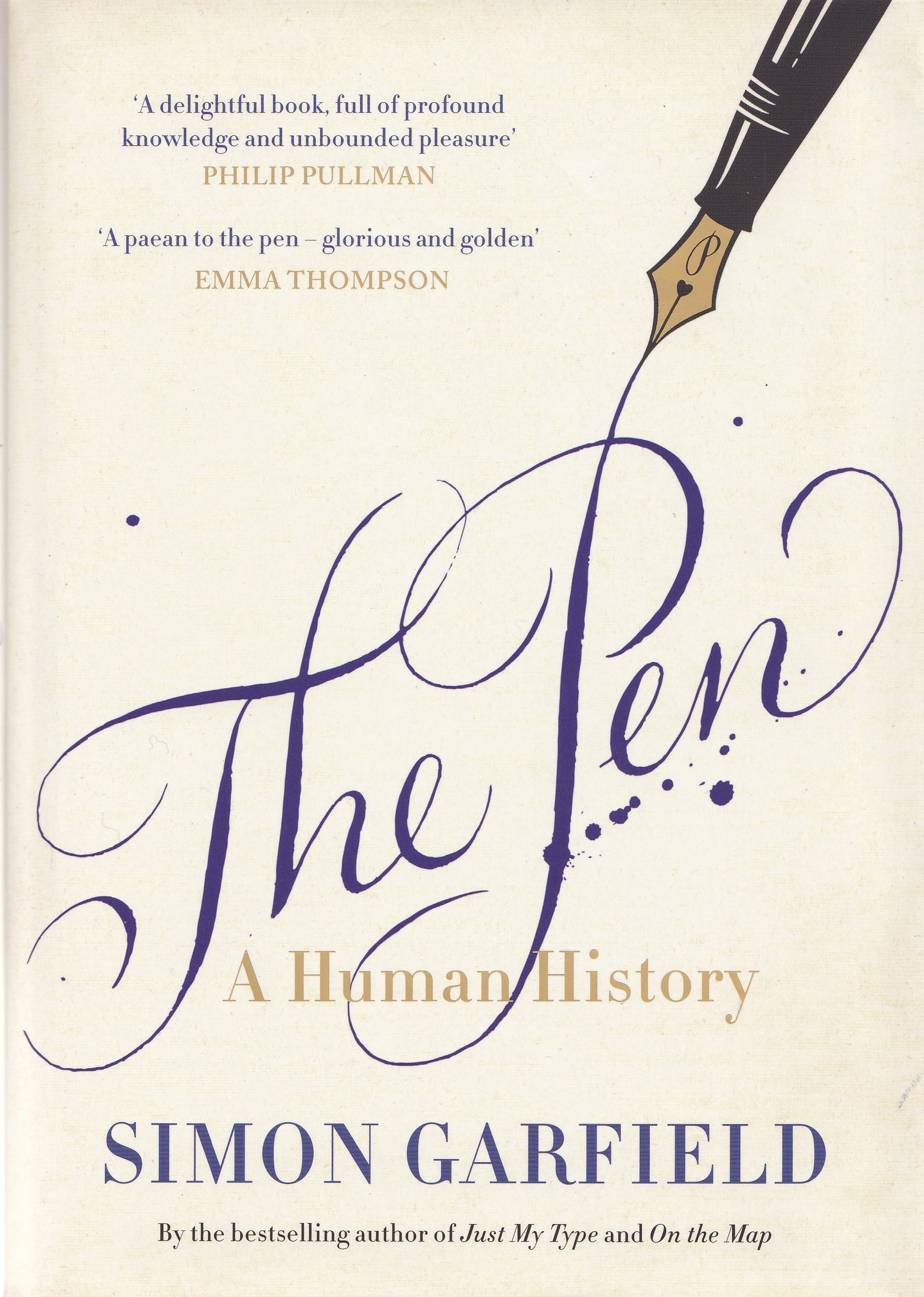
Garfield (Simon). The Pen, A Human History. Canongate, 2026.
I have admitted to what is perhaps almost a fetish about pens and other stationery, although I tend to think, wrongly, of stationery as everything except writing implements, here: The Elements (The Periodic Table). Part II. Including Parker and other pens, nuclear fission and our terrible railway network – Animal Wild, Kean (Sam). The Disappearing Spoon and other true tales from the Periodic Table, Black Swan, 2011, where Kean includes a lovely digression on the Parker 51. I also referred to this post: Long Live Dame Hilary Mantel – Animal Wild.
Simon Garfield has written on a number of subjects, unabashedly diving deep into the niche. There’s Just My Type: The original and best book about fonts which I already have, The Wrestling which I can’t really imagine holding my attention, On The Map: Why the world looks the way it does and perhaps most intriguingly Mauve: How one man invented a colour that changed the world, which deals with the unintentional discovery by means of a failed experiment of mauve, the world’s first synthetic dye. A moment of serendipity which changed the world – the colour purple.
My favourite brand these days is without a doubt Lamy, a German company, and whilst there’s a limit on how much I am willing to spend on a pen I have a fair few Lamy rollerballs and biros. Wrtiing with them is a silky experience and they always seem to get balance and heft just right.
This rollerball is a beauty, it balances perfectly and is even better with the cap popped onto the non-writing end.


I used to have three of these but the black one is lost or mislaid. As Garfield says, pens do have a habit of getting mislaid, sometimes turning up again in surprising places.

These Lamy biros are my go-to pens and they not very expensive. The refills seem to last forever. I like to have at least three in various places and once thought I had lost all of them. Only after I had re-ordered did I find them – one in the car, one in a jacket I hadn’t worn for a while, and one, absurdly, in a pen container. The blue version (15g) is not a patch on the silver (20g). Weight matters. The capped rollerball comes in at 35g, the other rollerballs above at 25g.


These Energel pens from Pentel with 0.7mm tips are another favourite for flow, comfort and inexpensive price.

I love this which came from Charles Darwin’s house – I think the wood is genuine and it bears Darwin’s facsimile signature and it fits in the hand beautifully.

This Graphgear propelling pencil from Pentel has a wonderful hi-tech look.

This oddity is, I am afraid, a porno pen. There’s a little translucent window to let in light and by looking down the end and twisting two sets of extremely explicit images appear. I genuinely have no idea where it came from.

The present book is indexed (always a plus, and there are plates in colour and black-and-white too) and that is where I started. As Garfield says is true for most people, the subject first took me back to my schooldays when Osmiroid and Platignum were the makes of choice. I never had the former but quite liked Platignum cartridge pens, not that they were terribly good. Parker was a real step up but for me Lamy has eclipsed them. Oddly, the German firm rOtring (sic) doesn’t get a mention, at least not in the index. Their pens are designed primarily for technical work and were a bit of an obsession for a while for a friend and me. The precision was the appeal. Cheap and cheerful Bics were all very well but most useful, as Garfield mentions, for winding tape back into a cassette.
At the primary school attended by my children, everything was ruined by a new headteacher. Before her arrival, there was a great deal of parental involvement in the small, rural establishment, from organising touch rugby and netball matches, walks and runs, to, in my case, helping with reading groups which I found very rewarding. The children were enthusiastic and seemed to enjoy them. I tried to take a light-hearted approach, usually starting with a word game or similar before moving on to the book in hand. I attempted to get them to think for themselves rather than being prescriptive. The new head, Mrs Buttcombe (or a name very like that, we had our own family nickname for her which I won’t repeat here) put a stop to all of it. I never understood why – it wasn’t about safety concerns, I for one was DBS checked. I think she was one of thse people who cannot bear anything not to be in her complete control. I was never thanked for my efforts and I doubt any other parents were. She had come from a very different, more urban school and never stopped to think that a different approach and regime might have been more appropriate in a different environment.
I went in to complain about one of her decisions, which was to ban pupils from bringing their own pens to school for fear of creating envy. That’s the kind of thinking which says there must be no losers (and therefore no winners) on sports day. I can’t be sure at this remove but I think she did recant. What a very great shame if parents cannot reward a child for improving their handwriting with the gift of a decent pen, to be treasured. A little rite of passage. She was not an intelligent woman and this seemed to me to border on the wicked.
As well as school I also immediately thought, on picking up this book, of king Charles and his peculiar little televised tantrum over a pen – that is indexed and I look forward to Garfield’s commentary. He points out that Jane Austen and Charles Dickens both had issues with their writing tools.
I always prefer blue ink to black, in fact I insist on it, I don’t know why. Green is supposed to indicate a kind of madness and is best avoided. We learn that Barack Obama wrote the first draft of his memoir on those yellow legal pads, favoured by my father but not by me.
The Pen opens with an auction at Christie’s, happening to mention Meg (Margaret) Ford, international head of Books and Science, who is an old friend whom I first met working in a bookshop in New York. The story is of the Crosby-Schoyden Codex (codices superseded scrolls) which sold for £2.4m (hammer price). It’s one of the oldest books in existence containing two of the earliest biblical texts and was written with a reed (probably a Nilotic bullrush) on papyrus. The collector who sold the book, Martin Schoyen, amassed an incredible collection celebrating the tactility of pen, ink and paper.
A pen though, to keep things in perspective, is as Garfield says, just a stick with ink in or on it. As important an invention in terms of human progress, he suggests, as the wheel, the steam engine and the microchip. “There are few memorials in its honour, unless one counts the entire advance of human thought and integrity.” If you write with something, it’s a pen, including whatever scratched the cross-hatching into the lump of ochre, the earliest known human mark found in the Blombos Cave in South Africa and dating from more than 70,000 years ago. The electronic Apple pen is merely an “impersonation” of the real thing.
As with vinyl, pens are having a revival and there are plenty of avid collectors.
Pens and pencils, to my surprise do not have the same etymological root. The former derives from the quill, penna being Latin for a bird’s wing, whilst the latter is from penicillus, the hair of a painter’s brush, which became the French pincel.
The pen being mightier than the sword was another first thought – it turns out to be much more recent than I would have guessed, coming from Edward Bulwer-Lytton’s play Richelieu: or The Conspiracy Theory, 1839.
I feel I must have known that the penknife is so-called for the most obvious reason – the cutting and sharpening of quills.
As a fan of the John Wick films I also looked in vain at the index to see if there might be a mention of the hero’s ability to kill with a pencil, but it may yet come up.
Leave a Reply