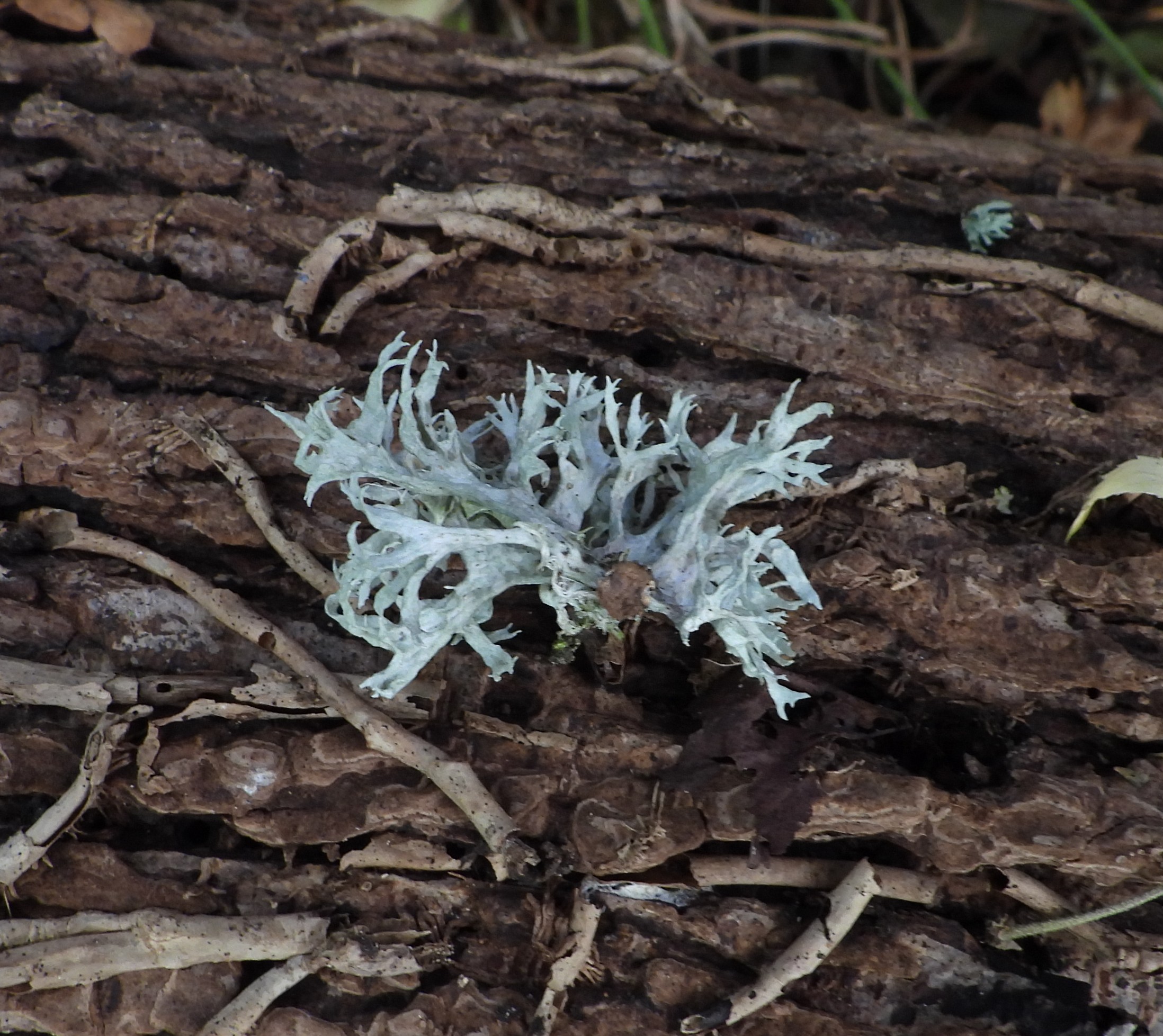
A short sunny walk yesterday was enlivened by this Oakmoss Lichen, above, and lichen community (four species, apparently), below.

Also this crust fungus.

I thought this dead sprig of holly was also strangely beautiful.

The walk was enlivened a great deal more by a surprising discovery. The footpath is very close to home (for obvious reasons I can’t say exactly where) and I have enjoyed it many, many times over the years, noticing a couple, at most, of disused badger sett entrances. That has dramatically changed. I counted eight entrances, at least six of them clearly active, most showing signs of recent digging.

A classic example. It rather confirms the point I made in a recent post, “Developers should have to show that a sett has definitely not been in use for at least six months, preferably a year. Or they should simply not be allowed to destroy them at all. If for no other than reason than that badgers might at some point want to use them again.”
A Sparrowhawk, a female this time, took a songbird in the garden a couple of days ago, as ever seen only from the corner of my eye. gone in a moment. Does anyone ever get a good look at one? It is hard to imagine a faster bird with such supreme control over its movements. A female Great Spotted Woodpecker has been visiting too – the half blind male from earlier this year I don’t think will have survived.
The Amur Tiger
The killing of a human by a tiger at Yorkshire Wildlife Park has made headline news. It seems the poor guy suffered from some form of autism. I am pleasantly surprised to note that the tiger will not be euthanised, but he will not be bred from (no bad thing only in the sense that fewer imprisoned togers must be a good thing) and will have to spend the rest of his miserable days in a smaller enclosure.
The Amur or Siberian Tiger is, arguably, one of six remaining subspecies,, the others being Malayan, Sumatran, Bengal, Indochinese and South China; the Bali, Javan, Caspian Tigers are all extinct.
There really shouldn’t be any tigers or other big cats (or in my view any captive wild animals at all) in the UK or anywhere else.
As Will Travers of the Born Free Foundation puts it, “So, more broadly, what about zoos? Born Free, founded by my parents and me, Virginia McKenna and Bill Travers, has argued for more than 40 years that the conservation work carried out by zoos is, at best, very modest – that the funds deployed by zoos to protect wildlife in its natural habitat are meagre, that zoo claims that they educate the public are hard to substantiate, and that millions of wild animals are confined in the world’s 10,000 zoos largely for our entertainment. The modern zoo concept has been around for about 200 years (London Zoo was founded in 1826) and we believe its time is over. That doesn’t mean randomly releasing currently captive animals into the wild. Most would surely die. But it does mean progressively shifting our emphasis towards the conservation of species in their natural habitat through effective conservation policies, land management practices that leave space for nature, and the deployment of innovative finance models that recognise the value of the ecosystem services nature provides and invests in a future that looks after the natural world by leaving it alone.”
At Yorkshire Wildlife Park the tiger enclosure comprises just two acres, a tiny area. Female tigers may have a range of between 10 and 70 square kilometres, males sometimes between 60 and 100. Two acres is a tiny fraction of these. If we take a figure of 60 square kilometres as a default, we are looking at approximately 0.0135 percent.
Turpitude
See here for the background on this: Seaweed, Feral cats in Australia, America, Dr Dolittle and the Bullfight and Ozzy Man Reviews – Animal Wild
Merriam Webster defines turpitude as “inherent baseness, depravity”, also “a base act”, adding: “Turpitude comes from Latin turpis, meaning “vile” or “base.” The word is often heard in the phrase “moral turpitude,” an expression used in law to designate an act or behavior that gravely violates the sentiment or accepted standard of the community. A criminal offense that involves moral turpitude is considered wrong or evil by moral standards, in addition to being the violation of a statute.”
Trump is keen on renaming things and I am wondering whether to do a little of my own, the USMT, the United States of Moral Turpitude. The decision to livestream a firing squad execution has been rescinded. I expect a Trump advisor, the sort of person who uses the word “optics”, has pointed out that the optics would not be great. The rest of the world’s outrage was less likely to have been a factor. Emily Maitlis nicknamed Hegseth as “Fratboy in Chief” which describes him perfectly.
I had never heard of roller derby, a sport of sorts that cropped up in a cop show I was watching. It definitely falls into the category of pointless and demeaning American staples. It seems one player from each side has to go round in a circle whilst everyone else tries to stop them by knocking them over and often injuring them. Weird.
I mentioned Farage in the same post and now I am pleasanly surprised to read that the Catholic Church has condemned his plan to close the UK to all asylum seekers if he becomes prime minister, saying that his claim to represent Judeo-Christian values could not be further from the truth – the Bible teaches that those fleeing persecution should not be turned away. Pope Leo has also spoken out against the politics of hatred and division. Reform is beset by scandal after scandal. We can only hope that they will eventually disappear, never to be remembered other than as a sombre warning.
Sewage
This problem is not going away. It was good to see Danny Dyer et al. delivering a petition, signed by over 350,000 people, to 10 Downing Street, calling for public ownership of water. Burnham’s plan merely to “increase public control” doesn’t cut it.
I clearly remember from my childhood the putrid stench coming from the sewage works at Slough experienced while driving along the M4. Then, I assumed because of improved treatment and modernisation, it vanished. But now, as I learnt driving my daughter to Luton Airport in the small hours the other day, it is back with a vengeance. I suppose people living nearby become inured to it, stop noticing it, but it is once again impossible to ignore for those passing by.
Elephant Polo
One of the things I love about the Lateral podcast is the many tangents it sends me off on and this was one of them. I had a vague memory of the colonial, cruel and humiliating spectacle. Thanks largely to PETA it is now a thing of the past following undercover footage of participating elephants being savagely beaten and stabbed with bullhooks to completely break their spirits before a game. It is a very tough watch. The matches themselves consist of a few elephants on either side with a bullhook-wielding mahout sat behind their heads and an upper class twat with a mallet further back giving instructions. What to make of it and more to the point what on earth did the elephants make of it?
Dogs and long grass
It would be understandable to think from some of my posts that I have something against dogs, but I don’t, as my books and weekly walk with Chilli, the Norfolk Terrier for the Cinnamon Trust attest. The ‘owners’ are the problem. Many are interested mostly in dominance, but there is no need for that. But there does have to be some element of control for safety and consideration of others. Chilli is lovely but stubborn and she likes to walk in the middle of the road and if there is traffic that is obviously dangerous. She now understands, through gentle persuasion, exactly what I mean when I say, “Chilli, pavement please” – not that she always complies immediately.
Now with that selfish sense of entitlement and arrogance that only certain types of dog ‘owners’ exhibit, there is a petition demanding that the grass in Calcot, West Berkshire, should be cut more frequently. The seeds of Wall Barley, also know as “flea darts” can become painfully embedded and sometimes a visit to the vet is needed. The petitioner is specifically talking about grass verges, left to grow naturally for the sake of wildlife and biodiversity, to the delight, surely, of most. The dog in the picture which heads the petition is not even on a lead (on a roadside verge, really?) and there is a blurred, worried looking human in the background clearly not in control of the situation.
Careful post-walk grooming is probably too much trouble, but I have a simpler solution. Don’t walk dogs in long grass if it is such a big problem. Walk them somewhere else. Not complicated.
The Wildlife Trusts say that Wall Barley flowers are “clingy as burdock burs and have been the subject of many games as children desperately try to stick them to each other and unsuspecting pets”, which does not suggest terrible danger. There are other ‘sticky’ grass seeds too of course but these anti-nature people do like to demonise particular species.
Elsewhere another person with a Cocker Spaniel complains in an unwitting, almost comedic show of stupidity and selfishness: “We come here in the early morning, and I used to let him off the lead. But because some of the grass was so bad and all the barley is up, I now have to keep him on the lead.” So leaving something to grow naturally is bad. And of course the Spaniel should be on a lead anyway.
Handwriting rebel
I think this memory was provoked by Lateral as well. When I was at school I thought my numerals “1” and “7” looked rather too alike and so I began using the version of seven with a horizontal line across the middle of the downward stroke.

This met with much disapproval – I even heard a teacher commenting on it with a sneer at a parents’ evening. It was a continental habit and therefore infra dig. I have a strong stubborn streak and so I continue to use it to this day. My old boss at Sotheby’s advised me that clients would take me more seriously if I lost the bangles, to which my response was to buy and wear many more, also continued to this day. Such are my little rebellions.
This is good on the subject: Regional handwriting variation – Wikipedia. The slash though the numeral “0” makes complete sense to avoid confusion with the letter “O” and there are other fascinating variations.
Razorbills & Guillemots
Sam & Ade Go Birding is a series I find gentle, charming and irritating in equal measure. I guess it’s the equivalent of Paul Whitehouse and Bob Mortimer’s Gone Fishing without the pointless cruelty, which is in part the story of a friendship, thoughts on aging and so on. Samuel West and Adrian Edmondson most recently visited Bempton Cliffs for the seabirds. I was reminded of seeing and photographing Guillemots in flight in Northumberland and thinking at the time how ungainly their flight was. Sam West explains what should have been obvious to me – those wings are adapted for underwater movement, they have evolved as the bare minimum required for flying.
From Animal Wild:

Leave a Reply