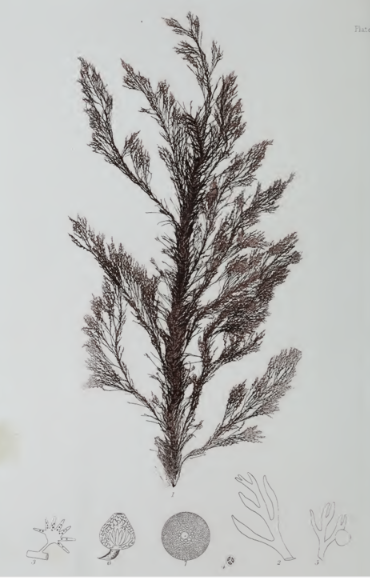
Seaweed
I am not sure why I was thinking about seaweed although it somehow evokes happy childhood memories. My brother and I used to collect the odd frond and take it home where it would desiccate and eventually fall apart. Who knew of the crime we were committing? I would now live rigidly by the mantra take nothing but photographs, leave nothing behind but your footprint, but it seemed harmless enough at the time. Apparently people take larger quantities and use it as garden fertiliser. Rarely if ever enforced, we have all been breaking the law. Seaweed belongs to, wait for it, the Crown Estate. They own the entire foreshore and seabed to a certain boundary all around the coastline. That they actually own the seaweed as well beggars belief.
The example above is Rhodemela subfusca and the illustration is from W.H. Johnstone and A. Croall’s The Nature-Printed British Seaweeds: a history, accompanied by figures and dissections, of the algae of the British Isles, 1859-1860

Feral cats in Australia
The most notorious example of misguided eradication of species is Mao Zedong’s elimination of Sparrows as part of his four pest campaign which was a primary cause of the deaths of millions or even tens of millions of people in the Great Chinese Famine.
Four Pests campaign – Wikipedia
A few videos I watched recently on Youtube show that Australia has historically competed hard for the crown in making decisions without the slightest forethought of inevitable consequences.
Rats were introduced through the arrival of European ships, going back as far as the First Fleet, with disastrous consequences: agricultural havoc and the extinction or devastation of multiple native bird, insect and reptile species. One way of mitigating the problem is the preservation and reintroduction of native bush rats who help to keep invasive rats out of bushland areas. But in the eighteenth and nineteenth centuries it was decided that the introduction of cats would be the best solution.
As those cats were abandoned or escaped, thriving colonies were established so that feral cats are now apex predators across much of the continent, against whom native ground-dwelling species (birds and mammals) have no defences. They too have proved themselves behind extinctions, an area in which Australia leads the world.
Then came the rabbits. Just one man, Thomas Austin, was responsible. In 1859 he introduced just 24 rabbits onto his property purely for hunting for ‘sport’. Within decades there were hundreds of millions of them, stripping native vegetation, causing catastrophic soil erosion and outcompeting marsupial herbivores. Diseases such as myxomatosis were introduced but they brought about only a temporary reduction in numbers as rabbits evolved to resist them.
So began the construction of the rabbit-proof fence (some 2,000 miles of it), cutting across Aboriginal ancestral lands, songlines and sacred sites and severely affecting local ecological systems upon which the Aboriginal people depended for survival. It didn’t work.
I have never been able to bring myself to watch the movie Rabbit-Proof Fence, I think I would find it too traumatic and harrowing, but it is grimly ironic that the fence served as the guide home in 1931 for the three children, of whom the movie tells the story, who were forcibly removed from their families, part of the Stolen Generation – a eugenicist policy continued until as recently as 1970. All of this without consent, compensation or even, to this day, apology.
It is thought that Dingos were the feral result of domestic dogs introduced to Australia by settlers between 3,500 and 5,000 years ago and they rapidly became the continent’s apex predator, resulting in the extinction of the Thylacine and Tasmanian Devil. Over time the ecosystem adapted and kangaroo, fox and cat populations were usefully kept in check. However, they also targeted livestock and so in the late nineteenth century it was deemed it was time for another fence, the Dingo Fence, in addition to mass culling and poisoning. It was another disaster. South and east of the fence, kangaroo, cat and fox populations exploded and small native mammals suffered accordingly. As a species, we seem extraordinarily reluctant to learn from our mistakes.
America (the United States of)
It has always made me smile to remember that when some jingoistic GI Joe type proudly announces that they are from America, the best way to annoy them is to ask them which one.
I used to fly to America a couple of times a year on business and clearly remember the bizarre form printed on green card which had to be filled in for submission on arrival. Alongside various other assurances, we were required to attest that we had never been arrested (even if not charged, presumably) or convicted “for an offense or crime involving moral turpitude”. Neither were we “seeking entry to engage in criminal or immoral activities”. The wording was absurdly vague and archaic and has now been changed, but if ever an entire country was descending into moral turpitude, the USA is it.
As the excellent analyst and commentator put it recently, the country is “hurtling to an abyss”, a moral abyss. Trump’s attack on the International Criminal Court, which exists to deal with war crimes, and plan to hold a livestreamed public execution are only the latest in his maniacal attacks on basic human decency and international law.
Nigel Farage has similarly outlined his latest plans on immigration including a five year ban on any grants of asylum and all active applications being declared void. Where is the compassion, the humanity?
Dr Dolittle and the bullfight
I continue to dip into the wonderful Dr Dolittle books which were a huge influence on me as a child and still bring tears to my eyes. I had forgotten the tale of the bullfight from The Voyages of Dr Dolittle. The narrator asks the doctor what a bullfight is.
To my great surprise the Doctor got red in the face with anger. It reminded me of the time when he had spoken of the lions and tigers in his private zoo. “A bullfight is a stupid, cruel, disgusting business,” said he. “These Spanish people are most lovable and hospitable folk. How they can enjoy these wretched bullfights is a thing I could never understand.”
Then the Doctor went on to explain to me how a bull was first made very angry by teasing and then allowed to run into a circus where men came out with red cloaks, waved them at him, and ran away. Next the bull was allowed to tire himself out by tossing and killing a lot of poor, old, broken-down horses who couldn’t defend themselves. Then, when the bull was thoroughly out of breath and wearied by this, a man came out with a sword and killed the bull. “Every Sunday,” said the Doctor, “in almost every big town in Spain there are six bulls killed like that and as many horses.” “But aren’t the men ever killed by the bull?” I asked. “Unfortunately very seldom,” said he. “A bull is not nearly as dangerous as he looks, even when he’s angry, if you are only quick on your feet and don’t lose your head. These bullfighters are very clever and nimble. And the people, especially the Spanish ladies, think no end of them. A famous bullfighter (or matador, as they call them) is a more important man in Spain than a king—Here comes another crowd of them round the corner, look. See the girls throwing kisses to them. Ridiculous business!”
Able to communicate with the bulls, the doctor arranges a staged fight from which he emerges victorious, seeming to have reduced the bulls to submission. This wins him a bet with the result that bullfighting is banned forever in the ‘Capa Blancas’.
Wonderfully, at the end of the spectacle, “with a final bow to the ladies John Dolittle took a cigar from his pocket, lit it and strolled out of the ring.”
Ozzy Man Reviews
Easily found on Youtube and elsewhere I love these sweary commentaries, especially when I am in need of light relief and they are about animals and they often make me laugh out loud. My favourite at the moment is the one below about Dolphins, but the ones about the two horses and the rabbit and Max the scared horse are just as hilarious.
Leave a Reply