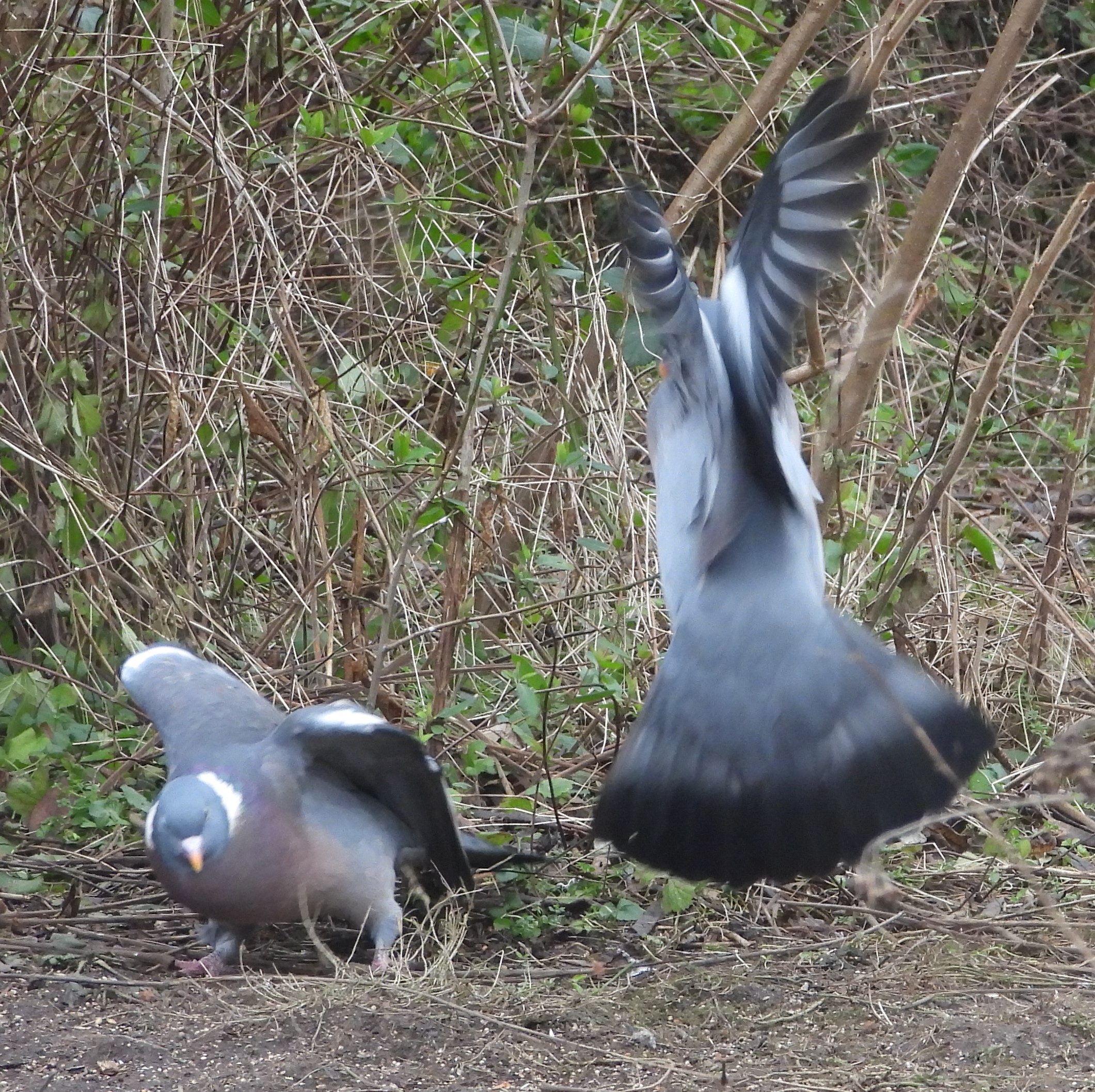
Bird of the day, the first I saw this morning, is the Wood Pigeon. Actually they are the first I see most mornings since they perch on the wires across the road outside my office window. There is always a pair here and they are often seen in a group of three which I find slightly puzzling. I don’t think they are parents and a fledgling, perhaps one is rival male, although they seem to co-exist wholly peacefully. Turning to the recently acquired garden bird books, I am surprised by the emotive and condemnatory language used since they are both British Trust for Ornithology publications. “Often seen as lumbering and clumsy” begins one account, suggesting a way to exclude them from ground feeding areas, and further describing them as “a major agricultural pest” and “a menace in the kitchen garden”. The other book has them as seen by some as unwelcome with the reputation of being “the most economically damaging bird species in Britain and Ireland.” Even their somewhat flimsy nests are described as “rather pathetic”.
I have decided not to cite population numbers and other statistics form these books since they are now so out of date. Setting aside all that negativity there is much to commend them – they are monogamous for life, for example. Some find their cooing irritating. I did for a while but adjusted my mindset and now find it charming and soothing. They are one of very few birds to produce crop milk (similar to mammalian milk) for their young and they lay two and only two eggs at a time which fit into the incubation patches on either side of the female’s breast. They have a long breeding season from March to December. They tend to move way from gardens and head for woodland in autumn where they make the most of beech mast, acorns and other bounty. They do eat a good deal of food in one go and the reason they perch for so long is to give them time to digest it. Only the adults have the white patches on the sides of their necks.
I am well aware from my animal rescue days that many people don’t like pigeons, but the British Trust for Ornithology really should know better than to encourage that.

The latest issue of BTO news has arrived, the first since the conference (The British Trust for Ornithology Conference 2026. Part I – Animal Wild and The British Trust for Ornithology Conference 2026. Part II – Animal Wild), issue 358, Spring 2026. I seem to be damning the organisation with faint praise and no little criticism lately, but the cover photo showing Starlings is underwhelming to say the least.
Ringing reports have shown that Barn Owls can disperse much further afield than previously thought, over 400 km in one case, and the oldest Black-tailed Godwit known to date is 29 years old. A Kittiwake was found to have travelled 2,752 km between ringing and recapture – apparently this is far from unusual.
The editor and a letter contributor wonder whether the BTO should not be more political in these difficult times. I think they should – the RSPB has made great strides on that front.
I like the thoughts of BTO Youth Rep Jose-Maria Kimburi who speculates that birds may, like humans, feel a need to belong and that frequent immigration and emigration may help ecosystems to thrive. Farage et al. take note instead of, in his case, raking in a six-figure sum from making Cameo videos to order in which he will be as extremist, racist or sexist or any combination of those as you like.
Blue is a relatively uncommon colour in nature but I would love to see a Red- or White-spotted Bluethroat. I hadn’t heard of them but they can be seen in the UK annually, although thy are scarce migrants.
Santiago Cárdenas-Calle, Birdwatch Survey organiser, who I am sure spoke to us at the conference, writes about his experiences in the UK and in his homeland Ecuador. He points out that early European naturalists were able to travel around colonised countries because they had the time and institutional support and perhaps had an unwarranted authority over what counted as a discovery, whilst local people provided most of the work and unsung knowledge. He dares to wonder if much has changed. ‘Parachute’ science’ can be seen in the fact that studies conducted in the global south are for the most part led by global north researchers. This neo-colonialism can render conservation fragile “when knowledge, authority and decision-making are detached from the people and places that must sustain it over time.” It is a resounding point. It’s accompanied by yet another image from Will Rose – they never fail to enchant me.
Phillip Boersch-Supan, reports on a forum about future-proofing biodiversity measurements. It covered measurement challenges and gaps, using the data for decision making, best practices “for data collection, processing and sharing”, the potential benefits and pitfalls of using AI for analysis, and touching on “academic norms in the western scholarly tradition as well as the need to respectfully engage with the knowledge of Indigenous [I like the capital case] peoples and other local communities”, rather echoing the words of Santiago Cárdenas-Calle.
Some of the articles cover topics we heard about at the conference, including European birds putting on less fat for autumn migration and the importance of soundscapes and ecoacoustics or bioacoustics. Jocelyn London takes the themes above further especially with regard to bioacoustics (‘Building trust and gaining consent’): “Conservation has a colonial history that has seen Indigenous and local communities (and the invaluable knowledge they possess) excluded from research, or dispossessed from their ancestral or community lands.” Researchers must earn trust and allay entirely understandable suspicions.
So, enough with the faint praise, this an excellent, important and though-provoking issue.
Leave a Reply