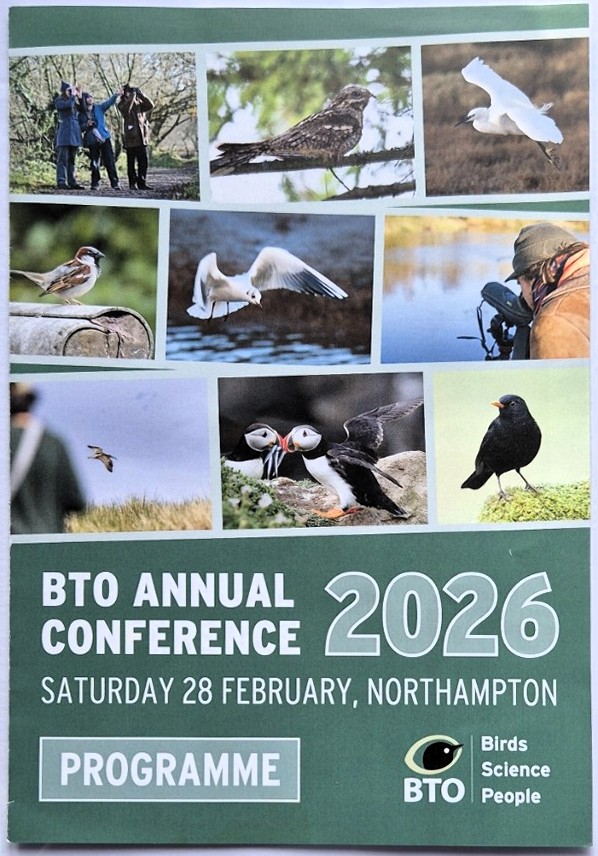
Sam Langlois gave an overview of seabird monitoring and tracking. In the past we simply have not known what goes on when the birds are out at sea but now with telemetry in the form of GPS tags, we have data to inform marine spatial planning, species ecology and in particular Marine Protected Areas. We can collect data on the number and distance of foraging trips, how many dives there are and for how long and how deep.
The Black Guillemot, for example, has a fairly small range of around 5km from the colony and dives less than 30m deep to the sea floor, preferring shallower waters. I have written several times about the terrible state of Lough Neagh on Ireland, most notably here: British Wildlife magazine June 2024 – Animal Wild. Nevertheless Lesser Black-backed Gulls are doing well there – but they don’t really use the lough itself and, it turns out, were most commonly flying back and forth to forage from the local slaughterhouse.
We know that winter storms have huge impacts but still have major knowledge gaps. We cannot tag diving seabirds for more than a few days or weeks in the breeding season – they are almost impossible to catch outside that although there has been some success with Shags, including immature birds.
Nick Marriner spoke about monitoring at landscape scale in the Chilterns. He works with farmers and builds trust with them. It’s a long-term project requiring long-term investment. After five to ten years there has been some species recovery. He emphasised that there was no need to re-invent the wheel. Instead existing surveys and methods are used. Birds and butterflies are good indicators for wider landscape health.
72 one kilometre squares are monitored and compared to national trends. Yellowhammers, for example, are slightly increasing in number or at least stable, against the national trend. By relaying that information to farmers who have been persuaded to leave wildflower strips and not to flail hedgerows, there is a sense of achievement all round.
I bought two books from one of the stands, one of which it turns out I already have, not a mistake I often make, but they were priced very cheaply and both look to be full of great photos and information.


Harry Ewing and Sam Franks talked of trialling solutions to the problem of threatened Curlew populations, which have declined by 40% in 40 years in Europe. Globally they are ‘near threatened’. Agricultural intensification, tree planting and urbanisation are largely to blame and as ground nesters they are especially susceptible to predation. 0.68 chicks per pair per annum is the minimum sustainable rate of successful reproduction. Habitat management and predator control in the form of fencing or lethal control of foxed and corvids have helped.
In the Curlew solutions Trial between 2023 and 2025 326 nests were monitored, roughly half of them fenced and half not. Of the latter 159, 47 hatched, 112 failed, mostly due to predation by foxes (primarily), badgers, stoats, hedgehogs, corvids, sheep, raptors and deer. Of the 167 fenced nests 116 hatched and 51 failed – the hatching rate was 70% better. That is still not a sustainable rate of productivity and the fences don’t really help with chick survival.
We are still learning but headstarting really seems to be working. I wrote about the Curlew Recovery Project here: Wonders of wildlife in Norfolk part II, RSPB Snettisham and the Knot Spectacular – Animal Wild. In essence this involves taking eggs, incubating and rearing them and finally release. It iş happening across Europe. There are seven such projects in England. Five years on there have been 387 eggs of which 319 hatched producing 264 successful fledglings. To some extent we are seeing that they do return and breed. For some reason 2022 was better than other years and researchers are keen to know why.
These are short-term solutions – systemic landscape level changes are needed in the long term.
Finally it was the turn of James Pearce-Higgins, part of the BTO’s Senior Leadership Team. I found him hard to listen to and understand last year but it’s a tough spot to fill at the end of a long day. The gist was that biodiversity in relation to ecosystem health is predictable. He argued that the BTO was not just about monitoring and diagnosing decline – it’s also about trying to fix things, to test solutions and sustainable management.
Leave a Reply