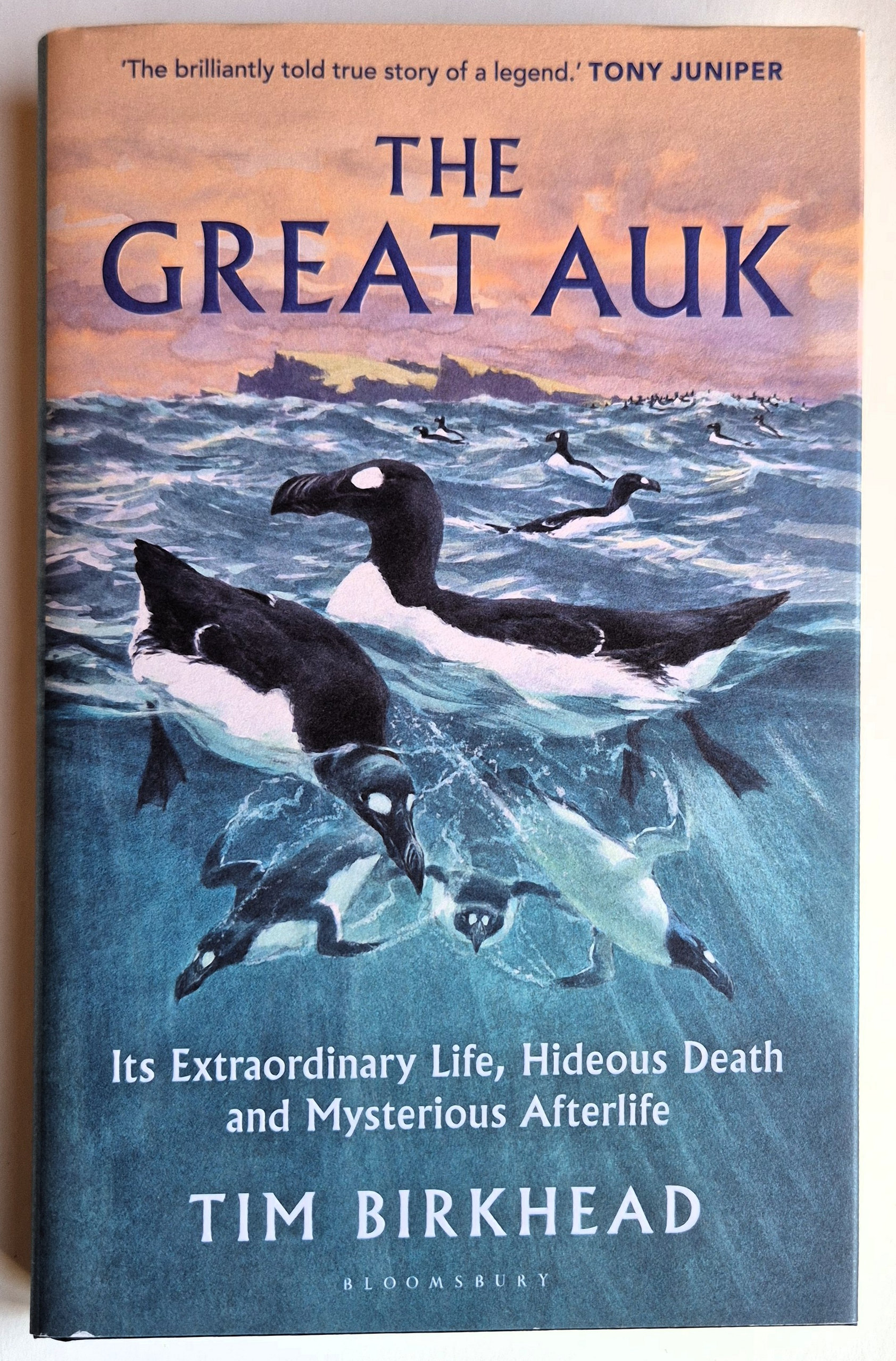
The Great Auk, Its Extraordinary Life, Hideous Death and Mysterious Afterlife by Tim Birkenhead, Bloomsbury Sigma, 2025.
I have already written about this book briefly when it was reviewed in British Wildlife magazine.
Of at least two other books I have said that there’s a danger with those about a single species that they can give a sense that absolutely everything an author has been able to find has been thrown into the mix, sometimes seemingly at random. This book does not suffer from this syndrome. It is an extremely well structured and written history of this remarkable bird, “its flightless vulnerability and the quiet dignity with which it met its end, slaughtered by mindless greedy men.” It gripped me completely from the outset.
The Great Auk’s best-known closest relatives (other auks) include the Razorbill, guillemots, puffins, Little Auk and more obscurely murrelets. The adjective is “alcid”. There are some 22 species in all. Penguins are not related (except in the sense that everything is) and quite distinct but instead an example of convergent evolution.
Pretty much all we have left of the Great Auk comprises 75 eggs and 78 skins and mounted specimens. This book traces the fates and locations of as many of them as possible.
“CRISPR” had me puzzled and is unexplained in the book. It turns out to be an acronym for “clustered regularly interspaced short palindromic repeats”, a family of DNA sequences.
The Great Auk became extinct before any ornithologist saw one alive. They were socially monogamous, working together to rear young but were not averse to ‘illicit liaisons’, like some of their alcid cousins.
“Sacrificing the ability to fly allowed the great auk to evolve a larger, heavier body and become a super-efficient underwater predator.” Also, they lose their ‘flight feathers’ one by one unlike other auls and most birds so that that efficiency is not lost.
Birkenhead concentrates on Funk Island, off Newfoundland, an “alcid idyll” in the 1400s. High seas washed the guano back into the water providing rich nutrients “fuelling the super-rich marine ecosystem of which the great auk is monarch.”
The beginning of the end was the arrival of João Álvares Fagundes in 1520. It was not long before the island became known as a stopover for transatlantic explorers eager to exploit almost unimaginable numbers of Great Auks, an abundant food source. In 1534 came the French explorer Jacques Cartier who organised a killing spree and others followed.
As with dodos, bobbies and loons, the names of whom are the giveaway, Great Auks were considered stupid because they were so easy to kill.
Known Great Auk fossils date back half a million years whilst the first modern humans arrived in Europe around 40,000 years ago “so great auks had many millennia of relative peace and quiet” in spite of the predations of foxes and bears.
The Great Auk is wonderfully illustrated. The images are far more than merely decorative (although the charming headpieces showing three Great Auks are precisely that), they are informative: a drawing of of a Newfoundland adult male human buried with implements and Great Auk beaks for example, or the image of everyday life in mid-eighteenth-century Greenland. It’s also good to have maps and portraits of the collectors, dealers and others we encounter later in the book. The colour plates are wonderful, showing a stuffed Great Auk, Funk Island, related birds, eggs and Edward Lear’s lithograph below. There’s also the heart of a Great Auk preserved in spirit from one of the two last Great Auks to be killed from the Natural History Museum of Denmark and a superb painting by David Quinn of Great Auks allopreening. The caption to one colour plate explains that Great Auks can be aged from the number of furrows in their beaks.

Reproductions of plates from Ootheca Wolleyana, show the variety of egg markings. This was an illustrated catalogue of the collection formed by John Wolley, edited by the great Alfred Newton, published in parts from 1864.

Descriptions of how Great Auks were killed and eaten are almost unreadably horrible. It seems they were thrown into cauldrons alive, had their feathers plucked whilst alive. By the early 1800s Great Auks were eliminated entirely from Funk Island. What horrified me most was the practice of “treading down”: men in search of eggs to eat would stamp on any existing eggs and young to ensure that any eggs collected the next day would be, by default, fresh. Senseless destruction. I assume the young were extirpated just for the hell of it, or perhaps to ensure that the adults laid more eggs. Frederic Lucas, scientist and collector recognised the potential of Funk Island for science in the 1880s, writing unambiguously: “Countless myriads of this flightless fowl had been hunted to death with the murderous instincts and disregard for the morrow so characteristic of the white race.”
There’s a pleasingly clear explanation of the Allee effect which I have not previously found easy to grasp. American ecologist Warder Clyde Allee, going against conventional wisdom of the 1930s, posited that certain species, rather than declining through suffering increased competition for food or breeding sites when populations are high actually thrive because of mutual assistance in finding food or defending against predators.
A skerry, incidentally, previously unknown to me, is a Scottish word for a reef or rocky island.
One of the portraits in the book shows Carl Franz Siemsen, a dealer in Great Auks “responsible for the deaths of at leats 21 great auks, including the last two birds.” He looks rather a pathetic individual. I was reminded of watching a documentary about rhino poachers which ended with the arrest of two individuals. I had been expecting obvious monsters, big men with hard hearts, but instead here were two utterly wretched, abject, skinny nobodies.
There’s a depressing list of other extinctions of flightless birds: Moas by Polynesians arriving in New Zealand in 1300, extermination by the late fifteenth century; Madagascar’s Elephant Birds around 1000; the Dodo of course, discovered on Mauritius in 1598, extinct by 1681 and the Rodrigues Solitaire by 1730. Birkenhead writes: “It is a constant, repeating and now entirely predictable scenario: human invasion, exploitation and extinction. It is a pattern that will probably see our own extinction. The great auk’s demise may seem like a mere curiosity to some, but it is a lesson we ignore at our peril.” The last two known Great Auks were killed in 1844 (it is possible but unlikely that a few others were around beyond that date).
As an aside, another bugbear of mine with certain writers is constant referencing forward but this author gets it just right: “as we will see later” a few times is fine, but “I will return to this in chapters 3, 5, 6 and 9” just irritates me. If you have structured the book properly there should be no need for the latter.
There’s an intriguing little section on the mathematics of the shapes of birds’ eggs. Scottish biologist D’Arcy Wentworth Thompson showed that maths could quite easily describe the shape of most eggs but not those of guillemots, which are pyriform (pear-shaped). The reason for the shape is stability on bare rocky ledges. The pointed shape means more surface area is in contact with the ledge, hence more friction.
I have often had my doubts about John Gould and his celebrated folios and Birkenhead describes him as “the bird-man darling of wealthy Victorians who coveted his big, bold, beautifully illustrated bird books. Gould excelled not only as an ornithologist, but also as a hard-nosed businessman.” His elevation to the status of Britain’s most celebrated bird artist is ironic: it was his wife and others who were responsible for the paintings based in his sketches. Ever concerned to be at the top of the tree, he was not above embroidering the facts and what he wrote about Great Auks seems to have been based on no evidence and much ignorance. Birkenhead is scathing: Gould created an illusion of authority, embellishing and romanticising earlier (erroneous) accounts, to make his text more attractive.
The author is very good indeed on collecting generally in his accounts of the major collectors of birds and their eggs, their compulsions and obsessions. and asking how we should think of them It’s a subject I feel I know a bit about having been a book dealer to collectors for most of my life and as something of a collector myself. “Collecting books is legal, collecting birds’ eggs is generally not, at least not now. Book collectors are harmless because their collecting may help authors [not sure about that though]. Egg-collecting is not …” Focus tends to be on birds with already vulnerable populations (collectors love rarity) and taking and blowing eggs deprives embryos of their lives.
Then there is addictive hoarding, “a recognised medical or psychological condition.” But collecting itself may be considered an addiction. I had at least one client who felt unburdened of a disease when he finally gave up his hobby, and I have come across many who could only be described as obsessive hoarders – every inch of space in their homes groaning under the weight of books, often including unopened parcels as was the case with deeply eccentric, wealthy Vivien Hewitt, the collector whose life we learn about in great detail. He would often unpack a parcel, inspect the contents and then wrap it up again. “Acquisition was everything.”
There’s a lovely analogy about Hewitt’s activities – the sums of money involved were mind-boggling. “His earlier propensity to collect birds’ eggs now burst like an exuberant flight of racing pigeons from a loft.” Already wealthy to put it mildly, this was after an inheritance from his uncle which meant he really had no financial restraints whatsoever. His dealers, especially the principal, Howard Gowland, were no doubt exploitative and his relationship with Hewitt was manipulative, sometimes craven, sometimes even flirtatious. Birkenhead suggests that there is a sexual element to the collecting instinct and I think he is right.
What Hewitt paid for the eggs of Great Auks is not always recorded, but it may be assumed that he spent the equivalent today of £235,000 on his thirteen eggs. It was “a protracted frenzy of acquisition”. Or a “pathological gathering”. It’s fascinating. When the drive to acquire English literature, books and manuscripts, at the Harry Ransom Center at the University of Texas was at its peak, of which we were major beneficiaries, the policy was to buy everything and worry about whether it was of value or worth cataloguing or not later. Birkenhead suggests that a common thread with obsessive collectors is a childhood trauma such as the loss of a parent. The need for reassurance is perhaps fulfilled by acquisition. He brings Oliver Sackler the disgraced American psychiatrist to the page. Ancient Chinese art was his thing and boxes began to arrive faster than they could be unpacked. Sackler’s biographer wrote that the unboxing “took on the spiritual aspect of a séance”. For Sackler it was all about the hunt and the sexual arousal that came with it.
Hewitt had boxes stacked everywhere, even on the landing making his family’s route to their bedrooms difficult, and his collection was stored haphazardly without any attempt at sorting or classification. “… after his death many boxes were found still unopened and uninspected. His bed-sitting room, as well as the pasages, were stacked high with countless boxes, and all available drawers were equally crammed.” I have seen this sort of thing many times. At one book collector’s house even the floors of almost every room were hidden by a layer of books, themselves coated in a repulsively thick layer of dust. Another collector I came across stored his ‘treasures’ in two garages to which he referred as the east and west wings of his library. I went in, fearing that the piles of newspapers, taller than I am, might topple and trap me. Most of it was unreachable. An Irish collector was visited by my old boss at Sotheby’s, the lovely Roger Griffiths. The grounds were full of sheds to store the books, which arrived constantly, by the van full, all the time Roger was there. I think my collecting of certain favourite authors, which I no longer do, of books about animals, animal rights and wildlife, which I do still do but at least I read them, and, modestly, of wildlife art, are not so outlandish. The art is displayed in the garden and summerhouse and I never stop noticing it, nor enjoying it. I have been gently teased by family and friends for the six metal birds I can see from here right now – but I say I enjoy their company. But I admit to a thrill when I see something I love and desire and sometimes to a complete lack of resistance.
None of which is to say I do not have respect and affection for collectors. There’s more on this here, written to celebrate my bookshop’s centenary in 2023. One hundred years of bookselling. June 2023 – Animal Wild.

But there are bibliophiles and bibliomaniacs.
Oology is a somewhat pseudo-scientific term for egg-collecting devised to accord the pursuit respectability and scientific credibility but from the 1900s public opinion was turning and by the 1930s Hewitt began to wonder about the eventual fate of his collections. Hewitt was by this time a collector of collections – he was not stealing from nature. After his death there was much wrangling amongst the the British Trust for Ornithology and museums. There was simply too much for the the British Trust for Ornithology to deal with and even questions as to the value of it. Taxidermy was out of fashion and favour too by the 1960s. To the extent that, disgracefully, one school on discovering that it owned an assemblage of taxidermy specimens, burnt the lot. Absurd though it seems now, egg and stuffed bird collections were perceived as having little or no scientific merit. Museums and other institutions did not cover themselves in glory in this regard and, again I speak from my time as a dealer in books and archives, the situation today from a peak in the mid to late twentieth century has deteriorated beyond belief. Of course museums and libraries cannot take everything offered to them, either by sale or gift, but the reluctance to be accountable and take anything at all seems now almost predominant. Even including purchases which would complete or at least complement current holdings. It is extraordinary to me. Who are we to decide what will be of research value to future generations, what should simply be discarded and destroyed? I am digressing, but if these things are not given a commercial value, if they are donated, they will not be honoured. Libraries do not like being given things and such that they are tends to accumulate dust in dark corners.
I was asked to write a piece about dust-jackets (not my first) for The Book Collector and in it I wrote about institutional attitudes to these ‘difficult’ to preserve items which are of course far more than merely decorative, promotional, ephemeral. The British Library, one of the copyright libraries which must legally obtain a copy of every book published in the UK (at the cost of authors and publishers, not the libraries), was especially guilty, deciding for a period to destroy all the dust-jackets from the books which arrived, for the sake of convenience, simultaneously destroying a significant aspect of bibliographical history. Whilst writing the piece I was in a delightful correspondence with the editor, the late James Fleming, nephew of Ian. He said that of course the British Library, which is only obliged to take first editions of newly published books, could not possibly be expected to collect later impressions and editions too. To which my answer was, “Why on earth not?” Different editions, often with major or minor textual and other changes, are equally part of the historical record.
Advances in our understanding of and ability to extract DNA make the egg and bird collections of immense scientific value now. That could not have been predicted at the time of Hewitt’s death which makes my point exactly.
Everything else aside, museum eggs played a crucial role in identifying the disastrous consequences of DDT from the effects of acid rain on eggshells.
As Birkenhead says, almost whether or not we have learnt a great deal about the life of the Great Auk from eggs and skins, which we have, destroying old collections as advocated by bird protection organisations is “completely pointless”.
I knew a book collector who wished to form a collection based on books written in prison but could not begin because it would have to include a copy of Mein Kampf, which he said, as a Catholic, he believed was an inherently evil object. And a bookseller I once worked for refused to deal in a first edition of it. Actually I am pretty sure he bought and sold a first edition anyway, just under the radar. I understand both these points of view of course but again would argue that it is not for me to judge to what purpose such a purchase might be put? Worship and adoration would of course be abhorrent, but academic study? I haven’t ever had a copy myself and would rather not, but I wouldn’t proscribe it. I have mostly refused to deal in the lucrative business of books which glorify hunting and shooting, although I have sold a number of copies of Walton’s The Compleat Angler, but that is pure squeamishness of a sort combined with a distaste for the people who are likely to want such things, but I do not consider myself in any position to condemn those who do.
Eight of Hewitt’s thirteen eggs are now “lost from view”, most likely in private hands, but four remain in public museums at least.
As we near the end of the book, the author considers the wisdom or otherwise of attempting to resurrect the Great Auk, a seductive notion. But would we not use that as an excuse not to worry about causing extinctions terribly much? And would it be fair to do so, he asks, when time, funds and efforts could be spent on saving endangered species we have not yet quite exterminated? And would it be fair on the birds whose environment has changed so much and when we cannot even protect rhinos? Illegal wildlife trade is after all a very major part of global organised crime.
The aforementioned Victorian Zoologist Alfred Newton, something of a hero of Birkenhead’s, was responsible he says for just one significant biological discovery: that humans can cause species to become extinct. What a misnomer, he points out, Homo Sapiens is. The shock of Newton’s realisation “triggered a passion for protecting birds. That passion eventually grew into the bird protection movements we see today.”
Having learnt the word “filoplume” so recently, see Birdwatch magazine September 2025 – and my animal rescue volunteering comes to an end – Animal Wild, “feathers with connections to nerve receptors, unlike others, thought perhaps to enable birds to sense when there has been damage”, the end of this book provides yet another example of that phenomenon where you learn something new and suddenly see it everywhere.
We are told of the Kakapo, New Zealand’s flightless parrot. Like the Great Auk it is the largest of its kind and was abundant and widespread as well as culturally important to the indigenous people. Yet again, the arrival of Europeans with their dogs and other predators caused a population collapse from the mid-1800s. “As with the great auk, the scarcer the kakapo became, the more desperate scientists became to secure ‘specimens’. Thousands were killed and collected for zoos and museum collections … The bird came within a filoplume of extinction.” An intensive recovery programme in the wild has just about salvaged the situation but there were still only 252 individuals in 2022. As Birkenhead says, a finger in the dyke. We must not continue to fiddle while Rome burns.
His last line: “Let us celebrate the magnificent great auk and what its remains can continue to teach us about the value of life.”
There are three appencides, comprsing a map of putative Great Auk breeding colonies, a surprising proportion around Great Britain and Ireland, an illustrated table of Hewitt’s thirteen eggs and a list of bird species mentioned in the text.
Leave a Reply