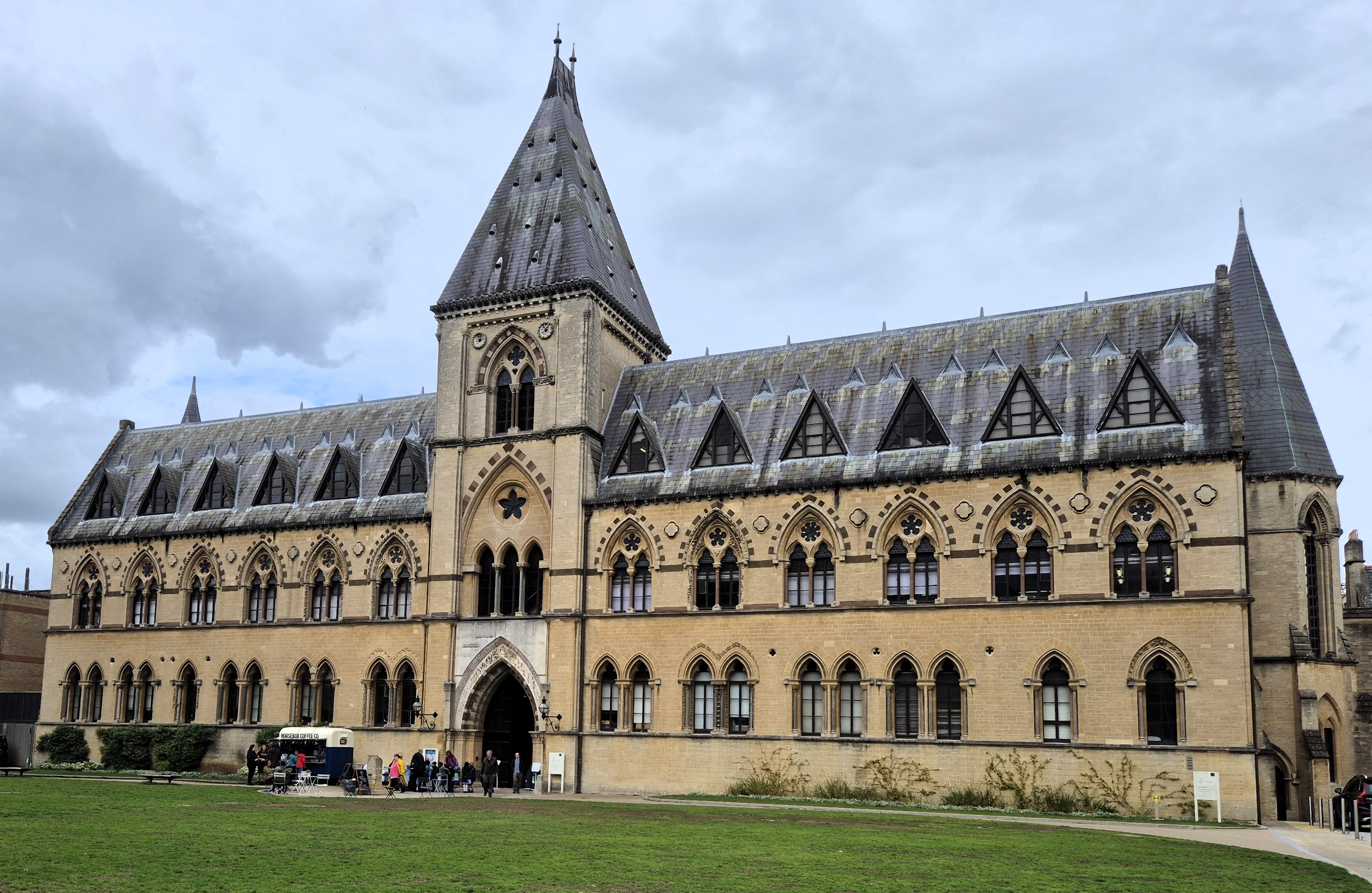
I managed to park remarkably nearby at a whopping £15.40 for two hours. Paying for parking is like light bulbs: things are supposed to be better and easier but actually are just more complicated and frustrating.
I went to the museum on a whim yesterday, wondering why it had been so long since my last visit. Now I realise it’s because the whole place is designed for children. From that viewpoint it’s marvellous and highly educational but as an adult I found it deeply unsatisfying.
The building is indubitably impressive as is the glass-roofed hall which greets you on entrance:

The dinosaur at the front is an Iguanadon bernissartensis, except that it isn’t, it’s a cast as are most or even all of the rest. Once thought to have walked on two legs, it is now believed it walked on all four. “The bones on the end of the fingers look a bit like hooves and were therefore well adapted for walking on the ground.” “Look a bit like hooves”? Come on now, that’s fine for young schoolchildren… And they weren’t well adapted because they looked a bit like hooves.

My next, predictable, issue was that stuffed animals give me the creeps. They tend to look sad, moth-eaten, unnatural. So they did not occupy me for long. I was keen to see the Dodo though, my interest piqued by my recent reading of Tim Birkenhead’s The Great Auk. I thought there were no stuffed Dodos extant but the Oxford Dodo, touted a museum highlight, was surely worth a look. Actually though, although the museum has the only extant soft tissue in the world as well as a head and some other bits and pieces, again this turned out to be a “cast”. A model, a fake if one is being unkind. I thought it was pretty terrible, a sort of three-dimensional cartoon version.
I dutifully covered all the displays. I liked these circular arrangements which were more works of art with a wow factor than scientifically informative.


This Tiger’s Eye, from South Africa, caught my eye.

So did this “Torus of Time” by Angel Palmer, 2023, made from rocks from and representing the geological ages in Britain. There was no further information about the artist though.

The statue of one of my all-time heroes Darwin is wonderful but I had to look online to learn that it was by Henry Hope Pinker and unveiled in 1899 – there was no indication of that whatsoever let alone any further information about the sculptor.

I ventured very briefly indeed into the Pitt Rivers Museum at the back. Weirdly dark, troubling and highly controversial, a museum of colonial theft and cultural appropriation. A relatively new director is attempting to deal with these issues. The shrunken heads (humans, sloths and monkeys from Ecuador and South America) have finally been removed. The indigenous people have long argued for this – these are the remains of their ancestors after all. Collectors were actually the cause of local warfare during the 19th and 20th century collecting peak (frenzy) so in demand were these objects.
From the BBC: “This difficult history has led the museum to engage more closely in acknowledging its past practices and the nature of its collecting, display and interpretation and the effects those have today,” the museum said in a statement. The museum founded in 1884 has 500,000 items, many “closely tied to British Imperial expansion” that were collected using violent means towards those being colonised.”
I am the last person to wish to delete the historical record but the Pitt Rivers Museum did have some very dodgy (i.e. racist) labelling and recently admitted having 145 artefacts stolen from Benin. Many stolen Benin bronzes, as has been widely reported, have been or are now being returned.
These things are always tricky. My solution to the statues problem would be to take them all down, put them all in one museum somewhere and label them appropriately. There’s no need to destroy them, but people from colonised countries, and/or with ancestors from the plantations, should not have to live in their shadows.
The museum café is a soulless section of the upper gallery with cheap hard plastic furniture and the shops are full of tat and books for very young children.
Thinking of “the other place” as Oxford and Cambridge universities childishly describe each other, and, again, The Great Auk (that book has had quite the impact on me), and relevantly to the above, I wanted to find out a little more about Alfred Newton, one of author Tim Birkenhead’s heroes.
His legacy to to the Department of Zoology at Corpus Christi can hardly be overstated. He was the first Professor there of Zoology and Comparative Anatomy and the longest serving incumbent to date – forty years. He left behind his remarkable collections of books, cartes-de-visites and bird eggs and sterna. The Cambridge Museum of Zoology, incidentally, has an actual Dodo skeleton, so one up to Cambridge.
Newton’s family’s fortune came from the sugar plantations of the West Indies, but he can hardly be held personally accountable for that. There is work ongoing has to how best to deal with it though. He published his Dictionary of Birds in four volumes between 1893 and 1896 and was an eager, immediate supporter and robust defender of the ideas of Darwin and Wallace. Quintessentially Victorian (although he saw three monarchs in his lifetime), he was eccentric and an early conservationist. There’s more about him here: The Great Auk – Animal Wild.
Leave a Reply