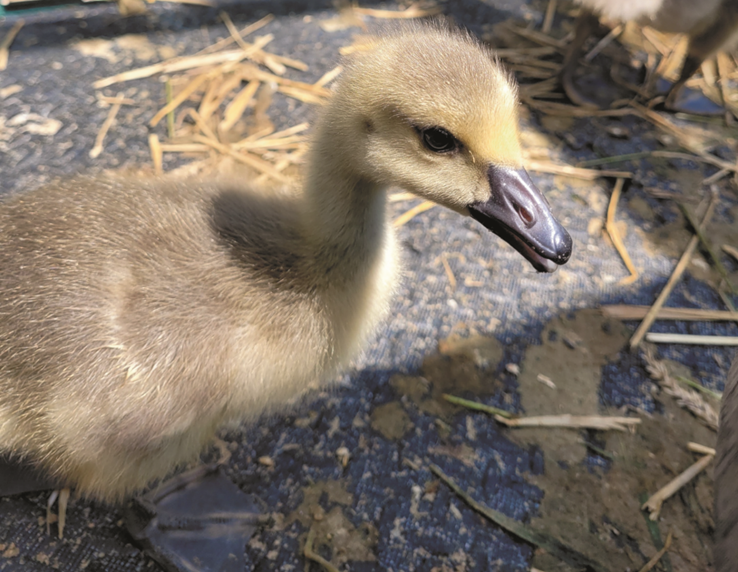
I have wanted to visit Swan Lifeline for a long time. On Saturday the perfect opportunity presented itself: a Canadian Gosling needed to be taken there from HART Wildlife Rescue, otherwise there would be just one lonely recuperating gosling at each rescue. The one pictured above was a HART rescue from a couple of years ago of whom I grew extremely fond. I’d witnessed a fight between two Jackdaws in the garden that morning which I actually found upsetting. One had the other pinned to the ground on its back and was pecking away at him with vigour. The charming little gosling was a welcome antidote. although heartbreakingly he was cheeping, calling for his mother for the entire hour of the journey.

Swan Lifeline is in Eton down a long, very narrow lane and is on an island. It took some finding. I was in luck – on duty was Claudia who used to be a volunteer at HART too. I got a full guided tour. They have about 25 swans at the moment and a capacity for around 50. The site is not huge but they use the space ingeniously and all of the birds have good-sized enclosures with more or less self-cleaning ponds with a constant flow of water. The sadly unsurprising reasons for the swan intakes included swallowing a ball bearing, being shot in the eye, and a torn foot from a fight with another swan. It is hoped that all but the one who had been shot will be released once fully recovered, that one will probably go to the Swan Sanctuary. I mentioned how angry it makes me when people say that swans are vicious, which of course the aren’t. “Oh no, they are the gentlest of creatures,” said Claudia.
These were taken from the bridge:


Delightfully, two wild Mute Swans have returned to the island this year and have given birth to five cygnets. Clearly they know it is safe for them there.
Some dreadful person has taken to dumping exotic ducks in Slough and they too have ended up here in numbers. They cannot be released, it would be illegal. If another home cannot be found, they may have to stay at Swan Lifeline. They are mostly one of three kinds of Whistling Ducks from various parts of the world, Fulvous, Wandering and White-headed I think, all of them stunningly beautiful. There are Egyptian Geese too and once there was a Nēnē or Hawaiian Goose (pronounced “nay-nay”, which I didn’t know), which is the world’s rarest goose.
The two Canada Goslings are getting on well – this sort of thing is much easier with geese than ducks who all too often resort to terrible bullying.
I fancied strolling up and down Eton High Street and perhaps browsing the bookshop, but after half an hour gave up on trying to find somewhere to park. These Etonians (gown not town) even cross the street differently I noticed, arrogantly, not bothering to look – as future world rulers they don’t feel the need.
So all in all four hours and over 140 miles just to ensure that two goslings were not lonely. Slightly mad but utterly wonderful.
Having emptied and refilled the pond at HART on Monday morning, I experienced the joy once again of letting a group of Mallards out. As soon as they realised there was water ahead of them (perhaps they just remembered but I think it more likely they could smell the water, although that sense is not their strongest) they sped up excitedly, then jumped in and splashed around and dived ecstatically.
I have been thinking back over my last few jaunts along the Kennet & Avon Canal (passim). Highlights were the Heron and the pair and little flock of Goldfinches. No wonder the collective noun for the latter is a charm. For the last couple of sections, the Wiltshire White Horse Trail hugs the canal. It is part of a much longer path of 93 miles which takes in all eight of the Wiltshire White Horses. As well as the one I saw, I remember noticing any number of mounds and barrows along the way. For more information I turned to a coincidentally well-timed purchase, Mary-Ann Ochota’s Hidden Histories; a spotter’s guide to the British landscape, Frances Lincoln, 2018.

It’s a lovely book, beautifully illustrated, accessibly written and very well indexed. Quite why the White Horses were created is hard to know, but they may have been territorial markings or the result or acts of worship. The cult of horse goddess Epona probably existed in Britain as well as on the continent. Seventeen survive in all (they do need maintenance, with in former times accompanying “rowdy” (bawdy?) carnivals). Although some are much more recent, the oldest is the Uffington Horse which is around 3,000 years old. It is highly stylised and very beautiful. Stylistically similar horses appear on Iron Age coins.
There was also what I took to be a standing stone at the Barge Inn in Honeystreet, not far from the famous henge at Avebury which consists of three stone circles, one of them the largest in Europe. I took this photo there a decade ago.

The Ordnance Survey map shows many ancient tumuli and barrows along the way, tumuli simply being round barrows. It wasn’t only bodies which were buried I was surprised to learn from Hidden Histories. Often included were beakers containing alcohol, tools and weapons and jewellery. There was a lot of plundering in the eighteenth, nineteenth and twentieth centuries. If the Ordnance Survey map shows words in gothic script, then it is known that these are man-made historical features, “even if the experts aren’t 100% certain what it was made for.” If it says “Burial mound” then that’s what it is.

Once you know this, the maps bear further study.
Not far from Honeystreet there is this, for example:

These are earth terraces constructed for agricultural or possibly ceremonial purposes.
Also:

Wansdyke (Woden’s Dyke) is a series of defensive ditches and embankments, one of the largest in the country. This is fascinating: Wansdyke – Wikipedia
Hidden Histories is one of those books which will take you off on all sorts of intriguing tangents. It includes sections on pub names, for example, architecture, roads, trees, and hedges and walls. I have always been fond of dry stone walls. It seems it is possible to date them (roughly) according to their style, the extent to which they are covered by peat or lichen and other factors. I agree with the author that they are works of art.

Birdwatch magazine, May 2025, issue 395, is full of all the usual twitching tales and species counts. There’s a very odd comment from Laurence Pitcher in an article about seabirds. Skuas, he says, “can be lazy and they do have a habit of making leisurely progress, so their tendency to divert from their migratory course to chase Kittiwakes or just loaf on the sea often skews expected arrival times!” I am sure it’s said affectionately, but it jarred with me nonetheless.
“Ruddy duck redux” , featured on the front cover, reports on the highly controversial international cull effort. See my account here:
Slimbridge a.k.a. the Wildfowl and Wetlands Trust was responsible for their introduction here, with the escape of “seventy unpinioned birds” and the deliberate release of a few more between 1956 and 1963. The more I learn about that place, the less I like. Pinioning is the repellent practice of chopping off parts of birds’s wings to stop them flying. I was surprised to see the term used so casually without condemnation in this magazine. It still goes on at Slimbridge and until an investigation and exposé in 2013, illegally so, without veterinary supervision.
Slimbridge Wetland Centre – Animal Wild
I do sometimes wonder about Birdwatch to what extent bird welfare is a priority.
DEFRA’s onslaught began in 2005 and ran until 2011. By 2009 6,200 Ruddy Ducks had been killed (the use of semi-automatic weapons is permitted, dear god), along with 34 non-target species including Coot, Tufted Duck, Common Pochard, Black-necked Grebe and Common Scoter. That figure comes from DEATHRA itself so I trust it about as much as I trust Tony Blair’s smile or anything he or Keir Starmer has ever said.
Talking of Keir Starmer, of “island of strangers” fame, inviting comparisons with Enoch Powell and his rivers of blood, isn’t it funny how governments can always find money for citizen control, the unnecessary and pointless Covid restrictions on our liberty for example, or their own bloated expense accounts for that matter, but not for renationalising the water companies which is way beyond urgent. Now he has found, somewhere and somehow after Rachel Reeves’ budget has totalled the economy, £4.7 billion to build three new prisons. Prison doesn’t really work most of the time – why not spend the money on education, rehabilitation, medical treatment and other more effective measures and solutions?
I thought immediately of Lucky Dube, that towering South African presence of African reggae, second only to Alpha Blondy from the Cote d’Ivoire (passim). Tiken Jah Fakoly from the same country is a strong contender and Ghanaian Blakk Rasta is very well worth checking out too and also a witty and trenchant political commentator. Our firm family favourite by Lucky Dube is “House of Exile” which is about all freedom fighters in exile but no doubt in particular those who had no choice but to live abroad during apartheid. I will never forget the house band at our hotel in the paradise that is Busua, Ghana, playing on the roof bar, at my request, “House of Exile” one balmy night. Lucky Dube was murdered in the course of a carjacking in Johannesburg in 2007. I have seen him live a few times, once in a very small venue, Bay 63 in Notting Hill I think it was. In spite of the tiny stage and very small crowd (fewer than a hundred people) he and his large band played as though their lives depended on it, as they always did, with their three obligatory (?) female backing singers, somehow all making space for all the dancing and joy which their music brings with it. The song I have in mind for Starmer is “Prisoner”:
“They won’t build no schools anymore
They won’t build no hospitals
All they’ll build will be prison, prison”

African reggae is is a wonderful combination of musical styles. A friend who is half Nigerian and half Jamaican asked me what “they were doing playing our music” which is an interesting take on it. Who were ‘they’ in the context? It’s a glorious ebb and flow of mutual influence. Reggae of course began in Jamaica and has since become the universal language of peace, love and speaking up for the oppressed.
I would love to have the time or be sufficiently devoted to lean how to tell between a Common and a Thrush Nightingale and I am not knocking the long article about it in this issue, but I will consider myself very lucky if I ever see any nightingale at all.
There’s a good short piece on egg coloration, for which two pigments are primarily responsible: biliverdin for blue and greenvand protoporphyrin for rusty-brown. How do they make the elaborate spots and squiggles? We don’t know. I love stuff we don’t know.
Finally, how lovely to see both House Martins and Swifts hunting over the village yesterday evening …
Leave a Reply