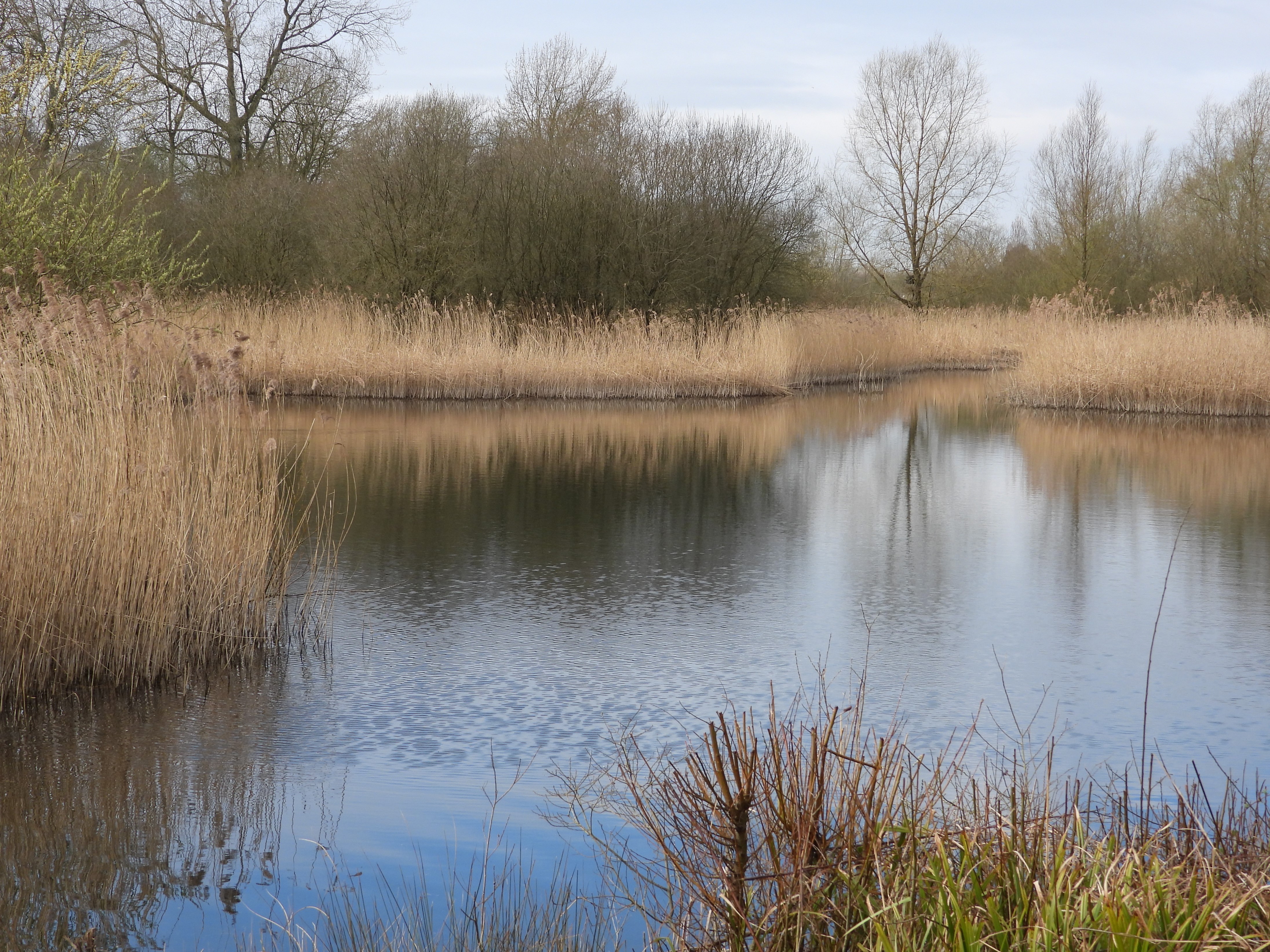
This is a roughly forty minute drive from me and is part of the Cotswold Lakes area, much of which is given over to water sports. It is also part of the Cotswold Water Park Site of Special Scientific Interest, is Cotswold Lakes Trust’s flagship site and consists of wetland lagoons, scrapes, reedbeds and ponds. I had hope to see more water birds but I had left it a bit late in the year, especially what with short stopping and climate change. The winter migrants had mostly moved on I suppose. Nevertheless, I spent several hours there and walked about seven miles which seemed pretty effortless given the flat terrain.
These bulrushes were the first thing which caught my eye.

“Bulrush” is a bit of a generic term for a number of species in the Typha genus, but these are (great) reedmace – they can be dominant in wetland areas, excluding other plants. This is Typha latifoli.


Goat willow
One sign I did not expect to see read “Warning, Treacherous Quicksand”. Quicksand, in Wiltshire? It was a trope in some of the comics I read as a child, like Beezer and Beano. Good to know though, but the constant reminders of uneven ground and deep water and another advising against walking on thin ice seemed superfluous. Who exactly are these signs for?
A lot of trees and shrubs had been cut back, or cut down to keep the footpath clear. I wondered what the purpose of these vertical notches was.

Three Mute Swans on the lake – is it even possible to take a bad photograph of a swan? There were lot of loud partial take-offs and landings (those wingbeats!) but timing and distance were not in my favour.


A gate, chain and padlock barred access to this lovely spot. It and much other land in the area belongs to Thamesmead Angling.

I took the permissive path on the way back which runs closer to the water but the longer public footpath (the Thames Path) on this leg. I very much felt hemmed in. All I was permitted was this narrow strip through the woodland with barbed wire fencing on either side. Consolation was the loud birdsong, especially from Chiffchaffs and Robins. The reserve was wonderfully quiet – I saw barely another soul. Thamesmead Angling seems not to be the same as Thamesmead Town Angling Club and I have been unable to find out anything about them. As ever, details of land ownership are hard to come by.

Catkins on the stream
I’d seen on the online map that there were radar kissing gates, of which I had never heard. They allow access to mobility scooters and the like, users are given keys.
Eventually I reached the bird hide (one of only two on site) which is at the head of the area not locked off for the benefit of wildlife.
It is a lovely spot and the sun intermittently broke through, illustrated by the photo at the head of this post. The hide itself is a delightfully eccentric construction, now shockingly in a bad state of repair. Someone loved it once. Whoever originally paid for and built it would surely be saddened as would the artist of the wall painting. Whoever manages it should feel ashamed. Pretty poor for a ‘flagship’ site.


I enjoyed a while there, seeing about twenty Tufted Ducks.


There were also two Canada Geese and a Mallard.


More excitingly there were two or three Teal. Apologies for the half a Teal, he was a long way away. The female came much closer.


Helpfully, the females have a distinctive eye stripe. I thought too that the bills showed a slight upturn. They are the smallest ducks. The origin of the name is unknown but the colour took its name from the duck rather than the other way around.
Two birds in particular made my heart beat faster, the Cormorants and a Great Crested Grebe. There were one and then two Cormorants in a tree, accompanied by Rooks – to be honest I didn’t know that was where they nested – possibly as many as six altogether. They are a hugely impressive sight in flight.


These too were at a considerable distance. Excuses, excuses. It was the Great Crested Grebe which made my day. He spent twenty minutes or so diving in front of the hide. There are some nice reflections in the water and in one of these you can still the droplets in the air from his re-emergence.


So not a terrible day for birds, but not a great one either. It made me think of Ogden Nash, the American writer of light verse, and his famous short poem:
Spring is sprung,
the grass is riz,
I wonder where the boidies is.
They say the boid is on the wing.
But that’s absoid.
The wing is on the boid.
I had thought “The Purple Cow” was by him too, but it’s by Gelett Burgess:
I never saw a Purple Cow,
I never hope to see one,
But I can tell you, anyhow,
I’d rather see than be one!
I remember a variant from my childhood which ended “But from the milk we’re getting now, There certainly must be one!”
My favourite by Ogden Nash though is a twist on the rather cloying religious poem “Trees” (1913) by Joyce Kilmer, which begins:
I think that I shall never see
a poem lovely as a tree…
Nash’s famous subversion:
I think that I shall never see
A billboard lovely as a tree.
Perhaps, unless the billboards fall,
I’ll never see a tree at all.
I wonder if it inspired Joni Mitchell’s Big Yellow Taxi:
They paved paradise, put up a parking lot…
They took all the trees put ’em in a tree museum
And they charged the people a dollar an’ a half just to see ’em
Don’t it always seem to go
That you don’t know what you’ve got ’til it’s gone
They paved paradise, put up a parking lot…
Hey farmer, farmer put away that DDT now
Give me spots on my apples, but leave me the birds and the bees
Please
Just as I was thinking that I still had yet to see any Blackthorn in flower this year towards the end of my walk, I rounded a corner. It reminded me of my epiphanic moment with a bramble flower – such beauty in something so tiny and seemingly innocuous.


Leave a Reply