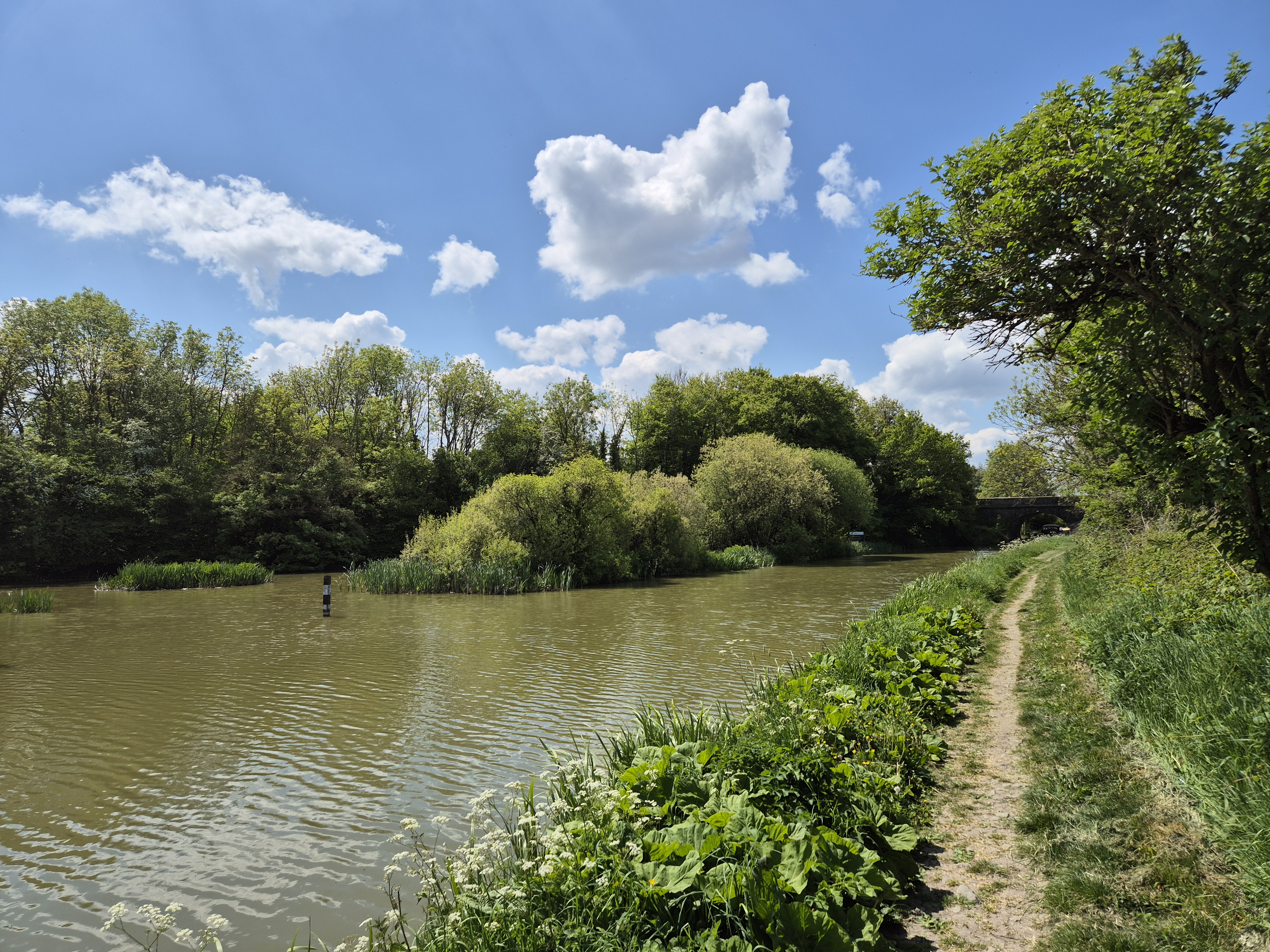
Pewsey Wharf to Honeystreet
Which sounds as though it might be the title of a novel or a poem. On my way to Pewsey I came to a rapid halt. Two tractors and a couple of other farm vehicles were working a field. This attracted no fewer than twenty-two Red Kites. Quite a spectacle. My photographic efforts failed completely and it wasn’t long before every passing vehicle on the busy A road was hooting me – it wasn’t the greatest place to have parked.
I now have a more robust phone holder for the bike than the flimsy freebie supplied with it. It really does the job and so I had the Ordnance Survey map app in view at all times. There are several bridges but no locks were needed at all on this stretch of the canal. This odd, rusty, ramshackle suspension bridge seems to go from nowhere to nowhere but must have been useful once. I don’t think I would trust it.

Some of the ride was reasonably smooth but most of it was decidedly not – roots and rocks as usual making for a very bumpy ride and a few near misses. I spoke to another cyclist who concurred – it would be nice not to have to concentrate quite so hard, to relax a little. After nearly five miles my nerves were in shreds. It does trees no good to walk or cycle on their roots, but I noticed at Bowdown Woods that they had no trouble pushing through the tarmacked paths there.
One bridge stood out but it’s not a normal bridge, oh no, it’s a posh bridge. Lady’s Bridge in fact. This decorated structure and Wilcot Wide Water were created by John Rennie to appease Lady Susannah Wroughton of Wilcot Manor who insisted that the canal had to be landscaped if it ws to pass through her estate, much like the Bruce family and their insistence on a tunnel (The Kennet & Avon Canal part IV – Animal Wild). What power these people wielded, and still do of course.
Lady’s Bridge:


Wilcot Wide Water:

The canal did not disappoint:


This is Picked Hill:

These bulrushes were in full seed dispersal mode, a little further on in their life cycle than those I saw at Cleveland Lakes (Cleveland Lakes Nature Reserve – Animal Wild).


Red Campion, Silene dioica, clearly not red:

It has been used to treat snakebites and it has been said helps to protect fairies from being discovered.

The Alton Barnes White Horse, one of eight surviving in Wiltshire. See Alton Barnes White Horse, Milk Hill – Visit Pewsey Vale.
“The White Horse, cut from chalk on the hillside approximately 1,000m north of the village of Alton Barnes, was commissioned in 1812 by Robert Pile or Pyle, a local tenant farmer. He paid John Thorne, a journeyman sign painter known as Jack the Painter, £20 to design and cut the horse. Thorne was evidently a rogue. Having copied the design of the Cherhill White Horse, east of Calne, which was cut in 1780, he pocketed an advance of the fee and decamped leaving a local resident John Harvey to carry out the actual work. Thorne was later convicted of a series of crimes and hanged.
The horse is 166ft high and 160ft in length. The disproportionate height is to prevent foreshortening when viewed from a distance.”
The Barge at Honeystreet is a wonderfully eccentric pub with characterful staff and customers. Breaded whitebait and a pint or two of Amstel, and a lovely conversation with two women who were camping behind the pub – it was one of their birthdays. I could happily have stayed all afternoon in the hot sunshine, talking about bangles and trips to Africa. I like whitebait but it has never been quite the same since a Faroe Islander defended the bloody and immensely cruel whale hunts which happen there by saying that better one life to feed many rather than the other way around. On its own it’s a hard argument to counter. But the grindadráp is hugely wasteful and the planet cannot afford to lose any more whales, whose meat is now so contaminated as to be dangerous for human consumption. I could have happily stayed for the evening too, which promised a reggae sound system.
For the blog I recently looked in vain for a decent picture of Mallards – I have tended to neglect to photograph them because I see them so often. A Moorhen here too, for good measure.


Moorhens have been by far the most stressy birds I have helped to look after at HART Wildlife Rescue. The Merlin app picked up a Reed Warbler too.
I had brought a book with me to read at lunchtime but as is increasingly the case I really didn’t need it. After the women had returned to their tent I just enjoyed the ambience. I found though that I was rather dreading the journey back. I had had to get off the bike and push so often that I began to wonder if I might just as well do the whole thing on foot. It seems miraculous that I have only suffered one puncture so far. Then a brainwave – go back by road. I have a bit of tendency to create strict rules for myself (in my book collecting for example), forgetting that if it’s my thing I can change or break those rules. I passed through villages and scenery I would never otherwise have seen. And it was easy (hills are a breeze with battery assistance). Most although not all of the motorists who overtook me had taken on board the new rules about allowing a cyclist as much room as you would another car. I think this will be my new modus operandi.
Honeystreet has a ruined boatyard where barges used to be made.


There’s a working boatyard too. And a hidden gem in the form of Honeystreet Mill which has a café and several shops and businesses, including a farm shop and The India Shop (The India Shop – The india Shop), which is connected by family with the one in Marlborough.
There I bought this lovely notebook – yet another of the many I have which are too nice actually to be used. I was given it in a bag made from old newspaper, thereby helping an organisation started in 2004 which supports street children in India by means of counselling, education, food and shelter and creates employment for 60 families in the surrounding villages who make the bags.


The mill area is also home to the Crop Circle Museum. The main part was closed, but I had a quick look round, full of cynicism, but it seems there is rather more to it all than I thought. In ancient Zulu culture they are known as Izishoze Zamatongo, which means writings of the gods. The oldest known printed reference is in a German version of a book supposedly dating from 1590, Dæmonolatria, although it is by a lay judge, Nicholas Rémy, and was first published in France in 1595. It was the circular dance which created the formation by “buck-hoofed beings” which was alleged to have happened in 1590. Crop circles are geolyphs, like the White Horses. In a 1678 pamphlet there’s a description of a circle with what we recognise as today’s characteristics, and the first scientific report appeared in the journal Nature in 1880. Official interest was attracted during the Second World War. In 1991 two men claimed to have created all the modern circles but their account is by no means accepted without question.
Leave a Reply