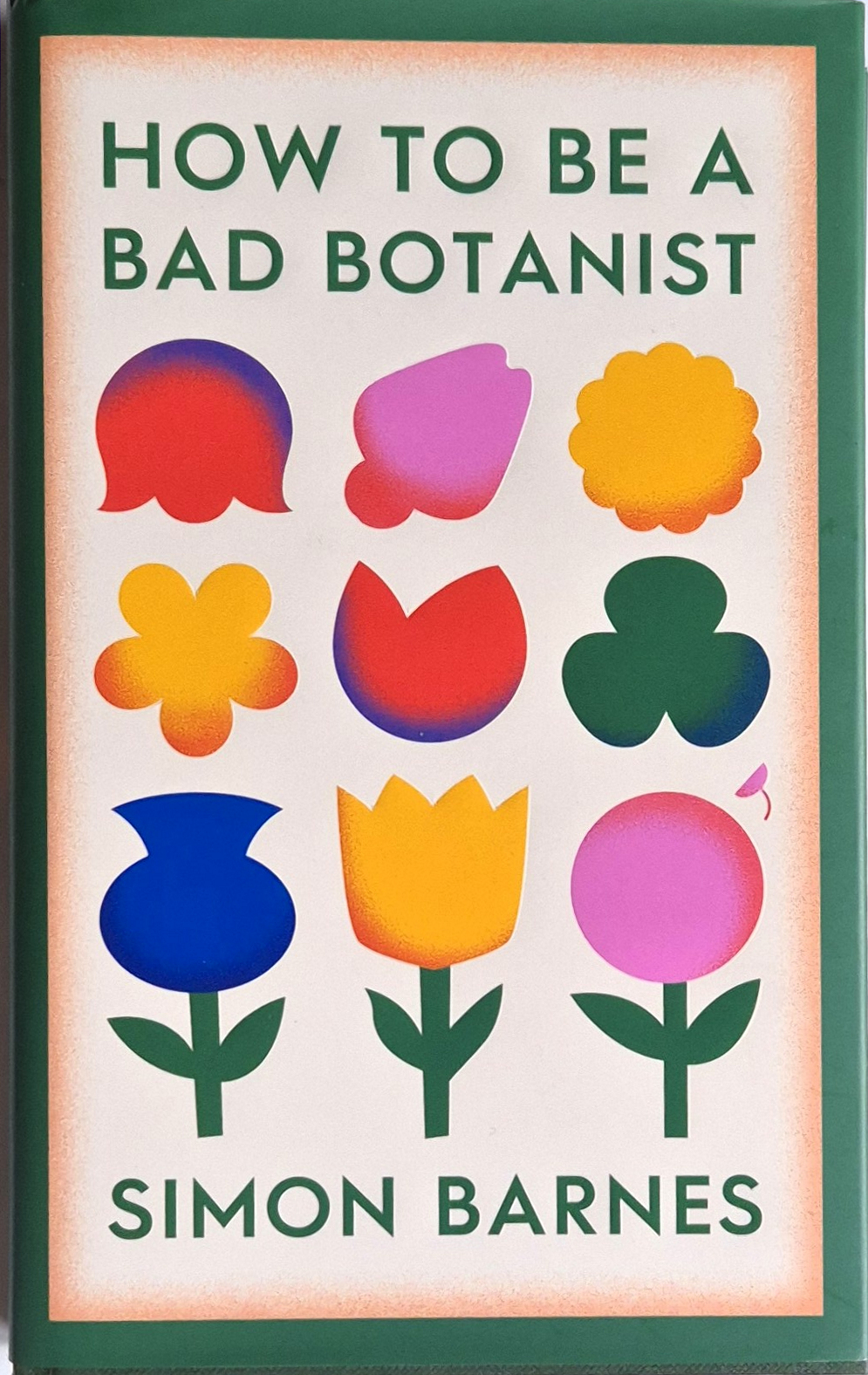
Barnes (Simon). How to be a Bad Botanist. Simon & Schuster, 2024.
Next, Barnes takes us on a walk along an “entangled riverbank”, then a chapter on domestication (mostly of plants) in which he surprises me: aurochs, the extinct ancestors of modern cattle, is an unusual word. Aurochs is both singular and plural but there are two alternative plurals: aurochses and aurochsen, neither of the latter recognised by WordPress’ spellchecker. It’s an interesting perspective to see that a wild grass species that we have changed into the wheat we know today is now everywhere, but that it is perhaps not a one-way arrangement, perhaps more of a symbiosis, where both humans and wheat have benefited.
I have never liked cultivated roses, I don’t know why. Here I learn that they cannot even exist without the help of a gardener: they cannot admit pollinators.
The opening of a second chapter on trees typifies the author’s gentle wit and lack of pretension: “This chapter is about trees that you think you should know already but are too embarrassed to ask…” I know know that feeling, although I can identify some of these – beech (grey bark verging on silver, oval pointed leaves), willow (like a weeping willow but reaching upwards), hawthorn (commonly part of a hedge, white blossoms and red berries or haws), hazel (those wonderful catkins or lambs’ tails in spring, with tiny red female flowers), London planes (can tolerate just about anything including heavy pollution), ash (distinctive leaf shape, often regarded as weeds), and sycamore (large palmate leaves and helicopter seeds).

Hawthorn
This, incidentally, is a goat willow tree (Salix caprea) which lives just by our house. From the yellowish colour of the catkins it’s possible to say that it is a male.


There’s also a brilliantly succinct chapter on plant evolution with such gems as the fact that many plants evolved (being the operative word) so as not to be able to self-pollinate which would lead to reduced genetic diversity. The importance of toadflax in the development of science for both Darwin and Linnaeus is emphasised in the following chapter, as were peas to Gregor Mendel who created the science of genetics.
I would love this book more if it had colour illustrations, aide-memoires to all the species under discussion. I would happily have spent another £10 or so for that and perhaps foregone the dust-jacket and the design, which I am not keen on, being repeated on the end-papers. I think I will make my own illustrated list, which will be fun to do. And then see what I can find.
A chapter on native and non-native conifers in the UK reveals that Crossbills, members of the finch family, have evolved their crossing bills (the clue’s in the name) specifically to extract seeds from conifer cones and concludes with an awestruck reverie on the Cedar of Lebanon. In the garden in which I grew up were a Silver Birch and a magnificent Cedar of Lebanon, which is probably why they remain my favourite trees. The latter is on the Lebanese flag. Just as Barnes says, they can be recognised “from their grandeur as much as any detail of needle and cone … After all, they inspired reverence in a ten-year-old”. And in this child too.


Dog rose (taken from Animal Wild)
“Naming of Parts” is about taxonomy, with a short diversion on parthenogenesis or virgin birth. It doesn’t occur in mammals at all (except for Mary I suppose, allegedly), but birth without fertilisation by a male produces clones. It does occur in some nematode worms, bees, scorpions and even a few vertebrates, occasionally in birds. There’s also a reminder that all dogs belong to the same species, they are all wolves really. It does annoy me when people talk about ‘breeds’ of wild animals – of course there is no such thing. And good to bear in mind that the identification of species is an ever-changing thing, nothing is set in stone and often involves a good deal of controversy. A hybridised plant would have an “x” in Roman in between the two Latin names in italics, useful to know. “Naming of Plants” would have been a more appropriate title for this chapter. I was rather expecting to learn about the nomenclature of different parts of plants, which I have become quite confused about whilst reading the book. A diagram would have been good.
Vilified plants are the sibject of “The Vampire Plants” and it is good to see myths I hear so often busted wide open. I have a friend who absolutely hates ivy, but it is not even parasitic, it takes nothing from its hosts (except support), although I know from experience that it can do a great deal of damage to a brick wall. Although it may compete for light, water and nutrients, and its very weight may be a problem for a very old tree, it is not a strangler. It is wrongly supposed to reduce the effects of alcohol, which is why Bacchus traditionally has an ivy wreath around his head – I had never thought to wonder. Ecologically, it is a great source of late season food and of winter shelter for invertebrates.

Ivy
Mistletoe, on the other hand is parasitic, or at least hemiparasitic – it can take its own light and nutrients but takes them from the host too. The kissing thing derives from ancient associations with fertility and “some claim that the white berries are reminiscent of semen.”
An example of a full-on holoparasite is dodder, which cannot survive by itself. Usually a reddish colour and forming a net of threads, it has no roots, no leaves. Yellow rattle is another hemiparasite and in flower meadows it is very useful since it weakens the growth of grass so making room for other plants.
Carnivorous plants are not confined to tropical locations, we have several here including sundew which traps and devours insects.

Convovulus Tricolor or Dwarf Morning Glory
(taken from Animal Wild)
Plants don’t want to be eaten (except in the sense of seeds being spread by animals) and they can’t run away, so what are their strategies? Thorns and spines of course, and poison. Poisonous plants include hydrangea, oleander, daffodil, wisteria, foxglove, lily of the valley and rhododendron. Cue slew of furious parental letters to primary schools where such things are permitted. That really does happen as I recounted in Animal Wild:
Amy-Jane Beer writes wittily in “As though of hemlock I had drunk” about the ridiculous overreaction to the presence of certain plants and animals, citing the usual media scaremongering (wasps, adders, flying ants, foxes who eat babies) and in particular the discover of hemlock near a school, where the head teacher advised parents to walk their children in the road to avoid it. It tastes terrible, she points out, and you would have to ingest an awful lot of it to die from it, which is also the case with, for example, bluebells, foxgloves and daffodils. Rather more significant were the dangers of walking in the road. She recalls absent-mindedly drinking a pint of water one morning in which she had put daffodils the night before for a few hours; it made her seriously ill. She quotes the BBC which should have been promoting the science talking of “dangerous plants lurking [her, here, not italics] in plain sight”.
On a sett survey we walked through tall bracken and all found ourselves itching. The simple fern contains ptaquiloside, which is a carcinogen, and hydrogen cyanide. One of us recalled the trick of bruising some and placing it around his head when sleeping out to repel biting insects.
The tubers are the only parts of potatoes which aren’t poisonous. Some plants, very efficiently, only produce poison when they are under attack. How do they know? The wood-wide web, whereby plants communicate with each other through the mycelium networks under the ground. Many stones and pips contain a mixture of sugar and cyanide. 100 grams of apple pips, if chewed and swallowed, could kill a person, and rhubarb leaves contain oxalic acid which isn’t good for you either. Moreover, some caterpillars and moths store the poisons from brassicas and ragwort and use them for their own purposes. Barnes lists various of the worst wild plants to avoid.
He finishes off with a chapter on orchids of which there are a surprising 52 species in Britain, which rely on mycelium to germinate and many of which grow on other plants (epiphytes). Some people are crazy about them, obsessive even, and huge sums were paid for them in the nineteenth century. The lady’s slipper orchid has had to be guarded and protected since 1930 such were the predations of colletcors. The name derives from the Greek ορχιδέα, meaning testicle, thanks to the root shapes of some species. Bee orchids, incredibly, develop labella which look, feel and smell like female long-horned solitary bees, Eucrea longicornis. Male bees pseudo-copulate and do the job the orchid wants: collecting pollen. Ghost orchids are obligate parasites on fungi and produce a flower as rarely as every ten years or much longer. Man orchids, as the name indicates, produce flowers which look like men with long, thin phalluses.


Early marsh orchid, Pyramidal orchid, Northern marsh orchid
(taken from Animal Wild)
Following this is the all too familiar refrain: climate change and in particular intensive agriculture (hedgerow destruction, field edge cultivation and poisons) are having a terrible effect on our native plant species, over half of which are in decline. But as Barnes says, “If there is hope for nature, it’s in our love for it.”
Barnes quotes my favourite poet, Gerard Manly Hopkins, as a header to his this final chapter. The poem is “Inversnaid” and it seems worth reprducing all of it here.
This darksome burn, horseback brown,
His rollrock highroad roaring down,
In coop and in comb the fleece of his foam
Flutes and low to the lake falls home.
A windpuff-bonnet of fáawn-fróth
Turns and twindles over the broth
Of a pool so pitchblack, féll-frówning,
It rounds and rounds Despair to drowning.
Degged with dew, dappled with dew,
Are the groins of the braes that the brook treads through,
Wiry heathpacks, flitches of fern,
And the beadbonny ash that sits over the burn.
What would the world be, once bereft
Of wet and of wildness? Let them be left,
O let them be left, wildness and wet;
Long live the weeds and the wilderness yet.
Leave a Reply