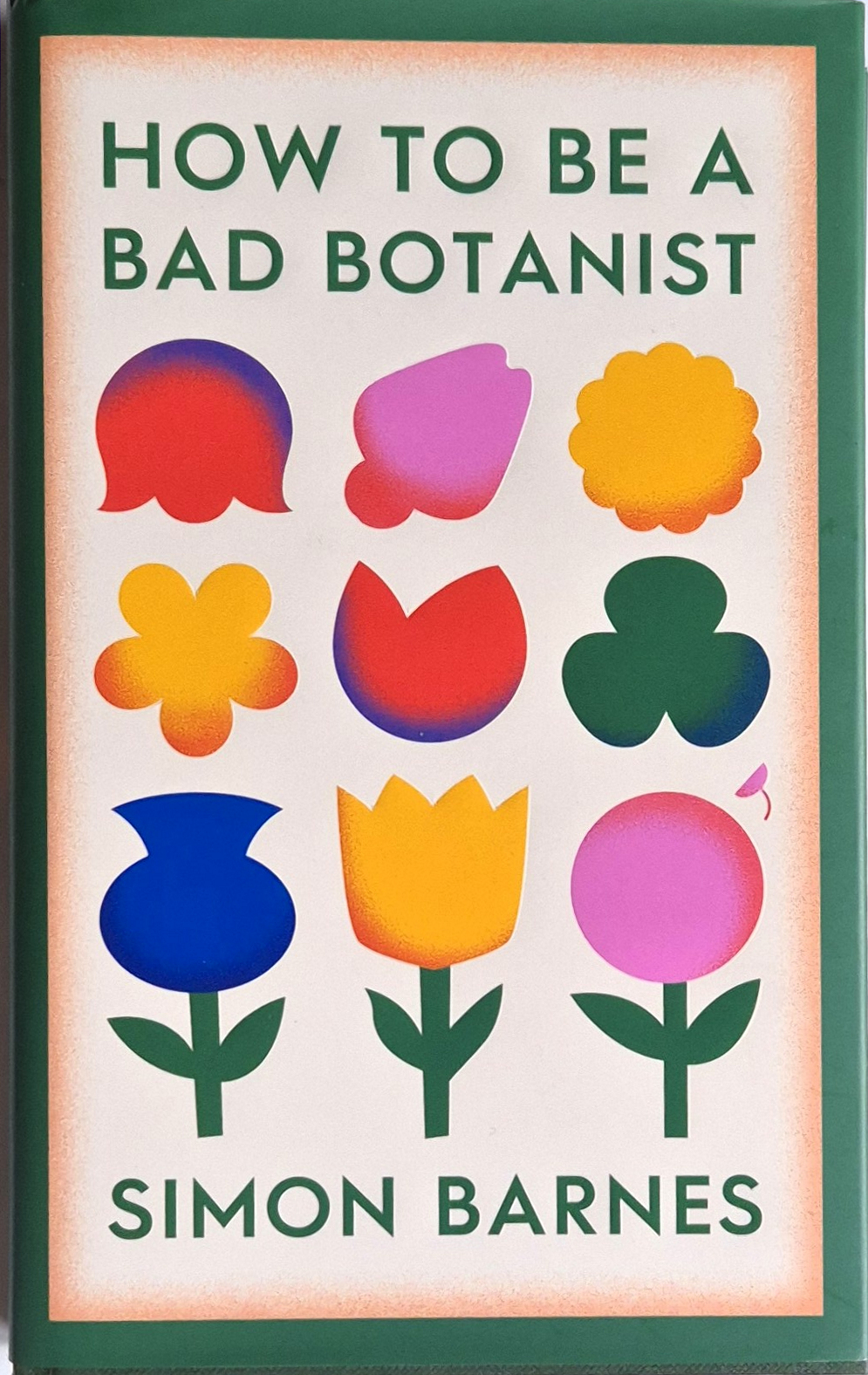
Barnes (Simon). How to be a Bad Botanist. Simon & Schuster, 2024.
Following his earlier How to be a Bad Birdwatcher, Simon Barnes here writes as beautifully, accessibly and inspiringly as ever. He is a very fine judge of how best to impart information and enthusiasm and to philosophise without ever patronising. The book is gorgeously illustrated by Cindy Lee Wright.
Her website is very much worth a visit:
“My subject matter is the natural world, usually the non human animals we are privileged to share it with. My hope and intention is to bring wild world closer, both to celebrate it’s astonishing beauty, and also to remind us of our responsibility for it. I also take the opportunity where relevant, to use poetry to enhance what is essentially a tribute to wildness. “
She is based in Norfolk and I am sure I saw some of her metal wildlife art when I was last in that part of the world. She also illustrated Barnes’ Rewild Yourself.
Since posting this I have been in touch with Cindy and she has kindly given me permission to reproduce one of the illustrations here.

I have also enjoyed these books as listed in the Animal Wild bibliography:
Barnes (Simon). Ten Million Aliens. Short Books, 2015
Barnes (Simon). The Meaning of Birds. Head of Zeus Ltd, 2016
Barnes (Simon). The Sacred Combe: a search for humanity’s heartland. Bloomsbury, 2016
Barnes (Simon). Rewild Yourself: 23 spellbinding ways to make nature more visible. Simon & Schuster, 2018

Wild primrose
A major epiphanic moment for me was noticing for the first time the close-up beauty of a bramble flower on a badger sett survey, the author’s was seeing, on Orford Ness, a ten-mile-long spit of shingle off the Suffolk Coast, the apparently surprising on such unpromising ground appearance and survival of yellow-horned poppies, sea kale and sea pea. He suggests that we all know a good deal more about botany than we think. Not only can we tell a blade of grass from a Christmas tree, we can probably recognise these ten wild plants: primrose, wild rose, daffodil, snowdrop, cow parsley, clover, daisy, dandelion, bluebell and buttercup. I have already learnt a certain amount about all of them, but Barnes invariably throws in a surprising snipper or two in his paragraph on each. He quite rightly criticises the pleasure so many people derive from their real or feigned ignorance (which I think is something to which English people are particularly prone), although I do take issue with his citing of Richard Dawkins’ ignorance of theology. That is very far from the truth. Like Dawkins, I am an atheist (to all intents and purposes) but that doesn’t mean I know nothing about religion, and not just Anglican Christianity which I could hardly avoid knowing about thanks to immersion (not literally, I am not baptised) at school.
It’s all about light. Plants alone “eat” light, or, rather, use the energy from light to create food, but so does everything else on earth at one remove or more. And we depend on them for fossil fuels too. “Plants, in short, are the only living things that can exploit and store the energy from the sun.” Plants are green and green is the colour of life. And plants waste product is oxygen, leading to one of the six major extinction episodes (the sixth is the one happening right now), but also leading to our very existence.
As with my newly found enthusiasm for fungi last year, or my noticing the profusion of blackthorn flowering alongside the A34 on my way to HART Wildlife Rescue a couple of years ago, once you have seen something, you suddenly see it everywhere, whether or not you remember what it is called. I do sometimes worry about my obsession with names (especially of birds), if something is beautiful what does it matter? But Barnes is right – naming is the beginning of knowing, it’s a portal, a way of engaging. I had never noticed that male Chaffinches have a green rump until today – now I will always notice it.

I am learning a lot from this book. Vascular plants are angiosperms, that is their seeds are in cases, whereas conifers, for example, are gymnosperms, their seeds are naked. There are three basic means of seed dispersion: wind, water and animals. Those plants whose seeds are scattered by the wind don’t need showy flowers, but of course it isn’t all about looks: scent plays a major role as well as shape and colour (including ultraviolet). And with many species of bees and ants, for instance, pollen is taken back to the hive for food, so that pollination is actually a side-effect. For that reason many flowers produce a surfeit of pollen. Scents are not just of the kind we find pleasing: from the rafflesia emanates a smell of putrefaction and death to attract carrion flies.
The purpose of every flower is to be fertilised and become a fruit: most of what we think of as vegetables are in fact fruits, rice is technically a fruit and flour is made from the fruits of wheat.
The forsythia here is especially good here this year, incidentally:

Barnes takes three short walks along the “entangled bank” by his home, noticing, identifying and telling us about the wild flowers he sees.
In a chapter on seed dispersal we learn of the many different strategies plants have evolved, whether in the ingenious aerodynamic shapes of dandelion and sycamore seeds, seeds designed to float, seeds expelled at speed (amazingly, the sandbox tree in the Americas fires its seeds out at something like 160 mph) or seeds destined to be carried away by animals. The inventor of Velcro was inspired by burs, whilst other seeds are designed to be eaten and excreted without suffering damage. In mast years an oak can produce as many as 10,000 acorns. The odds are against the individual but it only needs one to succeed, to become a mature tree, for the parent to have fulfilled its biological destiny.
Barnes does have an annoying tic which is his tendency to begin to write about a particular subject, then to say that he’ll come back to it in more detail in a later chapter. He does it a lot and I find it ungainly. Better to structure things differently.
He hits the nail on the head when he points out that wildlife enthusiasts can tend to ignore the botanical because they have become so attuned to sensing movement. He writes of two types of bindweed, a plant I am equivocal about. I have spent a lot of time ripping it out since it does have a habit of taking over, but on the other hand the way the tendrils work their way upwards and around other plants is truly remarkable and the flowers are lovely. They are also known as morning glory after all.

Also the sexy cuckoo-pint, pronounced to rhyme with bint, rather than like a pint of beer. “Pint” is one of those words with no rhyme in English at least. There are three colours amongst the rest, surprisingly: orange, silver and purple, if one excludes very obscure words (chilver and hirple and curple apparently). Ragwort is he says “not such much a plant as a controversy”. I wrote about this in Animal Wild:
A frequently given excuse for the use of glyphosate is the elimination of ragwort, that much demonised weed, which has allegedly killed thousands of horses. It is toxic to equines and other animals, but so are lots of other plants. The scale of the problem has been massively exaggerated for years and is to all intents and purposes a myth. Animals are generally pretty good at knowing what is good for them to eat and what isn’t and ragwort has a very bitter taste which a horse would have to be near starving to overcome and even then they would have to ingest a large quantity to cause serious damage. The alkaloids which cause liver problems are present in 3% of all flowering plants. The British Horse Society bandied about a figure of six thousand five hundred deaths based on bad science and statistical error. The Advertising Standards Authority attempts to shut down various instances of such propaganda. Which is not to say there are no deaths, there are certainly problems if ragwort finds its way into hay (by which time it will have lost its bitter taste), and so it does need managing in certain areas, but the numbers are tiny, distorted by those with vested interests and a sort of hysteria. It is not an invasive weed, its toxicity has been overstated and whilst I did spend time at Trindledown digging it up when we still had horses and ponies (the vet advised us then to burn it), there is no legal obligation on anyone to do so without a specific order as has been claimed. A Friends of the Earth briefing confirms that proven cases of poisoning are very uncommon and almost always go hand in hand with poor horse care and mismanagement. They also point out that thirty-five species of insects rely on ragwort for food, a further eighty-three have it as a significant food source, and that it is the seventh most important nectar-producing plant for pollinators such as bees and butterflies (this last figure from government research).
Like me, Barnes likes thistles. Again from Animal Wild:
It was telling that, being very fond of thistles, when I searched the websites of two local garden centres to see what they had in stock, I found myself in both cases on the page for the systemic, broad-spectrum weedkiller Roundup, which contains glyphosate, a chemical widely used in farming, forestry and gardening, which yellows and kills everything, and has terrible knock-on, long-term effects on wildlife, not only because of habitat loss but for example in badgers where it is thought possible that ingestion may even affect their breeding abilities, on bees’ ability to keep their colonies within the necessary temperature range, and likely on us too. It’s shocking that the search term “thistle” took me there, assuming that anyone’s interest would only be in eradicating them with poison.
Similarly when I just now googled to try to find out who might be making the small conical holes in the garden, almost every result took me to a list of ways to eliminate wildlife.
Turning his attention to trees, it’s startling to learn that there is no scientific definition of what a tree is. We just know them when we see them. I really hope I am right about this one – I think it’s an oak – since Barnes says that oaks look like oaks “even to the botanically unawakened, and are often obvious enough even in leafless winter.”

Leave a Reply