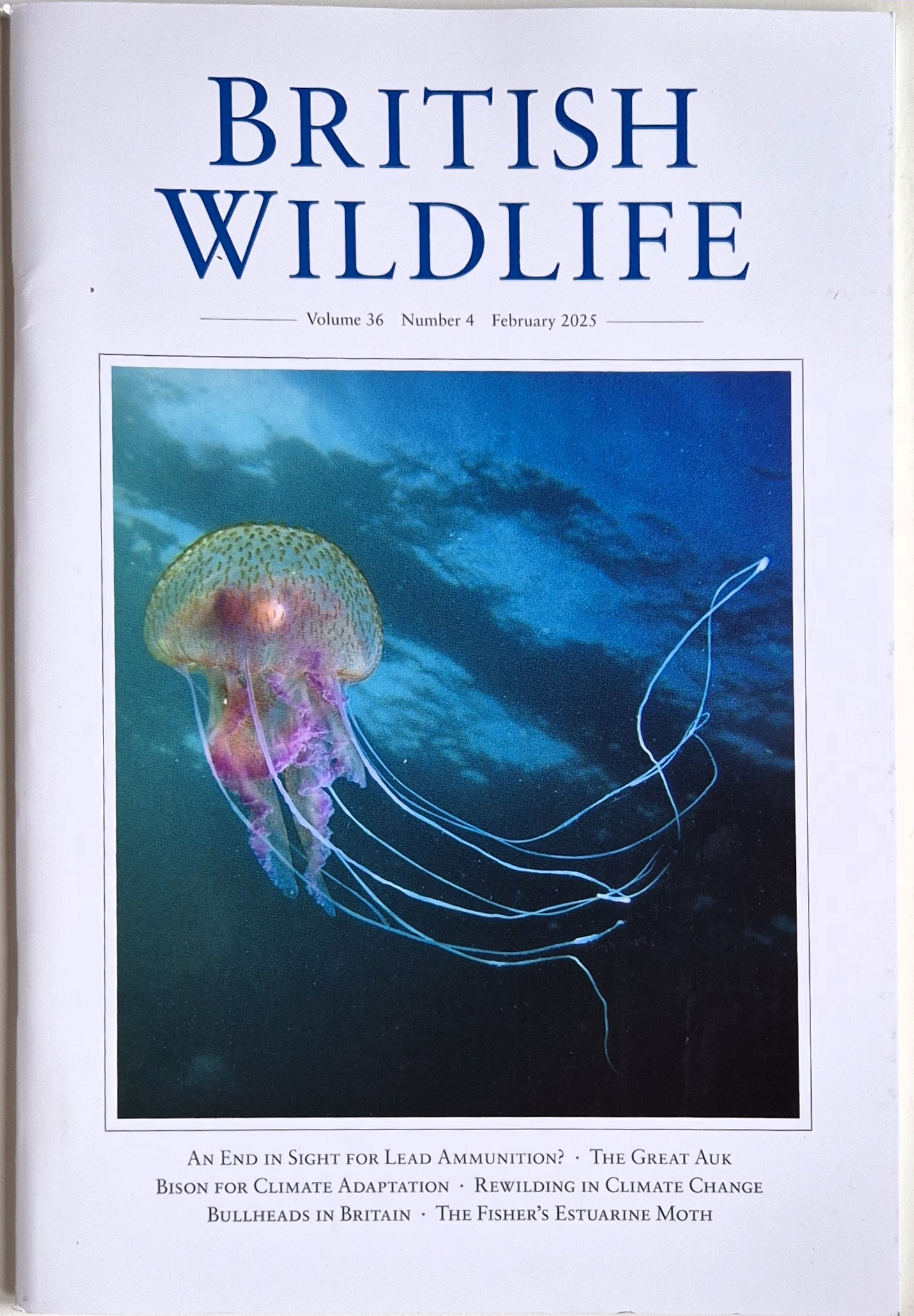
Volume 36, Number 4
There is invariably a superb photo on the cover, but this issue also has the text “An End in Sight for lead Ammunition?”, which is the opening editorial piece by Ruth Cromie. We have known about the toxicity of lead for over 2,000 years and its very severe effects on wildlife and humans, but still there is no political will for change, just the usual mindless stubbornness from the shooting fraternity. A paper published in the USA as long ago as 1919 showed that some two to three million waterfowl were likely killed by it each year – that’s not from being shot, that’s just from ingestion. The figure in the UK today is some 100,000 per year, including raptors. The Royal Commission on Environmental Pollution recommended it should be replaced by non-toxic alternatives in 1983 (although just don’t shoot birds in the first place would be my solution), reiterated in 1991 at a Brussels workshop, and in 1999 the African-Eurasian Waterbird Agreement included an obligation to ban lead shot in wetlands. Other countries such as the Netherlands, Denmark and Flanders all made the transition. Ruth Cromie quotes from a 2018 paper, a study of a man with chronic lead poisoning from eating game: “supersonic injection of toxin-leeching frangible projectiles into food is intuitively bad.” Wild Justice have carried out a number of surveys of game meat sold in our supermarkets with horrifying but unsurprising results. So why has it not been banned here? “… tradition … denialism and suspicion of motives for seeking restrictions … and vested interests, such as ammunition manufacturers”. All the usual suspects then. Large sums of taxpayers’ money have been spent on government studies to prove the blindingly obvious, but advice was rejected by, for example, Liz Truss of lettuce fame. Over ten years some 100,000 tonnes were released into our environment. A more recent study presented to Steve Reed, Environment Secretary, recommends a ban except for small calibre bullets (why on earth?) and sport shooting athletes – are they somehow supposed to be immune to the effects? But it’s a start. Alternatives are not even more expensive. As ever with these people, partial regulations and voluntary action have failed. If the ban finally does go through, “Future generations will wonder why it took us so long to get there.” Indeed.
BirdWatch magazine was a little too competitive twitchy for me this month for a full post, but an article about the Common (not so common) Pochard explains that hunting and the use of lead shot are taking their toll on populations in the UK and elsewhere: incredibly, these striking birds are still included in the list of permissible quarry species. It has been illegal to shoot them in Ireland since 2023.
This is from Meyer (Henry Leonard), Illustrations of British Birds, c.1835-1844., with the male in winter plumage in the foreground.

Wild Justice and Raptor Persecution UK have published this brilliant flow chart and raptor persecution statistics relating to driven grouse shooting.


The thing about guns is that they have only one purpose: killing animals or people. After the horror of the Dunblane shooting, the reliably appalling Prince Philip had this to say:
“If a cricketer, for instance, suddenly decided to go into a school and batter a lot of people to death with a cricket bat, which he could do very easily, I mean, are you going to ban cricket bats?” In a Radio 4 interview shortly after the Dunblane shootings in 1996. He said to the interviewer off-air afterwards: “That will really set the cat among the pigeons, won’t it?”
There’s a list of his gaffes and racism here:
Prince Philip: 90 of the Duke of Edinburgh’s most excruciating quotes and ‘jokes’ | The Independent
No. 59 is also especially unpleasant:
“It’s not a very big one, but at least it’s dead and it took an awful lot of killing!” Speaking about a crocodile he shot in Gambia in 1957.
Meanwhile, Protect the Wild reports on a police raid on the Cottesmore Hunt during which a pistol, a bolt gun, terrier locator collars and even the terriers themselves were seized. None of which would of course be needed for trail hunting. So much for the smokescreen. It also emerged that Natural England has been allowing hunting on protected wildlife sites. The police action is most welcome, but this should have been happening since the Hunting Act was passed twenty years ago. Maltreated hounds continue to run out of control, all too often putting themselves and others into dangerous situations. A regular dog ‘owner’ would be prosecuted. Rob Pownall of PtW points out that there are only ten bloodhound packs used for clean boot hunting, where the quarry is a human rather than a wild animal. But there are 250 foxhound, harrier and beagle packs. When the Hunting Act came in, the Countryside Alliance and others vowed they would break the law and one advocate actually threatened civil war over the issue. Bloodhounds are not trained to kill, so there are no ‘accidental’ deaths either. So why the resistance? Erm, tradition, of course. And the love of terrorising animals, cruelty and blood. These people are so predictably depressing. Rob also uncovers the legal but horrendous practuce of lamping, where wildlife is hunted at night using powerful spotlights, high-powered rifles, night vision, and trained dogs. Can wildlife not be left in peace at night at least?
UPDATE. They will never stop. Just four days ago a pregnant vixen was ripped apart by Holderness Hunt hounds. One foetus was left behind in the grass along with her internal organs.
In the garden incidentally, I was delighted to hear Coal Tits yesterday and to catch a fleeting glimpse of one of them. No photos … yet. I wouldn’t have recognised the sounds but the Merlin app did. I am pretty useless at bird calls and songs. I can manage a few, like Jackdaws and Magpies and can tell a Collared Dove from a Wood Pigeon (three and five calls respectively), but to be honest the smaller birds all sound pretty much the same to me. The sound of the Chiff-chaff has been pointed out to me many times, but I just can’t hear the onomatopoeia. The BTO is running an online course this month which I may try but fear it would be wasted on me – or perhaps it will improve my skills. Since writing this I have now signed up for the course. We shall see. The Coal Tits have not been present here for some years but they take my species count in the garden to nineteen, if I can count the Red Kites and Canada Geese overhead. The Jackdaws continue to be ruled by the Wood Pigeons – they will feed together but woe betide a Jackdaw who invades a certain personal space. It merely takes what I can only describe as an indignant look from the pigeon. For those who don’t like Jackdaws, I am constantly reminded that they shake food from the feeders which helps the ground feeding birds, the Dunnocks, Blackbirds and … the pigeons. I love how they look up at the feeder to assess position and distance before launching themselves. The other night at around 5.40 pm our local birds collectively decided it was bedtime and I watched fifty or so fly past west towards their roost. There were a couple of stragglers who headed in the wrong direction, northwards, but then they suddenly banked, like aeroplanes, and continued west.
And is it me or is this Blackbird’s beak particularly yellow-bright? I have actually saturated the colour somewhat since the photo otherwise did not do him justice.

In other news, we can hope for a ban on the import of seal fur when it is debated in Parliament this year, and Royal Mail has issued wildlife stamps: a hedgehog for first class and a badger for second class, but it seems ironic to be celebrating them in this way given what we are doing to them. But all awareness must be good. Hugh Warwick. author of Cull of the Wild, Killing in the Name of Conservation, which I reviewed pretty scathingly here
Cull of the Wild – Animal Wild
has it seems recanted, accepting that badger predation is no more than a minor factor in hedgehog decline, a point I have repeatedly made in certain quarters, based on a paper by Katie Lee at Nottingham Trent University:
“It used to be thought that badger density alone was enough to mean there would be no hedgehogs, but in the paper she writes, ‘badger density threshold for coexistence may be site-specific, based on the availability of habitat, abundance of local food resources, and may depend on the scale at which coexistence is being assessed … the take home from this paper is, I think, that hedgehogs and badgers have the capacity to coexist as long as there is enough food and shelter. This, in turn, is also supported by the fact that hedgehogs and badgers have managed to coexist for millennia… since the retreat of the last ice sheet. What has changed is the way in which we manage the land – and the ecological deserts into which we turn farms.”
The government has granted permission for the release of beavers in the UK, which is wonderful news. But then there’s Jon Swinney, First Minister of Scotland, who has ruled out lynx reintroductions. There was the sad case of the unlicensed release of four who were recaptured, one of them having died, but careful and responsible reintroduction would be a wonderful thing to retore the balance, help with deer numbers, and be a huge step for biodiversity. Why not? Because farmers don’t like them for their alleged impact on livestock. As one online commentator says: “I’m still surprised, although I know I shouldn’t be, at the amount of sway these people have over the decision makers.” It gets worse. Swinney has also ruled out introducing White-tailed Eagles, again pandering to the farming community. His comments on other reintroductions are either idiotic or highly disingenuous or both: that there had been unspecified “unintended consequences” from the eagles and that that the Eurasian Beaver population in Perthshire was now “formidably more comprehensive than it was at the beginning” and that he had witnessed “very directly and dramatically” the impact of beavers on flood prevention measures in his own constituency. But it is common knowledge now that beavers are wonderful for the environment, for everyone, even farmers. Swinney is wildly out of touch with the Zeitgeist.
Chris Packham doesn’t like daffodils, he calls them “naffodils”, but shares my sense that spring is impatient this year. The RSPCA has called for a more humane way of killing pigs than CO2 but they really need to address the elephant in the room – the money they rake in from the useless and corrupt assured farm scheme.
PETA is again protesting the abhorrent and cruel grotesquerie of the Crufts dog show, now dropped by the BBC but to air on Channel 4. “The pageant promotes extreme features that leave dogs suffering. Pugs strugggle to breathe, Cavalier King Charles spaniels have oversized brains for their skulls, and bulldogs can’t even mate unaided.” Following another campaign five years long, the University of Bristol has finally stopped their pointless forced swim tests.
Hillside Animal Sanctuary has been busy rescuing deer – just sometimes their injuries are not so bad as to require euthanasia and they are given safe, comfortable and peaceful lives.
This post has gone on way longer than intended and so I will return to the rest of British Wildlife magazine in another.
Leave a Reply