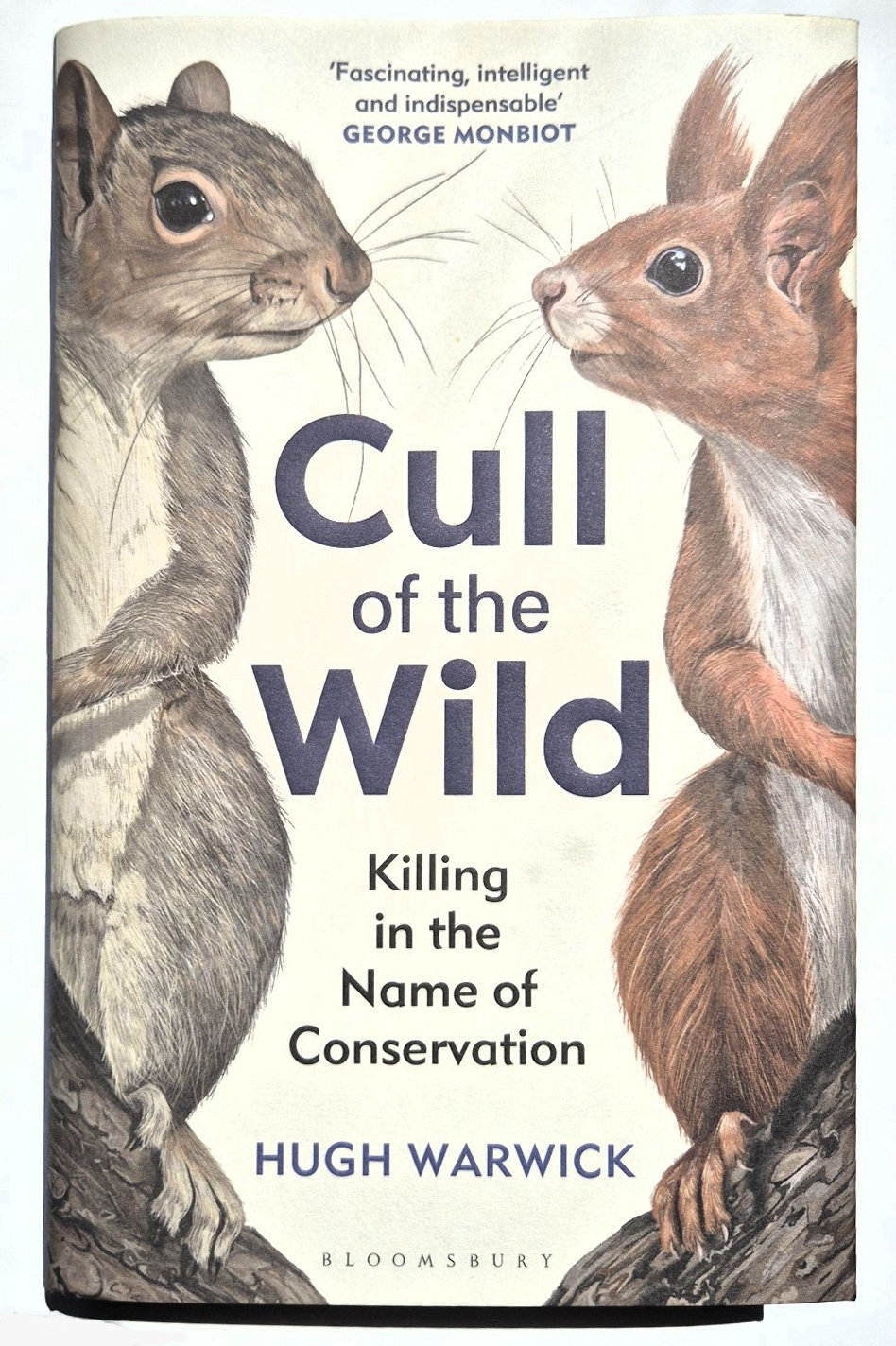
A review of Cull of the Wild, Killing in the Name of Conservation, by Hugh Warwick, Bloomsbury, 2024.
Rarely has a book made me as angry as this one. It is not generally the aim of this blog to do a hatchet job on anyone else’s books, but I am making an exception.
I have often said that I spend a lot of time agonising and worrying about invasive or in some cases ‘invasive’ species and what, if anything, to do about them. I bought this book in search of information and illumination, both sadly lacking.
In his introduction, Warwick sets out his starting point and outlines his beliefs but it is very much an over long exercise in introspection. I find the entire book solipsistic in the extreme.
I read the first 100 pages or so, then gave up. There seemed little point in just getting angrier and angrier. But I did then flick through the index to see what he might have to say about particular subjects close to my heart.
The author points out, over and over again, that these are complex issues – well, no shit, Sherlock. But rather than trying to find a way through them, he constantly compromises. His arguments are often specious or go nowhere at all. He talks, for example, of traps designed to kill squirrels having been sold without guards to make sure that hedgehogs were not also slaughtered. He seems to accept without demur the argument put out by the manufacturer that without the traps, foresters would rely on poisoned bait, which would be a worse outcome. Simple solution (mine, not his): don’t just accept the status quo, campaign for a ban on the use of poison which puts any wildlife at risk and force manufacturers to do their job responsibly, if indeed they should be doing it at all.
The final line of a very short chapter about cane toads is: “The take-home message about this species is that the best way to stop a cane toad invasion is simply not to start one.” Well, yeah. But how is that helpful?
Warwick is a self-confessed hedeghog obsessive, which is fine of course, but in the chapter on that subject as elsewhere he sets out arguments but fails in any way to justify them. I did wonder if I was misreading this book completely. It has a ringing endorsement by the great George Monbiot on the dust-jacket after all (although Warwick’s crowing over winning an argument with him I found rather distasteful). I checked out a couple of video interviews with him but I could only watch them for a short time. One such, part of Chris Packham’s lockdown Self-Isolating Bird Club, includes this hedgehog expert’s statement that hedgehogs move surprisingly fast given that they “only have little legs”. No they don’t. I have spent many hours weighing, checking and feeding hedgehogs, and their legs are in fact quite long, especially in proportion to the rest of their bodies. Around four inches in fact. He is a spokesperson for the British Hedgehog Preservation Society which, in spite of his excellent campaigning for hedgehog highways, I find rather worrying.
His liking for Starlings and their murmurations he describes as “tedious and predictable, like your favourite movie being Casablanca or favourite dog being a Labrador.” Starlings are one of my favourite birds, so I am sorry to be such a bore, but actually a lot of people hate Starlings and they are widely persecuted – and red-listed. He describes a scientific survey of Starling numbers in which he played a part when he was a student, during which he smoked a spliff and listened to Jethro Tull on his headphones. I have absolutely no objection to either of those things (I used to like Jethro Tull myself but am less keen on Ian Anderson’s large-scale salmon farming), but should he not have been concentrating?
He describes someone’s library as fascinating but “a bit weighted towards ornithological monographs.” What a strange thing to say, at least without a qualifying “for my taste”.
When he writes about vivisection he describes it as merely “distasteful” and happily quotes, without dissent, a description of laboratory animals living a “life of ease” as well as the absurd suggestion that animal experimentation is “highly regulated and carefully scrutinised.” It is typical of the author to say that farmed animals whose lives end in slaughterhouses have a far worse existence, as though that in any way justified anything. This is bad, but that is worse, so it’s ok. This is bad, but if not that then something worse would happen, so it’s ok.
There is also an awful lot of “I had not thought to ask” which is not great for a scientist. The book as whole could have done with a great deal more proof-reading and editing. I cannot imagine for whom it was written. He talks, with a typically egotistical approach, of his “prejudice” – “I hate killing.” That isn’t a prejudice is it? Surely it’s the norm unless you are a sadist, psycho- or sociopath or someone otherwise entirely without compassion?
On the Capercaillie he talks of their leks. “Lek” he says means “play”. That is indeed its Swedish etymology, but it not what the word means in the context. It is a place where males gather to perform courtship displays. I am sure he knows this. But then he compounds it by suggesting that playing is very unlike a bird. He has got to be kidding.
See my observation of Great Tits here: Wildlife notes – Animal Wild
On the subject of what constitutes an invasive species, he is at one point authoritative. Hares, rabbits and fallow deer (none of them originally native to the UK) are not, to say so would be “nonsense”, but he does not attempt to say why. Wallabies and Parakeets are fine, because he happens to like them. This is in the chapter on squirrels where he argues that if grey squirrels are not ‘managed’ commercial planting of broadleaf trees will happen less because it will become uneconomic. What are this guy’s priorities?
On page 88 he describes himself as “happy to think that at least squirrels would not attempt crossing by water” to the island of Anglesey. I don’t know why he thought that but a few pages later he recounts exactly that happening. Guess what? The turbulent water he saw is not always turbulent.
It is typical that he writes that “Lockdown did me no favours.” It did no one any favours. I am not too interested in the fact that he put on weight.
He doesn’t seem even to like or approve of wildlife rescues very much.
Here we go again on page 95. Cotton-top tamarins bred in captivity become too numerous. “There are already far more in captivity around the world than in the wild.” He concludes: “Healthy tamarins have to be euthanised.” Is that really the best he can come up with? It gets worse. The alternative is to sell the animals to laboratories and use the money to help future generations and their habitats. This gave him a feeling of “revulsion” – but as usual, there is a “But…”
Where was his editor on page 98? “He described how he had developed a killing strategy for grey squirrels: He described how he had developed a strategy for maximising the kill of grey squirrels.” Sic.
In the chapter on deer he notes that the timing of the showing of the last episode of Inspector Morse was “poor” since he wanted to embark on some fieldwork in the woods. These tv schedulers are just so inconsiderate. It may have been unfortunate from his point of view, but “poor”?
By this point I had had enough. I cannot make out his agenda, but he seems to me an apologist for a lot of practices which are, for me, totally unacceptable. I am also not sure how he wrote a book on culling without a single mention of badgers, according to the index at least.
From the index I looked up his references to Chris Packham. During a visit to his house he noticed Chris’s hackles rise when Warwick said he would be attending a show amongst the attendees of which would almost certainly be those responsible for the death threats against Chris and his family, perhaps even the people who set fire to his gates. This, he says, “certainly left me feeling uneasy.” He has often avoided Hen Harrier Days, organised by Chris Packham, because they occur in the summer holidays “and it always seems to rain.”
What probably raised Chris’ hackles at least as much was Warwick’s use of the word “pest” in a Self-Isolating Bird Club interview. It is a word he uses through out the book, but it, along with “vermin”, is a word Chris has abjured entirely for years:
“I shudder when I hear anyone refer to ‘vermin’ or ‘pests’ in reference to any creature that might eat other creatures that hunters and gamekeepers want to kill. These negative words essentially say that such creatures aren’t worth anything and it’s fine to slaughter them, indeed it may be a duty to do so. That way hen harriers, eagles, red kites, foxes, stoats, pine martens and more can all be dismissed. Often those saying this claim their aim is to protect wildlife. This is to divide wildlife into good wildlife and bad wildlife, rather like the deserving and undeserving poor of the nineteenth century (and a view that hasn’t gone away unfortunately). Wildlife is wildlife. All wildlife. No species is more deserving than another.”
Warwick seems of the entirely opposite persuasion. Here he talks of his love of corvids: “And then I saw a magpie killing a fledgling blackbird … There is little upset when a peregrine stoops on a pigeon … because the peregrine is a masterful predator and in a second the bird is dead. The magpie was clumsy and that gave the impression of cruelty.” What the actual f**k?
He also writes about the killing by poisoning of the White-tailed Eagles in Dorset in 2022 (see Animal Wild). He describes the efforts of the Dorset Police wildlife crime team as “amazing”, but no action was taken and the toxicology tests were mysteriously “inconclusive”. On the same page he says that the birds were found with seven times the lethal dose of rodenticide in their bodies. Ruth Tingay of Wild Justice and author of Raptor Persecution UK on the other hand opined that the case was shut down prematurely and deplored the police refusal to answer Freedom of Information requests. It is almost as though Warwick is setting out to be muddle-headed.
He does not probe further the view of one interviewee that he uses snares and Larsen traps “due to [his] passionate desire to cause minimal suffering.” “Snares have a very low impact on the captured animal.” Warwick himself describes both methods as having been demonised by those opposed to a certain “lifestyle”.
Enough already, I think I have made my point.
Leave a Reply