
I usually review and summarise the British Trust for Ornithology’s news magazine at some length, but I have to say that I found the winter 2024 edition rather lacklustre. It features a Harlequin Duck (I prefer the less gaudy Mandarins) on the cover to accompany a piece about the hoary and difficult subject of invasive species. It felt to me that there had been a bit of a struggle to fill this issue – it’s all relative, they do set the bar very high. One piece on the value of botanical recording reminded me of a happy conversation with Ed Hutchings during my trip to Norfolk. Both he and the other group leader Nick Acheson often seemed rather apologetic about pointing out plants as though we were unlikely to be interested, but as Ed and I agreed, how very odd to be interested only in birds to the exclusion of all else.

My sumac tree has shed all its leaves now and also the dark red drupes. I remembered that in years past the ground used to be densely adorned with them where they had fallen. But now, I wondered, where did they disappear? The answer was blindingly obvious – they provide food for the birds. How wonderful. I confess to a twinge of pride that I had enabled this cycle through an increasingly wildlife friendly approach to gardening.
The blackbirds, both male and female, are suddenly back in the garden too – I wonder where they have been. For the second morning running one of the bars and plastic covers on the seed feeder was on the ground. I suspect the Jackdaws have worked out how to do it. I wouldn’t put it past them and they are certainly clever enough. The Wood Pigeons meanwhile are trying hard to create more Wood Pigeons. It seems an odd time of year for it, but it seems they breed throughout the year with late broods even in December not unheard of.
RSPB Magazine
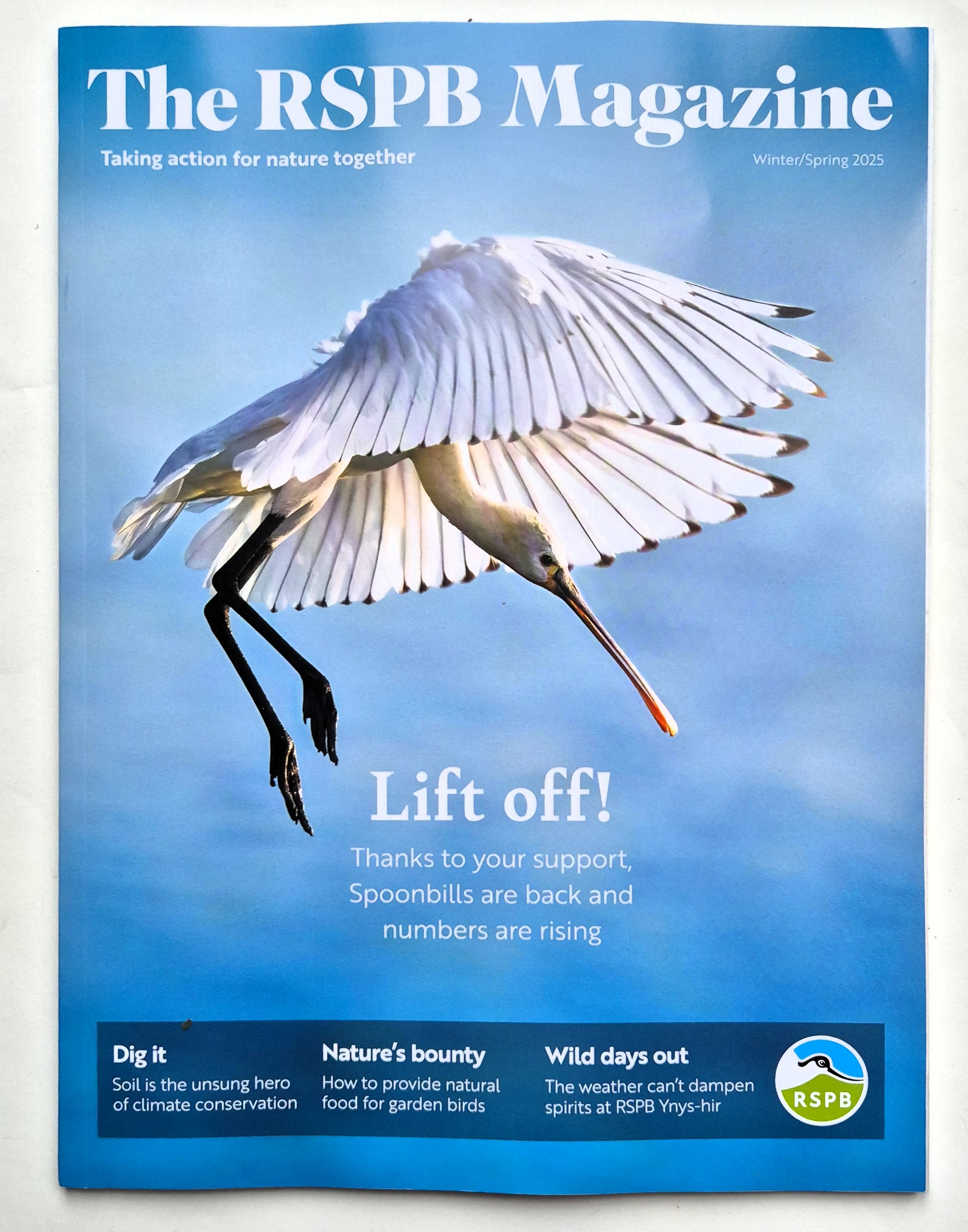
The RSPB’s magazine for Winter/Spring 2025 has a superb shot of a Spoonbill in flight on the cover, a species I first saw properly in Norfolk this year and which is doing well. The number of breeding pairs has doubled over four years. Chief Executive Beccy Speight echoes my sentiments above in her opening comment section about the restoration of the Flow Country in north-east Scotland, severely damaged peat bog, now a UNESCO World Heritage Site. She adds: “The changes I’ve made to my garden over the last few years have paid me back many times over.” The Flow Country restoration has been decades in the making and is still ongoing.
The Big Garden Birdwatch is coming up again, this time from the 24th to 26th January 2025.
Dominic Couzens contributes “The tale of tails”. I have long been bewitched by the perfect control Red Kites have over them, constantly making tiny, precise adjustments. Sparrowhawks fan out and narrow their tails and move them left and right as they fly through branches, enabling them to steer, speed up and slow down. Tails are also vital in various species for “balance, stability, signalling, flushing prey and promoting a bird in courtship.” In flight, we learn, they provide some 15% of total lift (more than I would have guessed) and reduce drag. Birds such as Swallows and terns have forked tails (as do Red Kites) to assist with sharp turns, whereas geese and ducks have shorter, triangular tails for stability, whether in the air or water. Tails, across species, are also crucial as air brakes for accurate landing. I wrote about Peacock tails not long ago, but many males have longer tails than females, like Magpies and skuas, and male Swallows with longer streamers are likely to attract more females.
Jim Moir, aka Vic Reeves, has book of his bird paintings out. I cannot say they work terribly well for me.
How do bulbs know when to push out new shoots? Another oƒ those questions to which I thought I vaguely knew the answer but didn’t. There are four forms of bulb: ‘true’ bulbs, corms, rhizomes and tubers. They are dormant in the winter but may continue to grow their roots, insulated by the soil. Some produce proteins which act as antifreeze. When temperatures rise, carbohydrates turn to sugars and the plant ends its dormant phase. “Milder winters and more erratic earlier or warmer springs, brought on by climate change, can disrupt this ancient process.”
A short interview with Howard Jones, an RSPB investigator, reveals that his team recorded 1,344 birds of prey as victims of illegal persecution in the UK between 2009 and 2023.
There’s a reminder to visit the RSPB reserves. Arne (and Poole Harbour) are very much top of my list for early next year and I keep meaning to visit WWT Slimbridge again. I don’t mind wrapping up for the cold (too much) but as a sufferer of SAD syndrome (isn’t everyone) I do need a bit of sunshine to encourage me. I might well see Spoonbills at Arne, but it is hardly surprising that I had scarcely seen them before. It was not until 2010 that a breeding colony was seen, in Norfolk, after a long absence. Their success and that of a number of other species owes much to the restoration of wetland habitat from arable land. They usually nest in trees but a group in Suffolk chose the ground and the company of Lesser Black-backed Gulls instead. The chicks are affectionately known as “teaspoons”. Spoonbills are very vulnerable to and hate disturbance so the RSPB manages viewing with great care as well as controlling water levels for them (not too shallow, not too deep).
I think I always say that Simon Barnes is one of my very favourite nature writers. Here he is on herons watching us “with that expression of mad intensity that herons do so well.” He too extols the value of wetlands, saying that those at Minsmere and Titchwell Marsh for example “are cathedrals that we should value as we do Yorkminster and St Paul’s”.
We often forget about the importance of our soils and the RSPB works hard on this too. “Just one quarter of a teaspoon can contain up to a whopping ten billion organisms.” The lovely earthy smell when rain falls on dry soil consists of plant oils which stop germination in dry weather and bacteria. The mixture, geosmin, is picked up and released as the raindrops fall and burst. Soil should matter most of all to farmers, one would think, but modern farming practices have degraded it on as much as 50% of agricultural land globally (pesticides, inorganic fertilisers, heavy machinery, intensive grazing). Some farmers however are changing their ways towards a more nature-friendly and regenerative approach.
There is sound advice on feeding birds not only from seed feeders but also by planting in particular Teasel, dandelions, thistles, Groundsel, Common Knapweed and others. Ivy is especially good, as I have written before, although loathed by some, quite wrongly, as a killer of trees. It provides food later in the year when there is not much else about through their flowers, fat-rich berries, invertebrates hide among the leaves and it also provides useful cover for the birds themselves. Rowan, Hawthorn and Crab Apple are also strongly recommended. Pleased to say that I can tick off a number of these. Also Ragwort, another unjustifiably demonised plant. This is from Animal Wild:
A frequently given excuse for the use of glyphosate is the elimination of ragwort, that much demonised weed, which has allegedly killed thousands of horses. It is toxic to equines and other animals, but so are lots of other plants. The scale of the problem has been massively exaggerated for years and is to all intents and purposes a myth. Animals are generally pretty good at knowing what is good for them to eat and what isn’t and ragwort has a very bitter taste which a horse would have to be near starving to overcome and even then they would have to ingest a large quantity to cause serious damage. The alkaloids which cause liver problems are present in 3% of all flowering plants. The British Horse Society bandied about a figure of six thousand five hundred deaths based on bad science and statistical error. The Advertising Standards Authority attempts to shut down various instances of such propaganda. Which is not to say there are no deaths, there are certainly problems if ragwort finds its way into hay (by which time it will have lost its bitter taste), and so it does need managing in certain areas, but the numbers are tiny, distorted by those with vested interests and a sort of hysteria. It is not an invasive weed, its toxicity has been overstated and whilst I did spend time at Trindledown digging it up when we still had horses and ponies (the vet advised us then to burn it), there is no legal obligation on anyone to do so without a specific order as has been claimed. A Friends of the Earth briefing confirms that proven cases of poisoning are very uncommon and almost always go hand in hand with poor horse care and mismanagement. They also point out that thirty-five species of insects rely on ragwort for food, a further eighty-three have it as a significant food source, and that it is the seventh most important nectar-producing plant for pollinators such as bees and butterflies (this last figure from government research).
In the Action for nature section we read that whilst the RSPB works hard to help conserve Lapwings and Eurasian Curlews, it is almost certainly (99.6%) too late for the Slender-billed Curlew, “what is likely the first bird extinction since the 16th century.” We are also encouraged, as we enjoy 20 millions boating experiences around the UK annually, to avoid the inadvertent introduction of predators such as rats to island havens for seabirds: “check for stowaways, [keep] boats tidy, use rat guards on mooring lines …”
Tony Soper, the nature writer and broadcaster has died. Saddening – I remember his work from my childhood and no doubt he kindled my love of wildlife and of course that of many others.
Choughs are doing well. I would love to see one, a corvid easily recognisable by its very bright red break.
Cazz Jones gives a wonderful account of her trip to the richly biodiverse RSPB Ynys-hir in north Wales. There are photographs of a male Brambling, an otter, a Goshawk, Little Egrets and a flock of Greenland White-fronted Geese.
Amongst the readers letters is an account of witnessing a Great Tit feeding the chicks of a pair of Great Spotted Woodpeckers in between the parents’ efforts. Cross-species feeding, says the editor, is very little understood.
This has been, for me, the best and fullest issue of the magazine since I resumed my RSPB membership.
A seasonal aside: Holly berries on the dining table at home are labelled “Ilex”, a synonym, a genus consisting, incredibly, of over 570 species.

I have said before that I have issues with BBOWT, the Berkshire, Buckinghamshire and Oxfordshire Wildlife Trust, see:
A Swan, a Badger, a Gyrfalcon, a Fox, and Squirrel and Songbird theatre – Animal Wild
I am rather humbled by an insert in issue 112 for Winter 2024, which suggests a number of species to go out to find: Robin, Holly, Wren, Fox, tick, but I have never seen a Brambling, it is a long time since we had Coal Tits in the garden, the only fox I have seen in the wild was severely injured, the only Woodcock I have seen, I am sorry to say, was on a plate (I did not enjoy it), whilst Jelly ear fungus, Siskin and Goldcrest have continued to elude me. I actually think the magazine is great for encouraging children to have an interest in nature, although mine have never been persuaded.
From this week’s BirdGuides e-mail, depressing news of a bird hide burnt to the ground in Northamptonshire, as happened at a reserve not far from me. Cheeringly though, the hugely important colony of rare Roseate Terns on Coquet Island in Northumberland, which I have been lucky enough to visit, seems to be doing well having been ravaged by avian flu. A record number of 191 chicks hatched this year with 92% going on to fledge. There is also a report on what could be a major step forward, it seems to me, in bird counting. Previously Capercaillie populations were estimated by counting males at the leks. Now though, non-intrusive faecal sampling and genetic testing, in this case in the Pyrenees, has produced higher and presumably more accurate figures.
Finally, on a different note …
I subscribe to this blog:
https://shortwisdom.wordpress.com/
There are short quotations on all sorts of subjects every day. This one especially grabbed me:
“Owning land is like owning the ocean, or the air, no one owns land.” It is by Tamanend and encapsulates my long-held belief that land ownership is a notion perpetrated on the many by the few, whether in the world of the feudal system which still prevails in the UK today, or the colonisation of North America and Australia for example. Western concepts of land ownership simply made no sense to those aboriginal peoples which is why it was so cheaply traded when it was not simply stolen. This is from the Jamaica chapter of Animal Wild:
There is a growing problem in Jamaica as hotel chains and private individuals buy up more and more land – to an increasing extent Jamaican people have little or no access to the beaches. Mutabaruka, the Rastafarian dub poet and reggae musician has a lot to say about it in interview and verse, sounding the protest bell: “How can you buy or sell the sky? The warmth of the land? The idea is strange to us. If we do not own the freshness of the air and the sparkle of the water. How can you buy them?”
I have been on the receiving end of some pretty quizzical (or worse) looks when I have expressed my views on this subject. I am not so radical as to reject entirely the idea of owning buildings, property, but the land itself? Where would UK farmers be without it? As George Monbiot pointed out, one farmer saying that he owned the land and had worked for it didn’t really hold water – he had in fact inherited it. That sense of self-mythologising entitlement, whether from aristocrats, plutocrats or farmers is the cause of very many of our most serious problems.
Tamanend “the Affable” who lived in the seventeenth century, was, according to Wikipedia, “the Chief of Chiefs and Chief of the Turtle Clan of the Lenni-Lenape nation in the Delaware Valley , signing the founding peace treaty with William Penn.”
Chef Sitting Bull, the Hunkpapa Lakota leader, is also very much worth quoting in this context:
“We have now to deal with another race – small and feeble when our fathers first met them, but now great and overbearing. Strangely enough they have a mind to till the soil and the love of possession is a disease with them. These people have made many rules that the rich may break but the poor may not. They take their tithes from the poor and weak to support the rich and those who rule.”
“They claim this mother of ours, the Earth, for their own use, and fence their neighbors away from her, and deface her with their buildings and their refuse.”
Leave a Reply