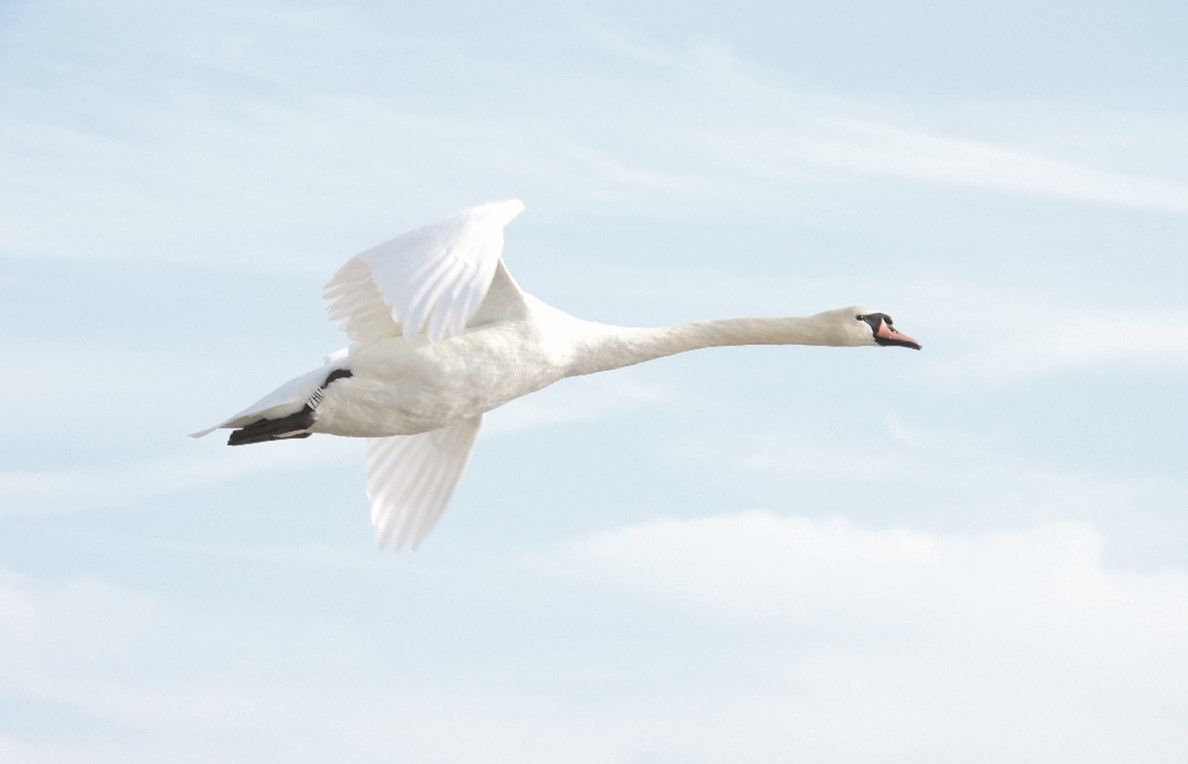
A first for me at HART Wildlife Rescue this week. Whilst others worked inside with the hedgehogs, I was assigned the Collared and Stock Doves and Feral Pigeons outside, which I am used to, and a Mute Swan, which I am not. The columbines flapped about a fair bit in the aviary but soon calmed down. I realised recently what it is that I do and centre manager Robyn endorsed it. It is to act as though you don’t know the birds are there: head down, carry on cleaning, watering and feeding, and simply don’t react even when they fly so close as to touch you. The swan was different again. They are our largest and heaviest water bird and so I will reluctantly admit to being very slightly nervous, which was ridiculous of me. They are bigger than the Canada Geese I have helped look after but not that much bigger. This individual looked especially large I think because the enclosure is not huge, it was different from seeing them in the wild. There was a lot of intimidatory hissing from the moment I got anywhere near the enclosure, but once I was in there she retreated behind her house and stayed put. Occasionally I had to get nearer to her than she liked, the fight or flight distance I suppose, and there was further hissing, but nothing more than that. If I had a pound for every time someone tells me that swans are vicious … if I hear it one more time I might scream. I wrote about this in Animal Wild following a visit to the Swannery at Abbotsbury, Dorset, where I took the picture at the head of this post:
Just one swan hissed at me so I simply moved away. Right on cue, when I got back that evening, three individuals, when I told them about my day, came out with something along the lines that yes, they were beautiful, what a shame they were so violent / vicious / aggressive. I asked one of them if he had got himself between a parent and cygnet in his canoe, and he admitted that he had been very close to the latter. Like any animal the swan was simply defending his or her offspring but purely because of his or her size, it had been found intimidating.
I adore swans. I don’t really understand anyone who doesn’t. But it is a very human thing to ascribe values to animals which suit our prejudices or are convenient for us. Goldfish do not have a short attention span, but we decided that they did to justify imprisoning them in small glass bowls.
I have just this minute learnt a new word from my favourite blogger, “eyrar”, the collective noun for a brood of cygnets.
November raindrops | absolutelynotnormal
Our badger group recently enjoyed an excellent talk by the founder and manager of Oxfordshire Wildlife Rescue, Luke, who learned his skills and built the rescue from the ground up. I have been thinking about volunteering there as well as at HART for some time and having pigeonholed Luke visited for an afternoon last week. In terms of acres, staff and admissions, it is pretty much the same size as HART. Mammals larger than hedgehogs and birds of prey are very much staff only at the latter, but within minutes at OWR I found myself in an enclosure with another volunteer (also part of the badger group), very close indeed to a beautiful female badger. I did wonder how safe this was but she was more nervous of us than vice versa. She was brought in with territorial wounds but the hope is that she will be released soon.
Luke had told us at the talk that the rescue was certainly seeing fewer badgers as a result of the cull, but that badger crime (interference with setts and badger-baiting) was very much on the rise, a clear sign that the pointless persecution of the protected species legitimises and normalises other acts of atrocious cruelty towards them, and killing them. In a moral and environmental climate where protected wildlife is slaughtered en masse at the behest of the government and at taxpayers’ expense, this is hardly surprising.
Next thing I knew, I was throwing dead chicks into the air to be caught by a Gyrfalcon. I had heard of these birds but didn’t know what they looked like, nor how to pronounce their name. I am not much the wiser having heard it spoken at least three different ways since. They are naturally only transient visitors to the UK, residing in some of the harshest climes on the planet, breeding in high arctic tundra. This one won’t be released because she simply doesn’t want to go. She is actually a Gyr x Peregrine cross, hybrids created for the purposes of falconry, and is thought to have spent most of her life in captivity. Apparently she wouldn’t eat when she came in after her ‘owner’ died but she took a shine to Luke and will now eat for anyone. Gyrs are the largest falcons. Their beauty is simply breath-taking.
The centre is somewhat in limbo at the moment. They are having to move from the current rented land and negotiations for new land and premises are proving protracted. Currently they are taking enclosures down and having to turn animals away, so this is not the moment for me to start volunteering regularly, but when that changes and during the move, I look forward to becoming part of it.
I am delighted to learn of the occasional presence of a fox in the garden. I have had my suspicions already this year, but a clear snuffle hole and what I am sure is fox poo confirm it.
I have just spent at least twenty minutes enjoying theatre in the garden. All of these are regular visitors. The interactions are fascinating. A Grey Squirrel on the nut feeder noticed the Magpie in the same tree and chased it up and away before returning to feed. The Magpie then came back with his or her mate and waited on the ground until the squirrel was gone, alongside the Jackdaws and Wood Pigeons (who continue utterly to dominate the corvids). The Sparrows carried on as usual at the adjacent seed feeder. The Dunnocks, as ground feeders, like the Pigeons, are happy to wait for seeds to fall to earth, dislodged by other birds. Ah, and now the Woodpecker is here again. Leaving the garden wilder each year brings me so much joy in this way.
Meanwhile another member of the badger group is taking the Berkshire, Buckinghamshire and Oxfordshire Wildlife Trust (BBOWT) to task for allowing the use of glyphosate by farmers on their land. She received this completely unsatisfactory reply:
“…As a rule BBOWT look to minimise the use of pesticides, but in certain circumstances, and by following best practice, the use of some chemical treatments offer negligible risks, and the outcomes justify their use.. In this case herbicide has been used to help re-establish grassland for grazing where certain ‘weed’ species have become dominant and would otherwise out-compete grasses and herbs in the early stages of establishment. However, in general terms we do aim to continually reduce the use of pesticides across our estate.”
This is also from Animal Wild:
It was telling that, being very fond of thistles, when I searched the websites of two local garden centres to see what they had in stock, I found myself in both cases on the page for the systemic, broad-spectrum weedkiller Roundup, which contains glyphosate, a chemical widely used in farming, forestry and gardening, which yellows and kills everything, and has terrible knock-on, long-term effects on wildlife, not only because of habitat loss but for example in badgers where it is thought possible that ingestion may even affect their breeding abilities, on bees’ ability to keep their colonies within the necessary temperature range, and likely on us too. It’s shocking that the search term “thistle” took me there, assuming that anyone’s interest would only be in eradicating them with poison. It is illegal in the EU but we are behind as usual, with a ban proposed only for 2025, yet research into how the microbiome might be damaged which would go right up the food chain, has barely begun. Environmental Health News reported in 2019 that “some of the bacteria and fungi that form the invisible scaffolding of our ecosystems use the shikimate pathway – the same series of chemical reactions that glyphosate blocks – to produce essential nutrients … Two studies in 2018 found that glyphosate could be harming honey bees by targeting the specialized bacteria that honey bees harbor in their gut. These bacteria use the shikimate pathway, so researchers hypothesized they may be susceptible to glyphosate’s effects. They think these bacteria may be involved in helping the honey bee immune system fight off infection.” In both aquatic and terrestrial environments, research suggests a link between glyphosate in some fish, molluscs and insects and changes in their metabolism, behaviour, growth and reproduction. It’s been used on a vast scale all over the world, especially since the development of glyphosate resistant crops and doesn’t just disappear. It stays around for months or even years, it builds up. It may or may not be carcinogenic to people, but the manufacturers have nevertheless paid out billions in lawsuit settlements.
A frequently given excuse for the use of glyphosate is the elimination of ragwort, that much demonised weed, which has allegedly killed thousands of horses. It is toxic to equines and other animals, but so are lots of other plants. The scale of the problem has been massively exaggerated for years and is to all intents and purposes a myth. Animals are generally pretty good at knowing what is good for them to eat and what isn’t and ragwort has a very bitter taste which a horse would have to be near starving to overcome and even then they would have to ingest a large quantity to cause serious damage. The alkaloids which cause liver problems are present in 3% of all flowering plants. The British Horse Society bandied about a figure of six thousand five hundred deaths based on bad science and statistical error. The Advertising Standards Authority attempts to shut down various instances of such propaganda. Which is not to say there are no deaths, there are certainly problems if ragwort finds its way into hay (by which time it will have lost its bitter taste), and so it does need managing in certain areas, but the numbers are tiny, distorted by those with vested interests and a sort of hysteria. It is not an invasive weed, its toxicity has been overstated and whilst I did spend time at Trindledown digging it up when we still had horses and ponies (the vet advised us then to burn it), there is no legal obligation on anyone to do so without a specific order as has been claimed. A Friends of the Earth briefing confirms that proven cases of poisoning are very uncommon and almost always go hand in hand with poor horse care and mismanagement. They also point out that thirty-five species of insects rely on ragwort for food, a further eighty-three have it as a significant food source, and that it is the seventh most important nectar-producing plant for pollinators such as bees and butterflies (this last figure from government research).
The Badger Trust has provided my friend with some useful suggestions, questions and links:
What site assessment was done on these three fields?
What assessments did they do of the area, with regard to badger foraging sites and what impact that their herbicides application might have on these?
Did they consider this, did they consider not spraying some of the areas where there were clear badger foraging signs or mammal path?
What other alternatives did they consider before opting for the Herbicide with Glyphosate?
As above, other alternatives are available and you’d think the Wildlife Trust would consider these first.
Alternatives to Herbicides by PAN UK – Issuu
It is very disappointing and dispiriting that an organisation whose sole remit is to protect wildlife should behave in such a thoughtless, cavalier and harmful fashion.
To what would be my children’s horror if they knew about it (they have put up with this sort of thing from me all their lives), I have started writing series of clues in the style of the tv quiz Only Connect and inflicting them on the Monday morning volunteers at HART during coffee breaks. A couple of them have been centre/ staff/volunteer orientated but these two are not, although I have slightly changed one of them. Simply find the connection between, as Victoria Coren-Mitchell says, these seemingly unrelated clues. I will send a free copy of Animal Trust to the first person who e-mails me with both correct answers.
*
A war movie set in the 1940s starring Richard Burton and Clint Eastwood.
The central character in the Pirates of the Caribbean films
The central character in To Kill a Mockingbird
The central character in Silence of the Lambs
*
Stonechat
Flatworm
Three-toed sloth
Pine marten
Leave a Reply