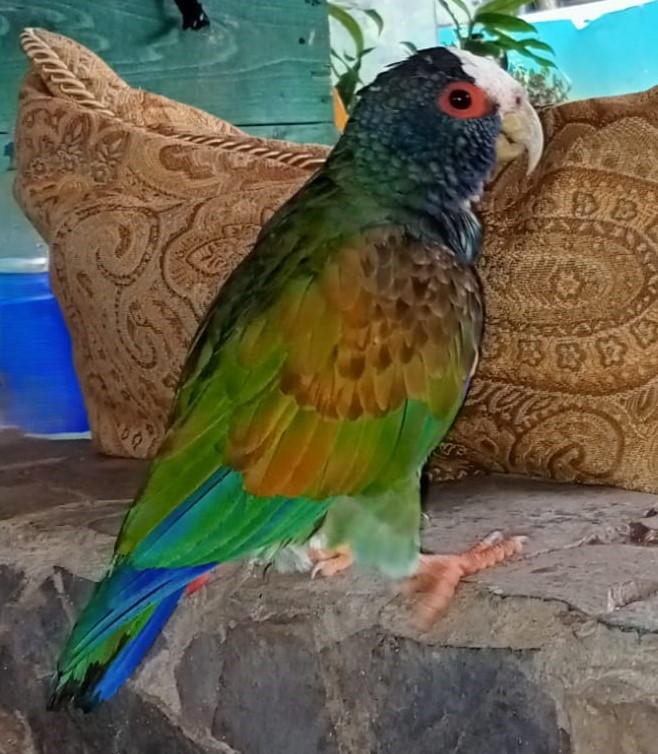
A close friend is in the enviable position, in spite of weeks of constant torrential rain, of volunteering at a wildlife rescue in Costa Rica. He has also passed a Teaching English as a Foreign Language course with flying colours. Enchanted by this bird’s visit, he sent me this picture. He noticed that when it arrived and was wet it looked black – the colours revealed themselves as it dried. This, it turns out, is because light hitting ridges on the feather is what gives us the illusion of colour. The ridges are compromised when wet. The White-crowned Parrot (Pionis senilis) is a relatively small and common species in the region and is most abundant in Costa Rica. At least the common name makes complete sense (I was recently told that the name and plumage of birds are really the last things to bear in mind for species identification), unlike that of the rare Black-faced Bunting mentioned in BirdGuides latest e-mail. I can see nothing whatsoever black about their faces. The White-crowned Parrot is, according to Wikipedia, the earliest known captive bird, but I don’t know how anyone can be certain of that.
Garden theatre was rather different from the day before, described here:
A Swan, a Badger, a Gyrfalcon, a Fox, and Squirrel and Songbird theatre – Animal Wild

This time, the squirrel did not get everything his or her own way. The proximity of a Jackdaw actually persuaded the squirrel to leave the feeder, although he or she was back soon enough. I watched it happen several times. I wonder if the thinking was, “There are three of them and only one of me.”
A sobering conversation from the recent sett survey which I did not mention before with a student who said that there had been five great extinction events in the planet’s history – so far. The sixth, she said, the Anthropocene, is around the corner.
Protect the Wild deplore the re-appearance on our screens of I’m a Celebrity … echoing my thoughts expressed in Animal Trust about the abuse of animals of which that dreadful show seems mostly to consist. It engenders and legitimises all the worst aspects of the treatment of other animals by our species.
Wild Justice reveals that levels of rodenticides found in birds of prey continue to rise alarmingly and urges the government to do more.
Also from BirdGuides, it seems we are having quite the influx of Hawfinches this year, a bird I have never seen. Worryingly, facing rising costs, the RSPB is having to consider the closure of shops, cafés, visitor centres and education programmes. What a terrible shame just one such closure would be. A piece on the difficult topic of mink reports that they have been eradicated from East Anglia. The Waterlife Recovery Trust stated that their complete eradication throughout the country was now “a realistic dream”. I do not question that they have a huge, harmful impact on other wildlife but was irritated to read further: “”It’s our choice. If we sit on our hands and do nothing, we’re consigning to death Water Voles, Common Kingfishers, Common Moorhens, ducklings, the good guys.” I find this a childish and somewhat dangerous simplification.
Having said that, I have only just realised that fungi seem to fall into three broad categories, good and bad. There are the saprophytic, which usefully feed on decaying matter, the mycorrhizal which have symbiotic relationships with plants such as trees (the wood wide web which we are only beginning to understand), and the parasitic which cause damage. Of course there is a great deal more to it than this.
BirdGuides further reports that in Scotland a mutilated Golden Eagle was found dumped in a plastic bag and a Red Kite was poisoned by carbofuran, a pesticide banned for over twenty years. As Mark Avery writes of the Labour front bench: ” … Nor will they know much of the [Hen Harriers,] Eurasian Goshawks, Red Kites, Common Buzzards and Peregrine Falcons that are bumped off, illegally, to underpin a rich person’s sport of shooting Red Grouse for fun.” He hopes that the Scottish licensing system will work, but it seems already that it is not.
From elsewhere, a list of natural enemies of Polar Bears: thin ice, seals’ claws and teeth, mosquitoes and flies, gulls and ravens (who harass the bears in mobs and steal their food), predatory Greenland Sharks, wolves (a threat to cubs and weakened adults), Arctic Foxes who compete for food resources, hypothermia, drowning, starvation, bacteria and viruses, parasites, walruses and adult male polar bears.

Curlew in Norfolk
Also a list of birds in Britain with seriously threatened and declining populations, far from exhaustive I am sure: Turtle Dove, Cuckoo, Nightingale, Skylark, Willow Tit, Starling, House Sparrow, Tree Sparrow, Grey Partridge, Lesser Spotted Woodpecker, Curlew, Lapwing, Corn Bunting, Yellow Wagtail, Marsh Tit, Yellowhammer and Puffin.
An ingenious scam from the water companies, is exposed by The Guardian and Watershed Investigations: it is called “flow trimming”, whereby sewage is diverted into rivers and ditches upstream of the treatment works, enabling claims that they are dealing with a higher proportion of the sewage which actually enters for treatment. What a way to make a profit and how do they sleep at night?
My recent post, incidentally, Church & State – Animal Wild, which might be considered quite the rant, does not seem to be as out of left field as I thought: I have read two pieces since making the same cases. A.N. Wilson, a devout Christian, writing in The Times, foresees the complete collapse of the Church of England of which he perceives Welby’s resignation as just one symptom. He concludes: “But the game is up. Enough is enough.”
Another interesting morning (when are they ever not?) at HART Wildlife Rescue. I was in the rather cramped and hot isolation room. Just one hedgehog and one Feral Pigeon to deal with, but this time I was taught differently. Rather than putting the pigeons and doves on the scales and hoping for the best while you clean out the pod, hold them close to your chest in a particular way and do everything else one-handed. It went very well (I was well taught) it was a lovely feeling to be sure that I was holding the bird correctly. I knew because she was completely calm. Even after three years I do feel honoured to be trusted with these things and some times wonder, are they sure about this?
Another volunteer posted about Nuthatches, a recent and new visitor to the garden here. I had no idea, but she had observed, that they store and cover stashes of food in crevices and holes in trees for nourishment in harder times.
As ever, there is dreadful fox hunting news. The notorious Blackmore and Sparkford Vale Hunt lost control of their hounds who killed a fox in a residential garden. There is a video of it as well as of the terriermen coming to collect the evidential carcase. This is the same hunt filmed from a drone killing a fox at the end of 2023, footage of which was aired on Channel 4 news.
Information about the corruption behind the badger cull was shared by a friend who was at a meeting at which Dan Dyer was one of the speakers. To cut a very long story short, there is clear proof that government scientists have been manipulating the data to get the result they want. Some scientists are too fearful of losing their jobs and grants to speak out but it seems, surprise, surprise, that the Labour government has pretty much turned its back on the issue, whilst the inheritance tax row and protests are a distraction.
Very sadly, dozens of swans and other birds have died in a London canal, tests showing that botulism was the cause. I wonder how or why it came to be present.

It has been a minute, so this has been a bit of a mixed bag of a post but I’ll end with images of Highland Cattle taken by my daughter and a striking moonlit cloudy night.


Leave a Reply