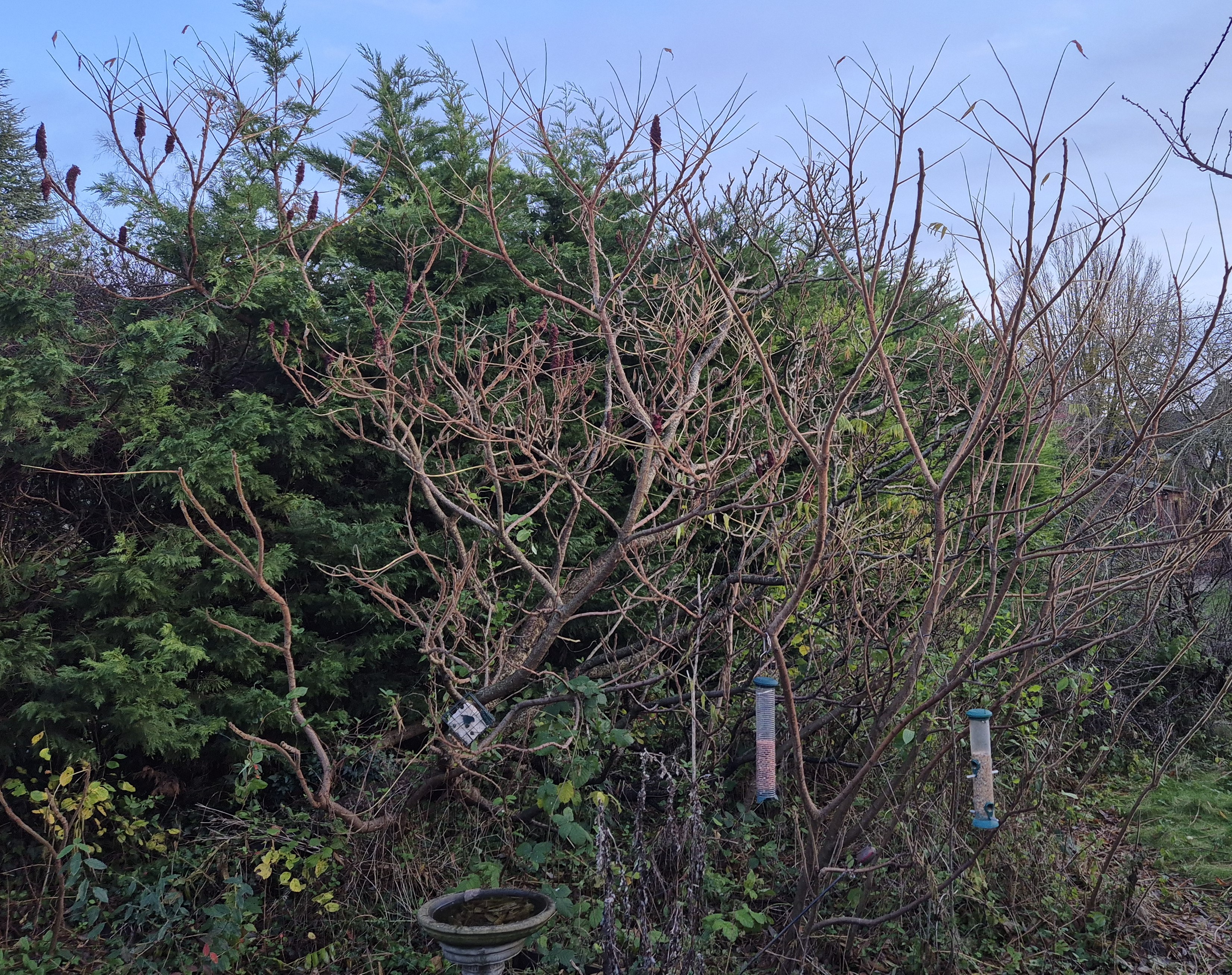
Why deciduous trees lose their leaves for winter is one of those questions to which I thought that I would obviously know the answer, but as I sat in the summerhouse this morning, crossword finished, warm and dry in cold, wet and windy weather, watching the last of the leaves falling from the sumac tree (above, there are still a few drupes at the top), which always awes me with its fiery autumnal colouring, I asked myself and realised I didn’t, not really. For deciduous trees its a strategy for cold weather. They enter a dormant phase, protecting themselves from freezing conditions and snow which might fall heavily enough to break branches. And they need vigorous new growth in spring. Conifers, because of the shape of their tough needles, will not accumulate such a weight of snow and, rather incredibly to my mind, they accumulate cryoprotectants in the needles which lower the freezing point of water in their cells.

I have recently taken out a trial subscription to New Scientist magazine. I am not sure how long I will continue it – I have four unread issues in front of me already and I probably have enough information to try to absorb as it is. There seems to be a great deal about human nutrition and medicine, neither of which, as it happens, particularly interest me. Some of the articles which do, from the 2nd November issue, follow. Even these headline snippets are pretty mind-blowing.
Evolution it is thought may be driven not just by genetic novelty but also in part by physical forces. Scientists compressing a single-celled organism, a type of archaea, observed that it developed into a muti-cellular structure containing different kinds of cells.
AI chatbots can be scammed and so, for now at least, we need to continue to let them operate but not without oversight. AI may in the future also be able to solve problems like the three-body problem (the tv series with that title is well worth watching) and others which have challenged human mathematicians for over a century.
A new type of battery “could be used on Mars” – it’s made of graphene (a single layer of carbon atoms) for the electrodes and simply clay and water stored in microscopic channels.
Some bacteria in our stomachs fight each other with what are in effect poison dart guns.
Dinosaur wings may have developed to assist with “running, jumping, braking and turning”, with full flight evolving later. This comes from a study of their tracks.
Oriental hornets with their predilection for ripe fruit, which contains ethanol from fermented sugar, have shown a remarkable tolerance – they don’t get intoxicated!
An amateur mathematician has discovered a new largest-known prime number. I once asked a customer who used to take me out for very, very good lunches and was a Professor of Logic at the Sorbonne, whether 1 is a prime number. It is still the subject of much heated debate, he said. The new prime is 2 to the power of 136,279,841, minus 1 and is 41,024,320 decimal digits long.
Very much up my street is a piece by Chris Sherwood about animal communication. It’s AI at work again, being used to try to understand how all sorts of animals communicate. Sperm whales in the Caribbean use “a phonetic alphabet of 143 combinations of clicks”. If we reach the point where we can communicate with animals ourselves, argues the author, CEO of the RSPCA, it might bring about a sea change in how we think of and treat them.
A review of a new film, Orca – Black & White Gold, by Sarah Nörenberg applauds its further exposure of that evil trade. The film concentrates in particular on a “whale jail”, a bay in the far east of Russia, where whales are held captive for onward sale to China, where they will be exploited and abused in aquaria and “attractions”.
There’s also, rather oddly, a favourable review of the tv series Ludwig. I am a fan of David Mitchell and of crosswords, but I lasted about five minutes with it. The suspension of disbelief required seemed to me irritating and ridiculous. There’s a quick crossword in the magazine too, but I only find cryptics satisfying – that’s not to show off, but I find it so much more rewarding in that epiphanic series of moments to know from the clues that the answers are the only possible ones, harder though they may be to reach.
So very much a curate’s egg for me so far, New Scientist. Any good science, all good science, is ultimately only speculation and theorising, but for me there seems rather a lot of telling readers what might be possible in the future rather than where we are at now.
Leave a Reply