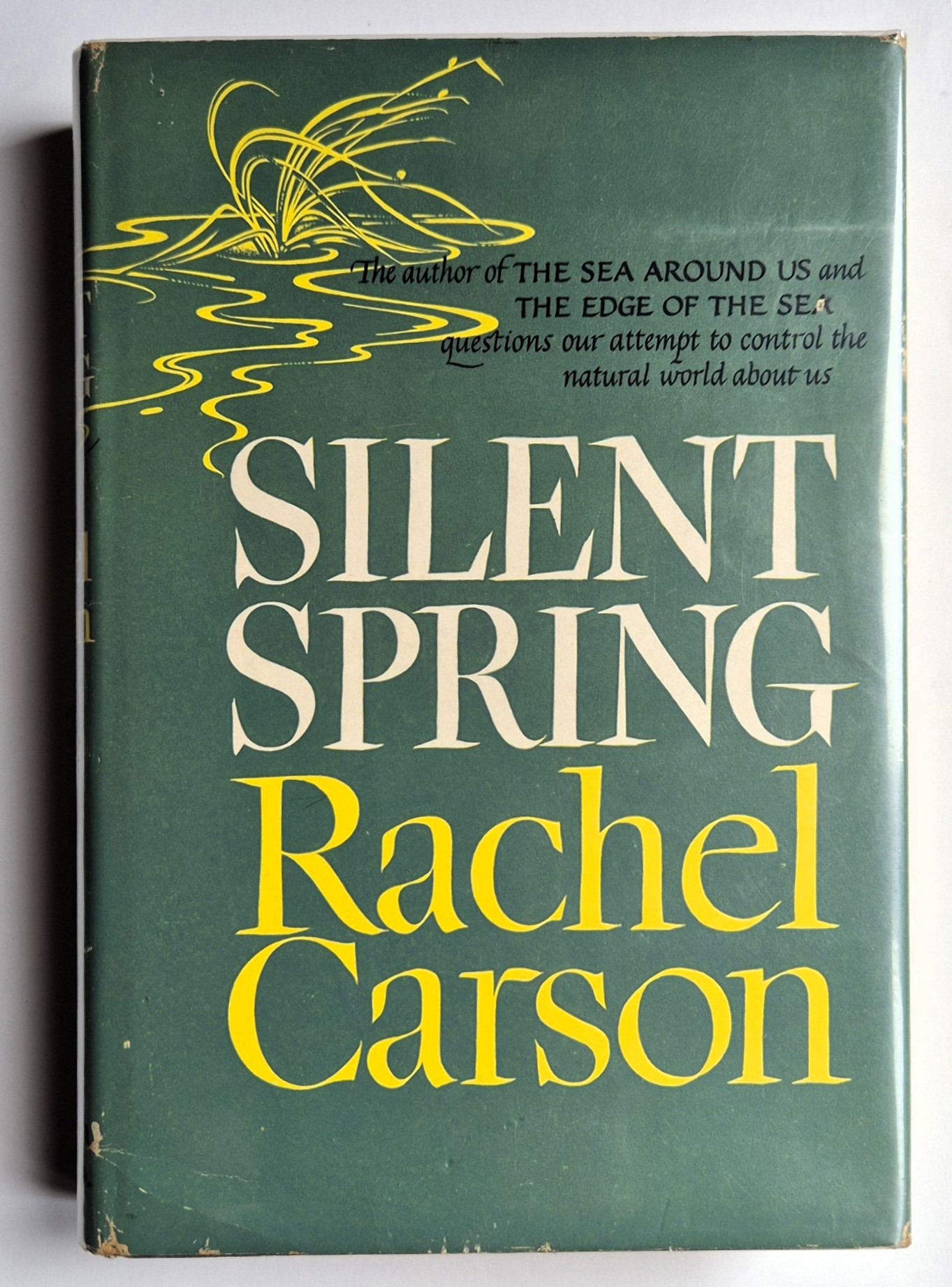
Silent Spring by Rachel Carson, Houghton Mifflin Company, Boston, 1962
In the course of the few days in which I read this book, I took time out to take part again in the annual Big Butterfly Count for the Butterfly Conservation Trust. The requirement is to sit outside for fifteen minutes and count butterflies and moths and record species. The result? Zero, zilch, not one. And that’s with two large buddleia in full bloom. It is clear that it has been a very bad year for insects and a terrible one for butterflies as noted by many conservation groups across the south of England. It is not just worrying, I find it terrifying. The silence is deafening.
Conversely, the garden songbirds and their newly fledged young are still very much around and using the feeders in mid-July. Usually they would be gone by now. It seems safe to assume that they are unable to find their insect diet elsewhere this year. Blackbirds are falling victim to the Usutu virus, spreading across southern England and decimating numbers. It is borne by mosquitoes whose presence is likely in part due to climate change. A neighbour enjoyed the presence of a large number of lapwings and their nests in an adjacent field in the spring. Only one pair survived. A few were predated by cats, but the rest of the nests were ploughed into the field by the farmer.
I have digressed from the book in hand.
I have two copies of the first edition of this seminal and hugely influential work, the importance of which cannot be overstated. Rachel Carson played a crucial part in laying the foundations for the environmental movement and saved countless lives, both those of humans and other species. She is regarded as the first “green”.
We used to exhibit annually at book fairs in New York and, alternately, San Francisco and Los Angeles. Being in California in February was never a hardship but eventually, after fifteen years, I tired of the routine of the fairs. Also, after the excitement of my first few visits to New York, I soon began to find it an oppressively claustrophobic place to be. At one of these fairs I bought the first copy for $50, probably in 1995 or thereabouts. There is a note to myself inside it that a copy at a fair in 1997 was priced at $200. I snapped up the second copy, again at a fair, for $100 in 1999. It is not why I bought either but it is not displeasing that I could reasonably ask at least £800 for either copy now. Signed copies are now priced at around £6,000 whilst for a copy inscribed by the author to the naturalist and photographer Alfred Eisenstaedt you would need an eye-watering £12,000.
For current purposes I have bought yet another copy, a Kindle version, just for the ease of quoting from it. Irritatingly, sloppy conversion to digital means that every “ll” is missing a letter giving “final y”, “skil ed” etc. I am wil ing to work around it, given that this only cost me £1.58.
The book was issued in green cloth with gilt lettering to the upper cover and spine, with a yellow top edge and patterned end-papers. The illustrations (to the dust-jacket, title-page and beginning of each chapter), utterly charming drawings, are by Lois and Louis Darling. As husband and wife they collaborated on writing and illustrating books including The Gull’s Way, 1965, a book about American Herring Gulls on an island in Maine, and A Place in the Sun: Ecology and the Living World, published in 1968, and Wikipedia tells us: “Darling had been interested in nature and the outdoors his entire life, and was an early environmentalist and conservationist. He was the president of Connecticut Conservationists, a consortium of environmentalist groups formed to oppose the dredging of Long Island Sound for the Connecticut Turnpike. The organization unsuccessfully sued the state of New York in 1956 to prevent the action, although they were successful in reducing the size of a planned parking lot that was to be built in a Connecticut salt marsh.”

The blurb (absent of course from the Kindle edition, one of many reasons these things remain deeply unsatisfactory) alone paints a horrifying picture from which we seem today to have learnt absolutely nothing: “For as long as man has dwelt on this planet, spring has been the season of rebirth and the singing of birds. Now in some parts of America, spring is strangely silent, for many of the birds are dead – incidental victims of our reckless attempt to control our environment by the use of chemicals that poison not only the insects against which they are directed but the birds in the air, the fish in the rivers, the earth which supplies our food, and, inevitably (to what degree is still unknown), man himself.” Any lessons learnt seem to have been forgotten or deliberately cast aside. As we look around us now in one of the most nature-depleted countries in the world and see the devastating effects of the use of chemicals (especially herbicides like glyphosate) by the farming industry and watch helplessly as our rivers, streams and seas are filled with toxic sewage, we can only wonder how it has come to pass that our environment has been allowed by our legislators to be sacrificed for the benefit of a small number of the extremely rich, forever in pursuit of filthy lucre at the dire and irreversible (if we don’t do something about it really, really soon, like now) expense of the rest of us, by which I mean all life on earth.
The author’s dedication is this:
To Albert Schweitzer who said “Man has lost the capacity to foresee and to forestall. He will end by destroying the earth.”
It is followed by this quotation from Keats:
“The sedge is wither’d from the lake, And no birds sing.”
And this from E.B. White, best known for Charlotte’s Web and his contributions to the New Yorker where he was a friend and associate of the great James Thurber (he is my favourite humourist and I will write a post about him at some point):
“I am pessimistic about the human race because it is too ingenious for its own good. Our approach to nature is to beat it into submission [my italics]. We would stand a better chance of survival if we accommodated ourselves to this planet and viewed it appreciatively instead of skeptically and dictatorially.”
For eons, says the author, plant and animal life on earth has largely been moulded by the environment. Only mankind acquired the power to change that environment and has chosen to do so by poisoning it, irrevocably, through radiation and chemicals used in the war against nature.
Carson’s primary target is the use of the insecticides like DDT to which the intended victim species fairly quickly evolved to become immune in any case. She asks: “How could intelligent beings seek to control a few unwanted species by a method that contaminated the entire environment and brought the threat of disease and death even to their own kind?” As she points out, this actually led to the irony of a problem of overproduction to the extent that the US taxpayer in 1962 spent in excess of £1bn storing the surplus. Insects only became a serious problem in agriculture as a result of intensification in the first place, vast acreages devoted to a single crop (just as happens in the UK and of course elsewhere today).
The insecticides, quickly present in just above every living thing, were a by-product of the race to develop agents of chemical warfare during World War II. A whole level up from previous weed and insect killers which relied on arsenic, which also caused massive problems throughout the ecosystem and is carcinogenic, DDT (short for dichloro-diphenyl-trichloro-ethane) was discovered by a German chemist in 1874, for which he won a Nobel prize. It does enormous harm even in tiny quantities stored in the body (which happens long-term), which it can enter in many different ways. Other chemicals similarly used are more toxic still. A quantity of one called aldrin could kill 400 quail with an amount no more than the size of an aspirin. The effects are passed down the generations.
Another “major group of insecticides, the alkyl or organic phosphates, are among the most poisonous chemicals in the world.” Secretly developed further in Germany for chemical warfare purposes, some became nerve gases, some insecticides. Carson continues: “Parathion is one of the most widely used of the organic phosphates. It is also one of the most powerful and dangerous. Honeybees become “wildly agitated and bellicose on contact with it, perform frantic cleaning movements, and are near death within half an hour.” And yet our government in the UK is still sanctioning the use of bee-killing chemicals (neonicotinoids) every year. Carson writes: “…some 7,000,000 pounds of parathion are now applied to fields and orchards of the United States – by hand sprayers, motorized blowers and dusters, and by airplane. The amount used on California farms alone could, according to one medical authority, ‘provide a lethal dose for 5 to 10 times the whole world’s population.’ ”
These things were and are not just used in agriculture but in gardening too.
The next stage: systemic insecticides defined by the ability to permeate the tissues of a plant or animal and make they themselves toxic, like something from the wild imaginings of the most evil of geniuses.
All of these chemicals were used with not even a pretence that there had been any research into them or knowledge of possible consequences. And they end up everywhere, in livestock, wildlife, food, water (rivers, streams, groundwater) and of course, humans. And they don’t go away.
Today, Big Pharma giant Bayer denies that glyphosate, the active ingredient in the popular weedkiller Roundup and others, is carcinogenic and yet it has already paid out £8.8bn in cancer claims alone and yet more on claims relating to water pollution and crop damage.
Carson then turns her attention to the still rather neglected subject of our living, ever-changing soil and the creatures which live within it. Some of the smaller species are specialised to a degree which is scarcely believable or even imaginable. They are all interdependent. Following Darwin’s lead (The Formation of Vegetable Mould, through the Action of Worms, with Observations on Their Habits, first published in 1881) she points out that of the larger inhabitants, earthworms are probably the most important.
“This soil community, then, consists of a web of interwoven lives, each in some way related to the others—the living creatures depending on the soil, but the soil in turn a vital element of the earth only so long as this community within it flourishes.” And when we poison this realm the damage is long-lasting to the point of permanent. Tobacco plants, for example, continued to pick up arsenic from the soil long after its use had been stopped. We interfere with the complex web of life, at all levels, at our great peril.
The chemical destruction of the sagebrush lands of the American West to make room for more grazing of course affected all the other life which depended on it. No one seems to have stopped to think that the land might have evolved in the way it did for a reason. The effect on non-target species was catastrophic too. “…The whole closely knit fabric of life has been ripped apart.”
Carson bemoans the widescale destruction of ‘messy’ roadside vegetation and its dire consequences but, yet again, this is a lesson we in the UK only just seem to be learning. Both then and now the sheer scale of the war on nature is truly, deeply shocking. We do so, even now, with a paucity of knowledge and forethought.
Chapter 7 begins with a recap and summary:
“As man proceeds toward his announced goal of the conquest of nature, he has written a depressing record of destruction, directed not only against the earth he inhabits but against the life that shares it with him. The history of the recent centuries has its black passages—the slaughter of the buffalo on the western plains, the massacre of the shorebirds by the market gunners, the near-extermination of the egrets for their plumage. Now, to these and others like them, we are adding a new chapter and a new kind of havoc – the direct kiling of birds, mammals, fishes, and indeed practically every form of wildlife by chemical insecticides indiscriminately sprayed on the land.”
Plus ça change … governments and manufacturers deny everything, no matter how compelling the evidence.
In 1954 and beyond in Michigan (and elsewhere) vast quantities of aldrin (chosen not because it was the most suitable but because it was the cheapest) and other insecticides were rained down from aeroplanes over a wide area in an unnecessary attempt to control the Japanese beetle, an accidental import. The local bird life was pretty much wiped out. Rabbits, muskrats, opossums, squirrels and fish were found dead in large numbers and cats and dogs either died or as with humans became seriously ill. Livestock was badly affected too. As shown elsewhere, there were other means available to control the beetle without any threat to other forms of life. But there is nothing selective about any of these deadly poisons – which is what they are and all that they are. The wholesale spraying of elm trees to try to eradicate Dutch Elm Disease proved more disastrous still, permeating and ricocheting around the entire ecosystem, the food chain.
In England, the treatment of seeds with insecticides before sowing also created havoc on an unprecedented scale. Carson notes that manufacturers’ tests rarely if ever included tests on wildlife. She asks: “Who has made the decision that sets in motion these chains of poisonings, this ever-widening wave of death that spreads out, like ripples when a pebble is dropped into a still pond?”
In America rivers and streams became bringers of death. The author goes into great detail in her ninth chapter. Hardly surprising: we were inflicting an indiscriminate rain of death on the surface of the planet. A chemical war. On ourselves. About which ordinary people had absolutely no choice, no say. And for the most part, it didn’t even work, didn’t even achieve its goals, accomplished precisely nothing. And either basic investigation into possible consequences was never carried out or it was ignored.
People were also encouraged, marketed at, to use insecticides not just in their gardens but in their homes, exposing homeowners to great risk with little or no warning (and that in very small print at best). They were already consuming DDT in their food and storing it in their body fat (where interactions with other poisons could make things very much worse).
Sudden illness and deaths of farmers, spraymen and pilots were bad enough, but what of the general human populace? This was an insidious, gradual, cumulative poisoning. Hard to measure, hard to prove cause and effect and by no means necessarily symptomatically obvious. But it seems certain that the worst effects are on our livers and central nervous systems. Even our very genes. And that is not even to attempt to summarise the potentially carcinogenic nature of the noxious substances.
Chapter 15 is entitled “Nature Fights Back”. Nature always establishes a balance, unless we try to control it. Then it all goes horribly wrong. This is my mantra. Insects evolve to resist the poisons, but the damage is done, natural environmental resistance has been weakened. One thinks of the elimination of apex predators, globally and in the UK – when has that ever led to a happy equilibrium? Kill the coyote – be plagued with field mice. I find Carson’s undiminished sense of wonder when describing the complexities and marvels of the insect world very touching. She has a lovely poetic style at times: “Here, above a pond, the dragonflies dart and the sun strikes fire from their wings.” She constantly illuminates the ironies: you might “trade one insect for a worse one” when you upset the natural dynamics. Why did and does any of this happen? Because there are “fortunes that are to be made in the chemical industry”. “…It was the advent of DDT and all its many relatives that ushered in the true Age of [insect] Resistance.” And these evolutionary changes can happen fast. When we attack the problems, we tend to make them worse. And yet we are still doing exactly that. We have no humility.
Carson concludes with a summary of alternative options, roads other than a chemical barrage against the very fabric of life. “The ‘control of nature’ is a phrase conceived in arrogance, born of the Neanderthal age of biology and philosophy, when it was supposed that nature exists for the convenience of man.”
This post is already twice as long as the recommended size for a blog and I was going to end it here, but then this happened. I was going through the papers and correspondence of Brian Phelan, see here:
Brian Phelan, Rest in Peace, 1934-2024 – Animal Wild
I was working at speed, as I tend to do, when something jumped out at me. A coincidence? Perhaps. I suspect not. Brian has already ‘spoken’ to me since his death and this may have been a bit of help from him as I connected with him again through his archive (these things are very revealing of a life). He was a great spirit, so that he has done this would not surprise me in the slightest. Amongst the thousands of pages of letters, scripts, treatments and papers were five pages on four leaves: a proposal for a film about Carson’s life. Brian headed it “John Keeling” who I take to be the wildlife filmmaker John T. Keeling. Drawing from it, it has enabled me to add the following about Rachel Carson the person. In his autograph annotations Brian gives the proposal pretty short shrift, his mind clearly honing in, with rapier precision: in essence, where is the film in all of this? Keeling in turn draws from Witness for Nature, a biography of Carson by Linda Lear, published in 1997.
Rachel Carson (1907-1964), is described as “slightly reserved with a great sense of humour”, popular with her colleagues and meticulous in her work. She first excelled as an English major, but changed this to biology, which altered the course of her life. She graduated magna cum laude in 1929 and in 1932 was awarded her Masters in marine zoology at Johns Hopkins University. Her early writing brought her acclaim for her ability to combine scientific accuracy with a poetic voice. Her second book, The Sea Around Us, was published in 1951 and quickly became a best-seller. The Edge of the Sea followed in 1955 and was also a success. It was with Silent Spring, however that she created “one of the most influential works of the twentieth century”.
The book was, of course, fiercely opposed by the chemical manufacturers: she was threatened with libel suits and one large company suggested “that the book was part of an evil communist plot to destroy the agriculture and economy of the country.” Monsanto* (ring a bell?) joined the attack.
The Environmental Protection Agency was founded in 1970, Friends of the Earth in 1969 and Greenpeace in 1971. In 1980 Carson was awarded the Presidential Medal of Freedom and a postage stamp featuring her was issued the following year.
This is what lingers now in my mind: how depressingly familiar all of this is. We are still fighting the same battles against industrial agriculture, corrupt politicians and media, and corporate greed. We have just been through a general election in the UK which has done little other than to expose the weaknesses and imbalances of our electoral system and which has offered precious little hope for the future. Apart from a few promises about sewage, the Lib Dems did not even engage with green issues and Labour did not seem to engage with anything at all. Labour has promised to improve animal welfare, but we have heard all that before from them. They have no plans to end the badger cull although they admit it is in “ineffective” but will allow the building of more houses on green belt land. Wildlife was pretty much absent from every mainstream agenda.
The Restore Nature Now march, see:
Restore Nature Now and my local Lib Dem candidate – Animal Wild
Restore Nature Now and my local Lib Dem candidate follow-up – Animal Wild
was powerful. The vested interests mentioned above and certain sections of the upper-class/aristocratic elite aside, the latter seeming to see the countryside as their own private killing fields and who blithely posture and dissemble to protect their feudalistic systems, I believe (I have to hope) that there is a silent and not so silent majority of people who do care, who are properly frightened for the planet, their children and grandchildren. I proudly wear a t-shirt: “Listen to Peter Tosh.” I am going to create one which will read “Listen to Rachel Carson”.
UPDATE. An e-mail this morning (18/7/24) from Ekō suggests that I am not being melodramatic about any of this:
Pesticide giants have a dirty little secret. When they test their poisons, they only look at the ‘active’ ingredient, ignoring a long list of what they presented for decades as ‘inert’ chemicals. But studies have found that mixing all of a pesticide’s ingredients together can make it over 1,000 times more toxic!
It’s a terrifying loophole. And the EU’s highest court just confirmed that member states are breaking the law by letting companies like Bayer-Monsanto get away with it. But we have a plan to force governments to obey the law.
Here’s how: we’ll work with partners to file a string of lawsuits against governments – from Belgium to Germany to France – to demand they uphold the law and force pesticide giants to come clean about the actual risks of their products.
Leave a Reply