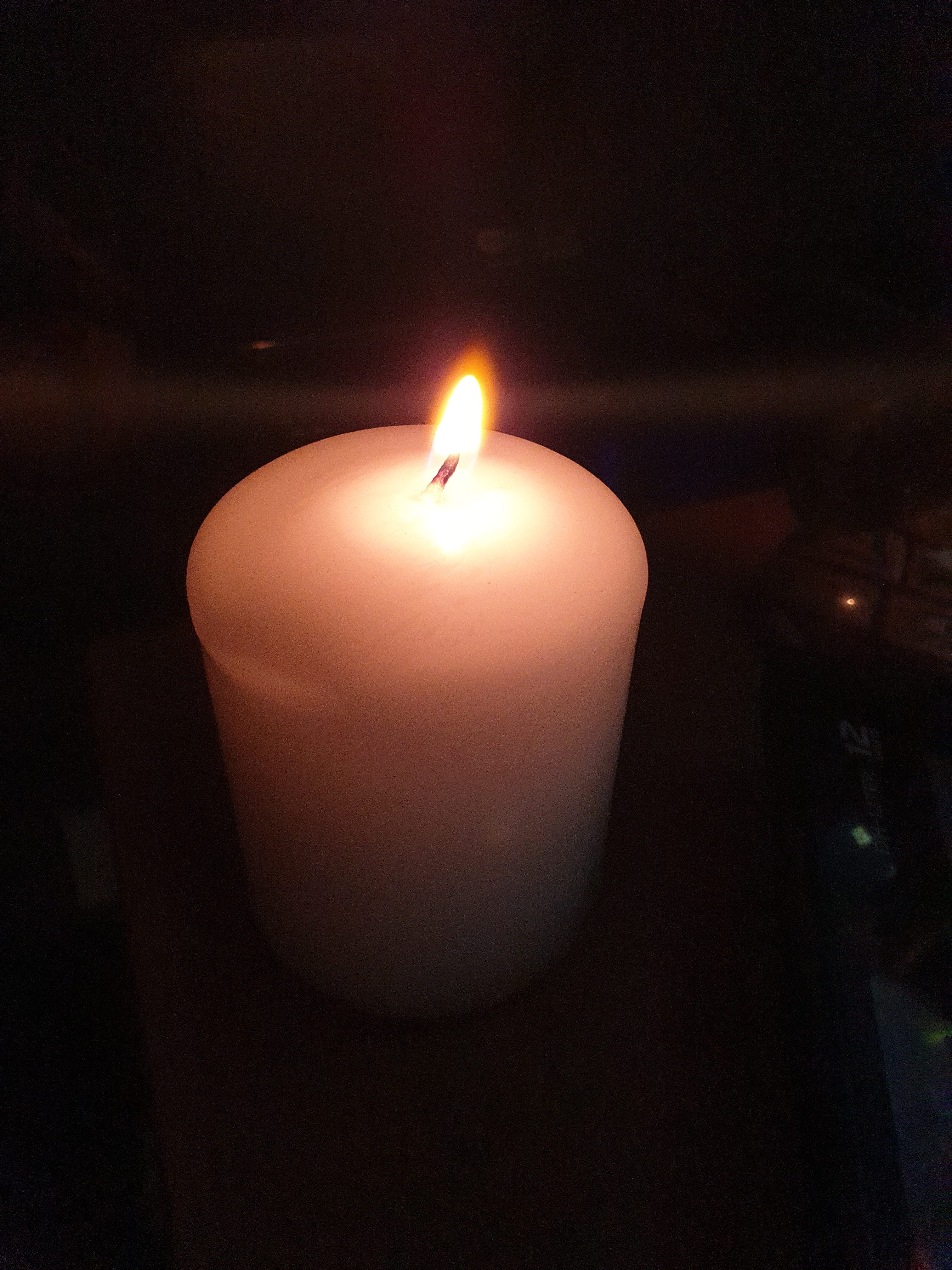
Carl Sagan has long been a hero of mine. It just occurred to me that Brian Cox is a modern-day version and indeed Cox has said that Sagan’s TV series Cosmos changed his life, inspiring him to dedicate it to science. Another hero, Richard Dawkins, is quoted as saying that he wishes he had written this book, This Demon-haunted World, science as a candle in the dark. I found it surprisingly difficult to get hold of a copy. This is the Ballantine Books edition of 1997 (I find the cover so unappealing that I have substituted my own photo of a candle from many years ago). I was motivated by watching for the umpteenth time the movie Contact based on Sagan’s novel and starring the luminescent Jodie Foster (I love Close Encounters of the Third Kind too).
The premise is based healthy on a combination of scepticism and wonder and the author sets out to “debunk witchcraft, faith-healing, demons and UFOs” and many other examples of pseudoscience (it was good to see reference to the amazing Randi, the magician who has achieved so much in the same sphere). The American spelling of scepticism, skepticism, gave me a jolt incidentally.
There’s a lovely anecdote on. the first page. A driver had been arranged to take Sagan to a conference and he was asked, “Isn’t it confusing to have the same name as that science guy?” “I am that science guy”, Sagan replied. And a perfect example of the author at his wittiest and most withering on the subject of channelling: “a way to hear what’s on the minds of dead people – not much it turns out”.
I hadn’t heard of Gresham’s Law, an economic tenet whereby bad money drives out good. I can’t claim fully to understand it but can see how it can be applied to good and bad science in popular culture.
The book was first published in 1995 but very much of it is prescient or remains so apposite that it could have been written yesterday. How very few of our political leaders have been scientifically literate for example.
There is much absurdity to tackle. Some followers of Christian Science deny the germ theory of disease to the extent that they would “rather see their children die than give them antibiotics”. Science is of course a two-edged sword. Scientists persuaded leaders of nations that they must be first to have nuclear weapons. “Then they manufactured 60,000 of them.” I had no idea there were so many.
On the wonder side: we are all made of “starstuff”, that is to say everything of which we are composed, apart from hydrogen, was created in red giant stars thousands of light years away in space and billions of year ago in time.”
In some countries nearly everyone believes in astrology, including government leaders. I remember my surprise at how seriously it was taken on a holiday in Sri Lanka where a family we stayed with would not consider an action without an astrological consultation. The Reagans were apparently highly susceptible. Sagan makes no bones about it: astrologers are, simply, charlatans.
The book also took me to thinking slightly differently about Nigel Farage, other rabble-rousers and the far right, or at least of a way to point out the absurdity of their doctrines. What if, instead of migrants, legal or illegal, on small boats or not, these people decided that it was Capricorns who were the source of all our woes? It would make no less sense.
How religions begin is a profoundly fascinating subject. I have heard people say how absurd they find Rastafarianism (for which I do have a respect) to which I have replied that it is a perfect example of the phenomenon, just a more recent one.
Sagan worries about the popularity of the movie Dumb and Dumber which celebrates ignorance and stupidity. It made me think of The Simpsons which brilliantly does completely the opposite while pretending not to (the series is full of partly hidden or subliminal references to complex mathematical and scientific problems and solutions).
Two new words. “Veridical” meaning relating to the truth and “asymptotic” which is a specific geometric term but more generally describes something which gets ever closer to a boundary without ever reaching it.
Two more heroes are mentioned, exemplars of “selfless courage”: Mohandas Gandhi and Martin Luther King Jr.
Michael Faraday is quoted on what the nature of science ought to be, warning of the powerful temptation “to seek for such evidence and appearances as are in the favour of our desires and to disregard those which oppose them … We receive as friendly that which agrees with [us], we resist with dislike that which opposes us; whereas the very reverse is required by every dictate of common sense.” I sometimes wonder if AI does not lead us astray in that way.
Sagan wonders how it is that so little of the findings of modern science are to be found in ancient scriptures if they are really divinely inspired, casting doubt on that belief. In a lovely but powerful throwaway he adds, “But of course I might be wrong.”
Our brains are predisposed to see patterns: the ‘canals’ on Mars, images in cloud formations, the man in the moon. The last is the result of “ancient catastrophes … It is a characteristic conceit [which we cannot help] to put a human face on random cosmic violence.” We are programmed from infancy to recognise faces. Different cultures though see very different things when looking at the moon such as a woman weaving, an elephant jumping off a cliff, a girl with a basket on her back and a rabbit.
Crop circles get very short shrift. One which read “We are not alone” would have been rather better had it read “You are not alone”. Sagan’s wit at work.
I must now admit that not long after this point in the book I decided to abandon it. It took me a long time but it was liberating when I realised that I didn’t absolutely have to finish every book I started. I once catalogued a bible owned by Gerard Manley Hopkins, heavily annotated by him. He is my favourite poet and my enthusiasm was such that I left no stone unturned. My father described my work as exhaustive to the point of exhausting and I began to find that with This Demon-haunted World. I think in part my disenchantment is down to the fact that Sagan is preaching to the converted (an ironic metaphor in the context) – I already disbelieve myths, superstitions and other examples of pseudoscience and so feel that there is no need to be taken through each one in great detail.
This is not a criticism of the book in any way. It needed to be written and as Dawkins says of Sagan he speaks for Earth and is his candidate for planetary ambassador. “He is wise, humane, witty, well read, and incapable of composing a dull sentence.”
Leave a Reply