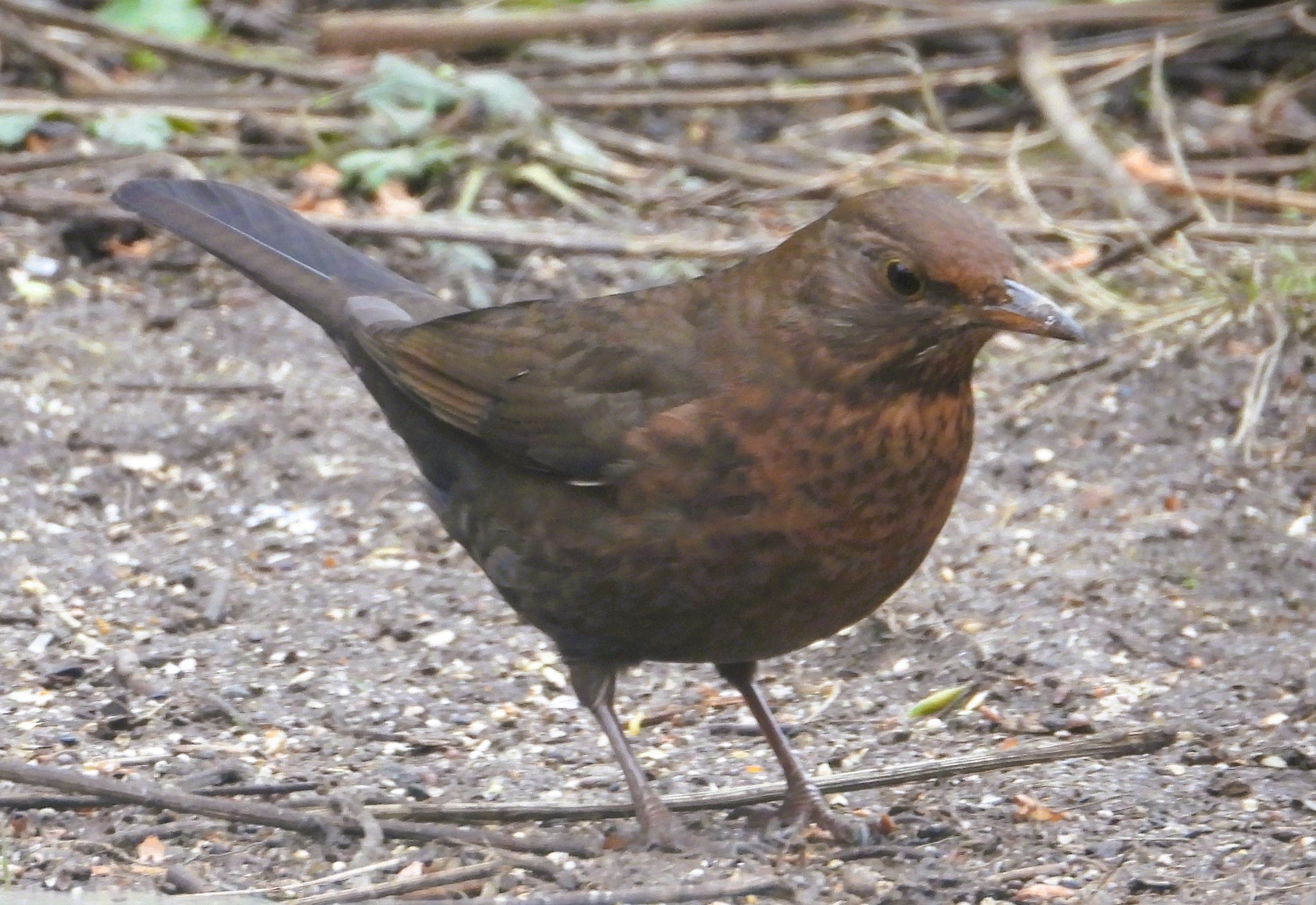
Dunnocks
Bird of the day is the Dunnock. There are always at least two in the garden. I have said many times how underrated their complex and beautiful plumage is. I cannot imagine why both of the garden bird books (both publications from the British Trust for Ornithology) I have been drawing from of late described them otherwise as unobtrusive, nondescript and plain. Their neat cup nests, often used by those brood parasites, Cuckoos, and bright blue eggs do merit some praise at least. They are easy to identify here because they are ground feeders, scurrying about in such a way that I have occasionally mistaken one, seen out of the corner of my eye, for a mouse. They are not sparrows but are sometimes called Hedge Sparrows. They are somewhat notorious for their complex social and sex lives. Commonly a female will breed with two males which works for her because both may feed the chicks. The subordinate male sometimes tries to destroy the nest and eggs but both males will defend territory together. Conversely a male may mate with two females in separate territories.
Mallard
A friend and I noticed a Mallard and her ducklings taking an ill-advised route to the canal which the pub we were in sits alongside. Happily we were able to escort them along the road, stopping traffic as necessary, before they came to any harm.
Nocturnal migration
The article below from BirdGuides is typical of the kind of information gathering that makes me very uncomfortable. Acoustically identifying nocturnally migrating birds is completely unintrusive but is of no use if the birds don’t call during migration. Radar cannot distinguish between species. Thermal imaging also does not affect the birds. But in America it is being used to locate them before lighting them up with a brief but intense, powerful flashlight. I simply cannot believe that that does not affect them.
Study unveils new method of identifying nocturnally migrating birds – BirdGuides
The RSPB on dogs
The RSPB has issued a plea to dog walkers not to allow their ‘pets’ to disturb ground-nesting birds. Disturbance alone can lead to nests being abandoned. “The charity is advising visitors to the countryside to keep to marked paths, keep dogs under close control between March and August, and maintain a distance of at least 100m from nesting birds or chicks. Additional guidance has been issued for water users, with swimmers and paddlers encouraged to follow predictable routes and avoid prolonged disturbance to feeding or breeding birds.”
Mike Shurmer, Head of Species and Habitats for RSPB England, highlighted how easily nests can be overlooked: “A skylark egg can be as small as the width of a five pence piece … chicks of species like curlew and oystercatcher are highly camouflaged but may be much closer to people than expected.” From the comments I agree that we should follow Norway’s example where dogs must be kept on leads in public (at all times, presumably), between April and August. I also agree that the RSPB could be stricter. Why not ask that dogs be kept on a short leash during the breeding season and that they should be banned altogether “from nature reserves and other nesting sites.”
RSPB urges public to give ground-nesting birds space this spring – BirdGuides
The Wildwood Five
I have written recently about the wolves at Wildwood in Kent being killed and signed the petition calling for an enquiry. There has been an update. The author, Davie Murray, asks why there has been a changing narrative from Wildwood and now has written confirmation from them that signs of “unusual aggression” were noticed months ago. Two of the Wildwood Five we now know were healthy and uninjured – which is not was originally said. Davie states “Legally you CANNOT euthanize CITES protected animals out of a fear or prediction.”
Petition update · Animal welfare OR legal risk management · Change.org
Pigeons
I am continuing to read Beastly Britain; an animal history, Yale University Press, 2025, by Karen R. Jones. I skimmed through the third chapter about sheep and it seems excellent but I have read and written so much about sheep that I didn’t feel obliged to read it in full.
The fourth chapter is about those much maligned birds, pigeons (“avis non grata“). Treated as vermin by some and shot in their millions each year, I have to admit I do slightly question the amount of time and resources spent on them by wildlife rescues, much as I love them and as obsessed by them as pigeon ‘fanciers’ seem to be. We learn from Karen R. Jones that there are 361 varieties in the UK. She concentrates on feral pigeons, the ones we see in our cities, and domestics. As ever she is very good on dialect names and the appearance of the birds in British place names and language. I had no idea that the Dodo was basically a three-foot tall pigeon.
All varieties descend form the Rock Dove and their habit of sleeping on ledges stems from their cliff-dwelling past – and they sleep on one leg. They have 340 degree vision, their hearing is better than ours and they are as intelligent as a three-year-old human child. I have written before about their unusual ability to produce crop milk. Uniquely they are able to suck in water – they do not need to tilt their heads back to drink. Our using them for food, medicine, their feathers and guano has a long history.
The use of pigeons to carry messages (which goes back to the twelfth century) , especially in military scenarios, and the weird hobby of pigeon racing stem from the birds’ ability to fly 600 miles without stopping at speeds of up to 60 mph. We still are far from a complete understanding of their homing abilities.
I am feeling like a stuck record but is there any issue relating to wildlife and the environment which the Labour government will not either completely retract or dither over its promises? They are now considering dropping the manifesto pledge to ban imports of foie gras and fur. DEFRA is mealy-mouthed as usual: “We are proud to have some of the highest animal welfare standards in the world [hmm]. We welcome the publication of our expert animal welfare committee’s report on the responsible sourcing of fur.”
Maths
I’ve been watching Hannah Fry’s three-part series about mathematics. It’s very odd although not uninteresting and I find her quite irritating at times. What has really struck me is that it is completely Eurocentric. There is simply no mention of the Islamic scientists, astronomers and mathematicians who pre-dated and laid the groundwork for their Western counterparts who followed centuries later. For more on this see Nuts & Bolts part II – Animal Wild
NASA
I don’t understand the latest NASA mission at all, the slingshot round the moon. I have read a number of articles about it but none seem to mention what it is actually for. As a couple of good letters in the paper say, we are busy trashing this planet and driving species to extinction. The money should be better spent.
Leave a Reply