Wolves
Firstly, a couple of follow-ups. I wrote recently about the wolves at Wildwood:
Still on the subject of canines, the five wolves kept at Wildwood Discovery Park in Kent have been killed since they had begun to attack and wound each other. I expect they were driven mad by their captivity. The first two wolves were imported from zoos in Germany and Sweden and they then produced three young. I have found it extremely difficult to ascertain the size of their enclosure but by sending Gemini AI a map of the forty acre ‘park’, I have an educated guess of perhaps 1.5 to 2 acres. Their natural range in the wild is hundreds of square miles. As the Born Free Foundation has said: “This is not conservation. Nor is it education in any meaningful sense. It is an approach that places animals in situations where their natural behaviours, which have evolved over generations to enable them to survive and thrive in the wild, become liabilities; where animals may pay with their life. Incidents like this demonstrate that, for certain species, the standards required to keep them successfully and humanely are extraordinarily difficult, if not impossible, to achieve.” There are also bison, bears and badgers at Wildwood. The badgers have just, roughly, 0.1 to 0.2 acres, partly behind glass. But in the wild they can forage for miles. I think the zoo (for that is what it is) where the animals are gawped at by humans much of the time should be shut down completely.
Now there is a petition which I have signed along with over 18,900 others. I cannot be 100% certain of its accuracy but I consider change.org a responsible organisation. It’s author is understandably outraged, being one of over 300 people who had adopted them. They were not contacted directly or informed at all by Wildwood but instead found out from a Google notification. The Wildwood Trust claims that the aggression was sudden but we now know that at least one of them had developed sepsis “which takes days, not hours, to develop.” Their internal communication refers to “a prolonged period” of escalating tension. Were there any attempts to rehome the wolves (not an impossibility) or separate them and if not why not?
Dogs
The second update is about the inbred puppies, a situation which just gets worse and worse. My current understanding is that two of the five puppies remain with their mother, a known biter. All of the puppies are just seven weeks old. Two have already been rehomed which violates Lucy’s Law – it doesn’t matter if they were sold or given away. That law stipulates that all puppies must remain with their mother until they are at least eight weeks old. The fifth was brought into the local pub two nights ago. She has not been vaccinated, which constitutes reckless endangerment. In any case, a busy pub (which has a constant flow of adult dogs) is not an appropriate environment for a puppy. I have sent my friend two warnings but am being ignored and so it is time for action. I cannot do nothing. My first move will to be call the dog warden. The adopters of the already rehomed (if that is the case) puppies will need to be sent a written Disclosure of Risk. Ideally they should be recalled and all of the dogs taken to a responsible and reputable rescue, such as the Dog’s Trust (something I suggested several weeks ago). If the pups have been advertised the breeding becomes illegal without a licence. In spite of all these violations the breeder considers himself “a responsible dog owner”.
Springsteen and Trump
Trump’s war rages on with no end in sight as the world looks on in horror. “What about the rest of the world?” as Ian Hislop asked recently. Kemi Badenoch has completely blown the sliver of credibility she had with me because of her conflicting statements on the matter. Incredibly she has now said that she will do away with carbon tax entirely if she comes to power.
The world’s best spokesperson on the war and the two murders by ICE agents in Minneapolis is without a doubt Bruce Springsteen. Robert De Niro has also denounced Trump in no uncertain terms but tends to repeat himself and is nowhere near as articulate as Springsteen who makes powerful pleas for change and justice in between songs on his ongoing protest tour. I have watched much of the first gig, in Minneapolis, and the perforamces are stellar. The first two songs are ‘War’ and ‘Born in the USA’, the latter famously completely misunderstood by one US president – Reagan or one of the Bushes, it doesn’t really matter. ‘American Skin (41 shots)’, ‘Chimes of Freedom’ and ‘My City of Ruins’ are also deeply heartfelt, apposite and poignant. I am reminded of just how good a drummer Max Weinberg is. He sits magisterially, not even breaking a sweat, as he pounds out the beat with precision and authority. And words fail me when it comes to Tom Morello, the guitarist from Rage Against the Machine, who guests on the tour, not for the first time. He must be one of the all-time greats.
Itchy Boots
I repeat my recommendation to try the Itchy Boots vlog on Youtube. One thing I forgot to mention last time was that because of the pace at which she travels, you get to have a real feel for and insight into the countries she visits.
John Niven
I was beginning to think I had run out of books about wildlife to read. In the interim I have read Kill Your Friends by John Niven, a scabrous, fast-paced and often hilarious account of the sordid goings on in the music industry with a style not dissimilar to that of Irvine Welsh. Irvine had a brief career as an A & R man himself, during which he turned down Muse and Coldplay. It’s great read but you do need a strong stomach.
Now I have started Beastly Britain; an animal history, Yale University Press, 2025, by Karen R. Jones, Professor of Environmental and Cultural History at the University of Kent.

I struggled with her style at first but am becoming accustomed to it. I found her “fabulous (and fabular) types” of animals irritating. They don’t mean quite the same thing and I know what she means but this seemed unnecessary.
Hedgehogs
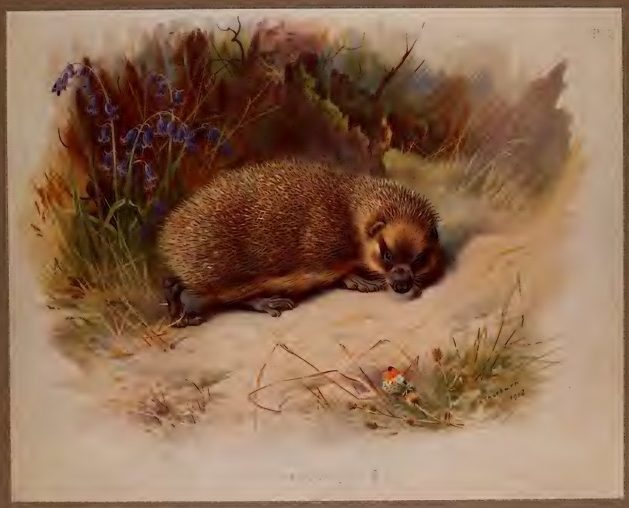
The image at the top of this post is from Thorburn (Archibald). British Mammals. Two volumes. Longmans, Green & Co., 1920-1921.
The first chapter is about hedgehogs, Britain”s most popular mammal. The fox is number two which is ironic considering what we still allow to be done to them in the name of sport. I have quite a lot of experience with hedgehogs from my time at HART Wildlife Rescue and so much of the information she offers was already known to me. I did not know however that the collective noun is an ‘array’. She dives deep into history, literature, etymology and dialect names but uses ” ‘hogs ” which I also found a little annoying – it looks inelegant on the page and I think she might as well just have spelled the word out. Humans do not come out of it well having assigned absurd myths to them such as gathering fruit by rolling around and collecting it on their spines. Also, as an excuse for their relentless persecution, they were accused of somehow stealing milk from cows. They were treated a vermin for a very long time. On one estate 5,904 were killed between 1938 and 1950. Which estate? Sandringham. Wouldn’t you just know it?
Foxes
The second chapter concerns foxes. The book is well illustrated and below is an image she uses of an etching by John Miller, an eighteenth-century German artist. It is rather peculiar. I had to source it elsewhere and zoom in to see the names of the various animals depicted. I would have guessed that the third one down was the Red Fox, Vulpes vulpes, the “European Fox” as it is called here but that is a Coyote or Prairie Wolf. The fox in question is the fourth working down and left to right. The others are Dusky Wolf, Common Wolf, Gross (?) Fox, Silver Fox and Red Fox. Is it me or was the artist confused?

Karen R. Jones cites quite a lot from Beatrix Potter but shares my unease with her strange tales.
She is very good on fox hunting dealing with it an unemotional way. The Foxhound was created by breeder Hugo Meynell, Master of the Quorn Hunt, the ‘father of the modern hunt’ but it is the Bilsdale Hunt in Yorkshire established by the then Duke of Buckingham in 1668 which claims to be the first to raise hounds specifically for the hunt. The bloodsport was hugely appealing to the aristocracy and the would-be upwardly mobile urban middle classes. There are other interesting details – the red scarlet costumes known as pink are so named because they were invented by Thomas Pink. Even back in the eighteenth century foxes were raised and even imported from abroad and released to be hunted. They were not always killed but instead would be terrorised over and over again.
There have always been opponents, such as twelfth-century philosopher John of Salisbury, nineteenth-century historian E.A. Freeman who wrote “blistering articles on the brutality of an atavistic leisure pursuit which had nothing to do with rural utility and of course Henry Salt. I wrote about him in Animal Trust: “author of the seminal Animals’ Rights considered in relation to social progress, with a bibliographical appendix. Also an essay on vivisection in America, 1894, had this to say, not without considerable wit: “… the sporting instinct is due to sheer callousness and insensibility; the sportsman, by force of habit, or by force of hereditary influence, cannot understand or sympathize with the sufferings he causes, and being, in the great majority of instances, a man of slow perception, he naturally finds it much easier to follow the hounds than to follow an argument…” He greatly influenced no less a figure than Gandhi, who picked up one of his leaflets in a vegetarian restaurant in London, as evidenced by a letter to Salt by Gandhi of 1929.“
I had forgotten that Dr Doolittle rescues a fox and her cubs from the hounds in one of Hugh Lofting’s wonderful books, Doctor Dolittle’s Circus.
I also quoted Charles Causley’s from poem in Animal Trust:
I saw a jolly hunter
With a jolly gun
Walking in the country
In the jolly sun.
The poem continues in the same vein, with the hunter ultimately shooting himself. “Jolly good, I said.”
Then came the Hunt Sabs of course formed in 1963. The RSPCA spoke out in 1976 and conducted a survey in 1980 showing that 70% of the British public opposed the ‘sport’. It took seven years of parliamentary wrangling before it and most other forms of hunting with dogs were finally banned in 2004. Which as we now know proved completely ineffective.
I do not disagree with Nick Hayes, author of the brilliant The Book of Trespass (passim) that the real meaning of the hunts, although claims that they killed 25,000 animals a year (not a small number but only 6% of the population) is as much to do with the demonstration of “possession, property, power and dominion” as anything else.
A third of our foxes now live in urban environments. There have been hypotheses that this came about because of myxomatosis which killed rabbits, an important food source, or good foraging in our suburbs and then our city centres, bu Karen R. Jones thinks that they miss the point. The foxes did not move in, “suburbia was … built on their home turf”. Reactions were predictable, especially in the tabloids. Foxes were cast as greedy menaces, killers of cats and “baby snatchers”. There were various failed attempts to reduce numbers but fox populations control themselves. We throw away 7.3 million tonnes of leftovers a year – it is hardly surprising that foxes will take opportunities where they can.
Today we read that an estimated 100,000 are killed on our roads and 70,000 to 80,000 are killed by farmers and gamekeepers every year. The author concludes with the suggestion that we might learn to live with them as they have had to learn and adapt to live with us.
Leave a Reply